All the Fabric!

I spoke to a local quilt guild this past week about the topic below and referred them to my blog instead of giving a handout. So here’s the same information for you, with about 1/3 of the quilts I showed.

Many of my quilty friends are over 50 and determined to use all the fabric they have in stash. For most of us, there are a good number of large cuts in addition to mountains of scraps, a few UFOs (unfinished objects), some orphan blocks, and a few special fabrics we just had to have. How will we ever use it all? Here are a few ideas.

Let’s start with those beautiful fabrics you just couldn’t resist. My favorite patterns for these are the BQ patterns from Maple Island Quilts. Here are some of mine.
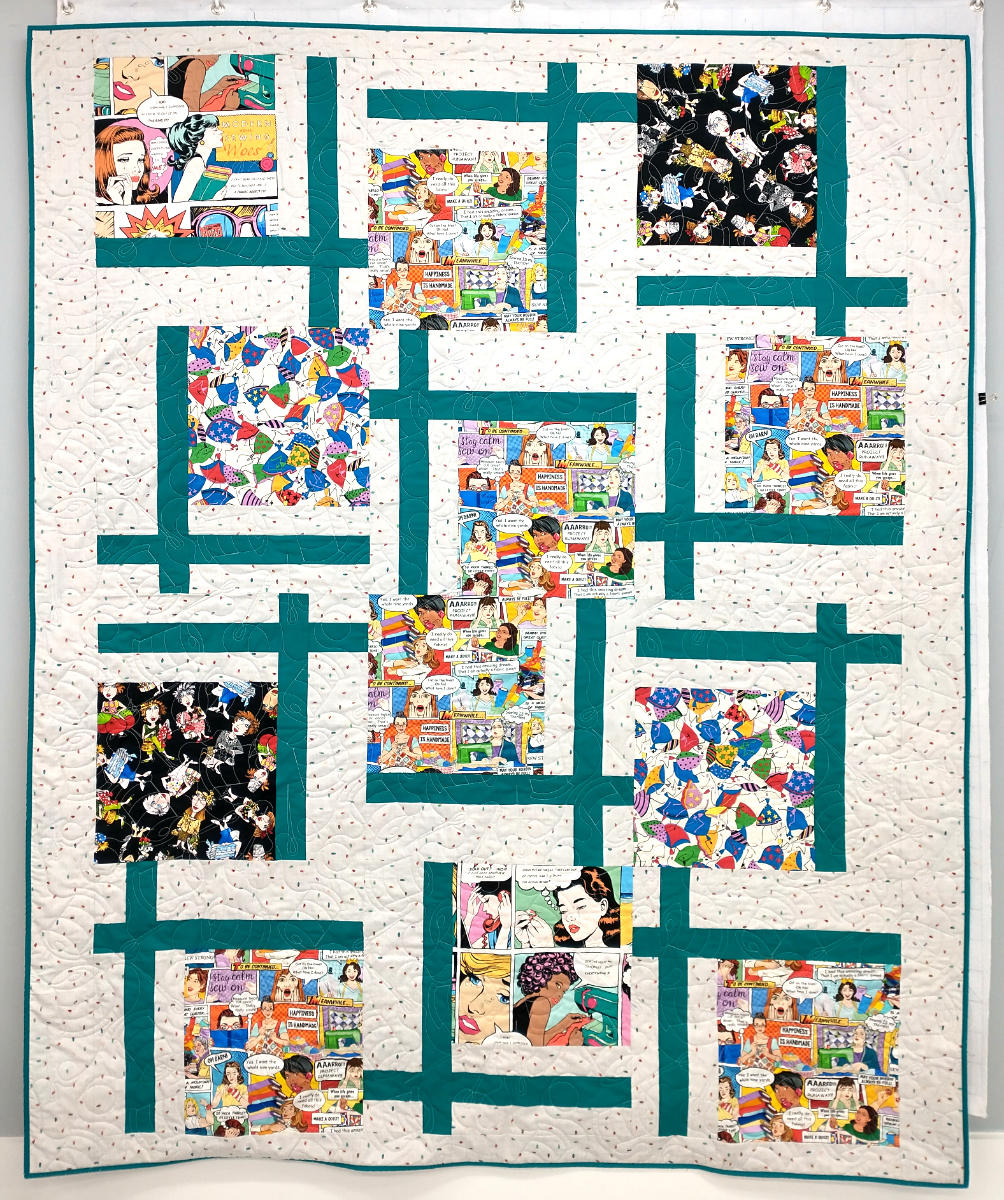
Patter is BQ2, available here

This pattern is BQ4 from Maple Island Quilts

Most of us also have big (a yard or more) cuts of fabric that aren’t focus fabrics. The good news is that many modern quilt patterns have big designs. That means they are quick to make, dramatic in appearance, and use up those big cuts as well as some smaller ones.
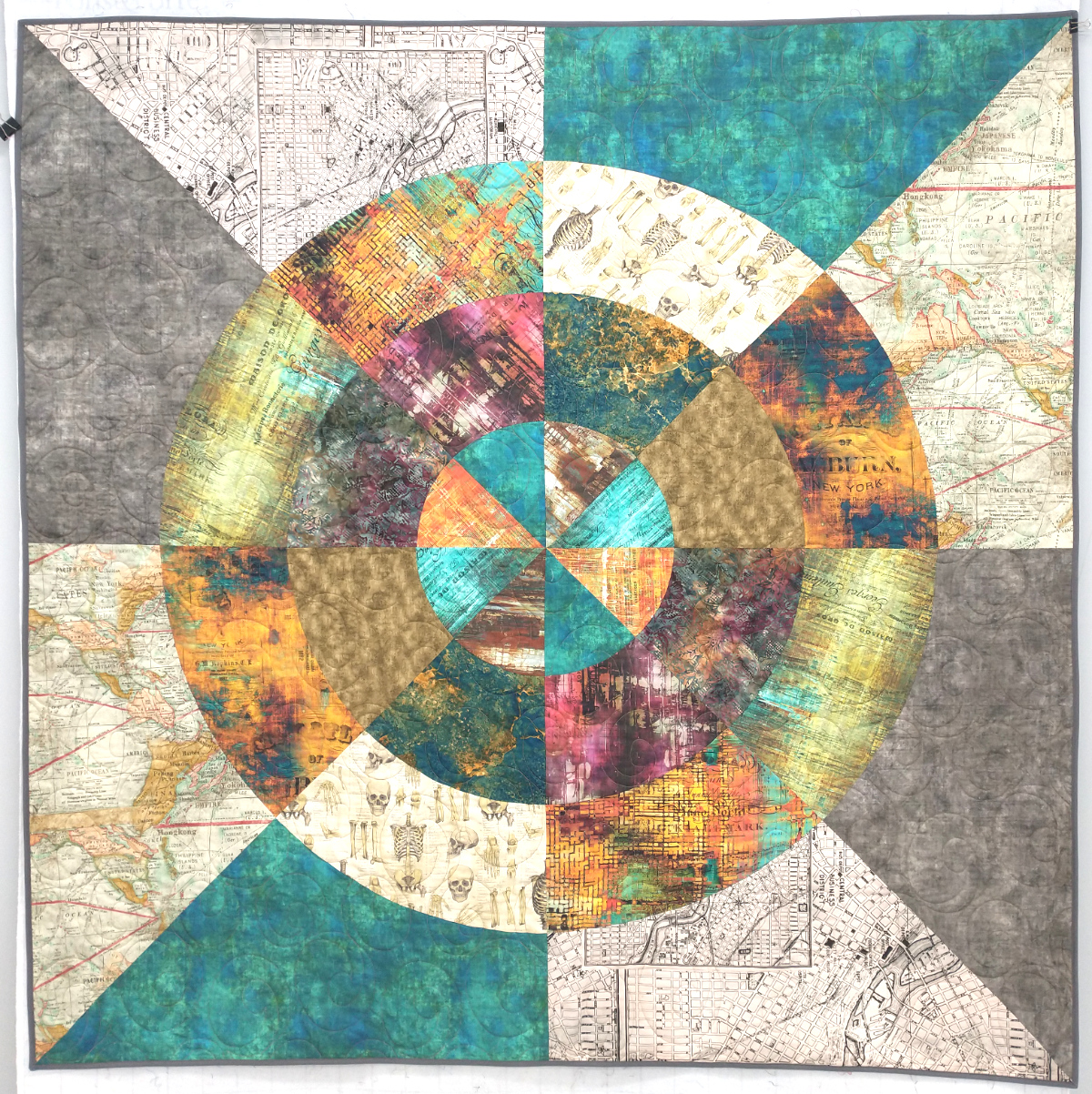
Curious By Nature is a free pattern available on the Free Spirit site, here.

There are many chandelier quilt patterns out there, but this one was free on the Free Spirit website, here

This is my version of the Bloem pattern by Libs Elliott.

This is derived from a design by Cheryl Arkison; you can look for more ideas in her books

Patterns by Eudaimonia Studio often use large pieces and are fairly easy to piece

Henry’s Humongous Hexagons, a pattern by Karl Hentsch

This is from the pattern “Contrasting” by Zen Chic; there are a number of Zen Chic patterns that use large cuts of fabric

I liked this pattern by Brigitte Heitland of Zen Chic so much that I made it twice

You can also use up yardage with books for “3 yard quilts”, like this one. Just pick three one-yard cuts from your stash and you’re ready to go! Then go back to your stash later and pull a fabric for a border if you want a larger quilt.
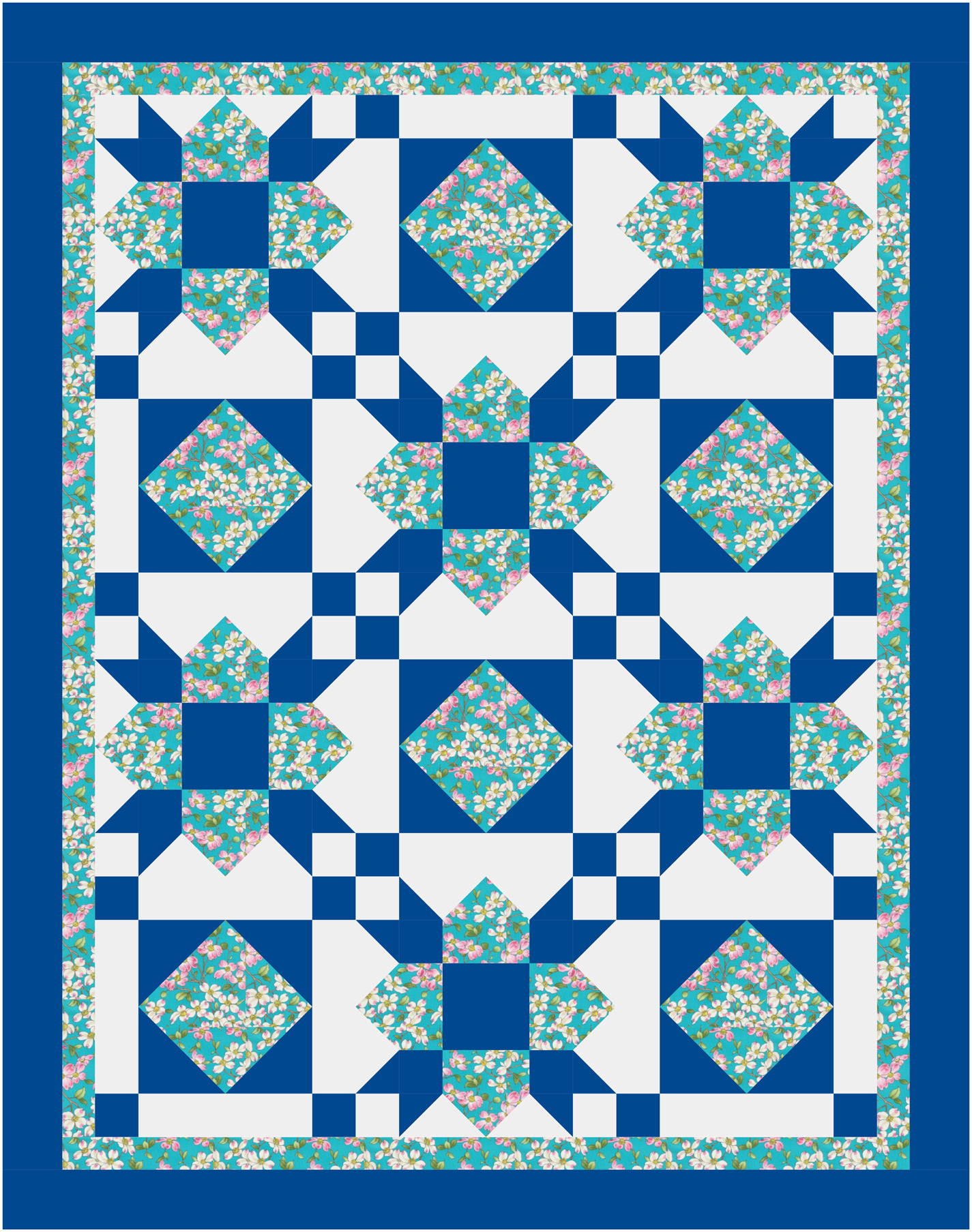
This 3 yard quilt pattern, written by me, is available from Studio Stitch

And then there are the collections, often of coordinated fabrics from the same line. There are many fat quarter patterns that can make good use of these. And some of the best fat quarter patterns are the oldies, Turning Twenty and Turning Twenty Again. Here are a couple I made years ago from those patterns.

Bermuda Sunrise quilt pattern

This pattern is Bermuda Sunrise by Linda Hahn. It plays well with fat quarters. Ignore my paper tags, please!

Triangles at Play is a quick and easy pattern by Sarah Ruiz

The three quilts above are from the book Cozy Modern Quilts by Kim Schaefer. It’s an old book, so try first to get it through AbeBooks or a similar used book source. I found it there recently for under $7 including shipping–less than the cost of a single quilt pattern!

This and other patterns by Sassafras Lane are surprisingly easy and are good for using fabric collections

There are many patterns for scraps. In addition to the printed patterns available (and probably already in your pattern stash) there are many free patterns online. Quiltdom is one site with scrap patterns ranging from easy to challenging. And it links to other sites, so you could spend all day scrolling instead of sewing…

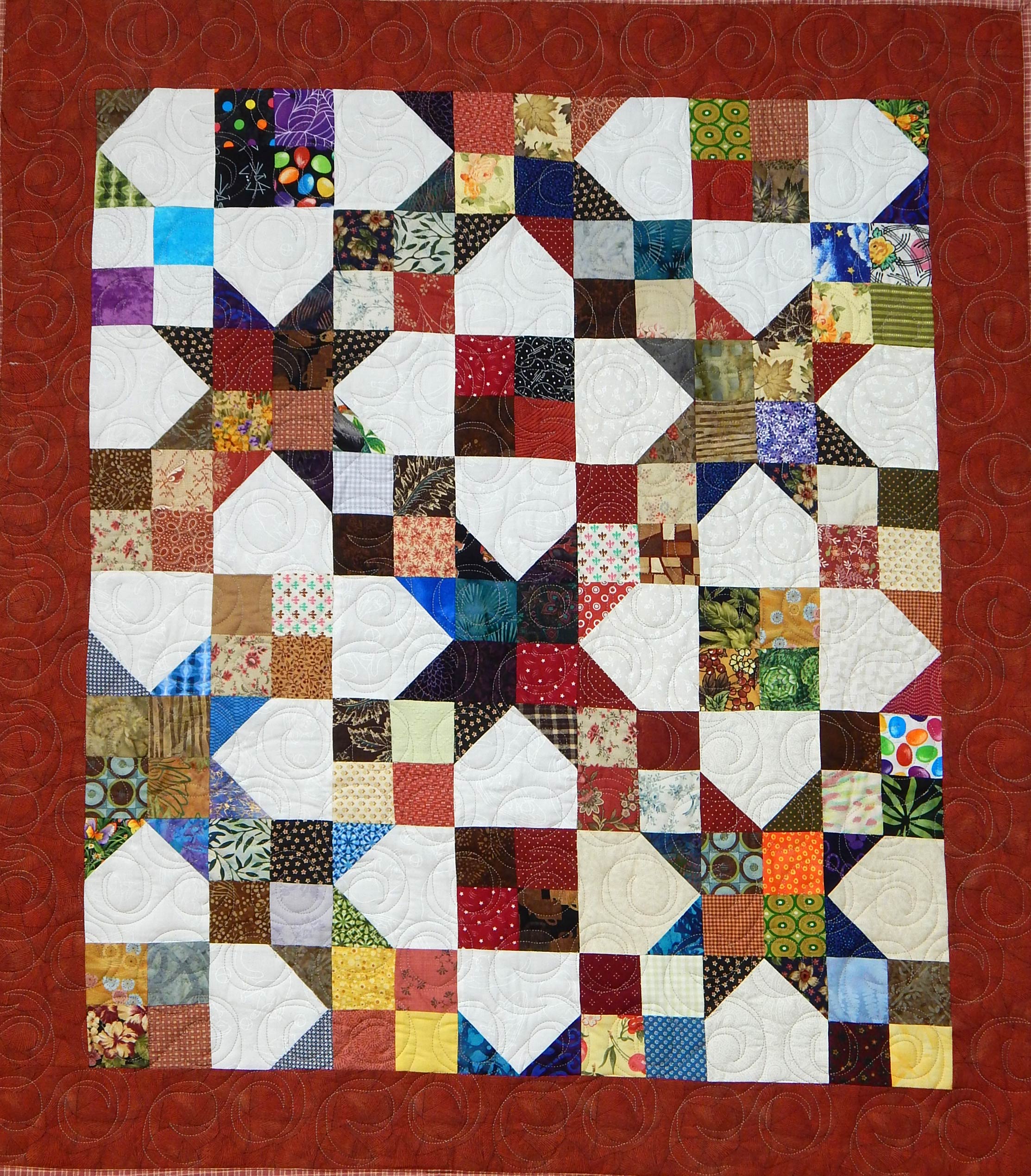
Here are a couple of my favorite scrap quilts. I choose simple blocks so I can use them as leaders-and-enders while making other projects, and often I have a quilt made before I know it. You don’t need a pattern for these–just copy them!

And then the orphan blocks and UFOs! Cut them up and use them to make improvised quilts. Be sure to have an interesting quilting pattern if you have a lot of negative space.

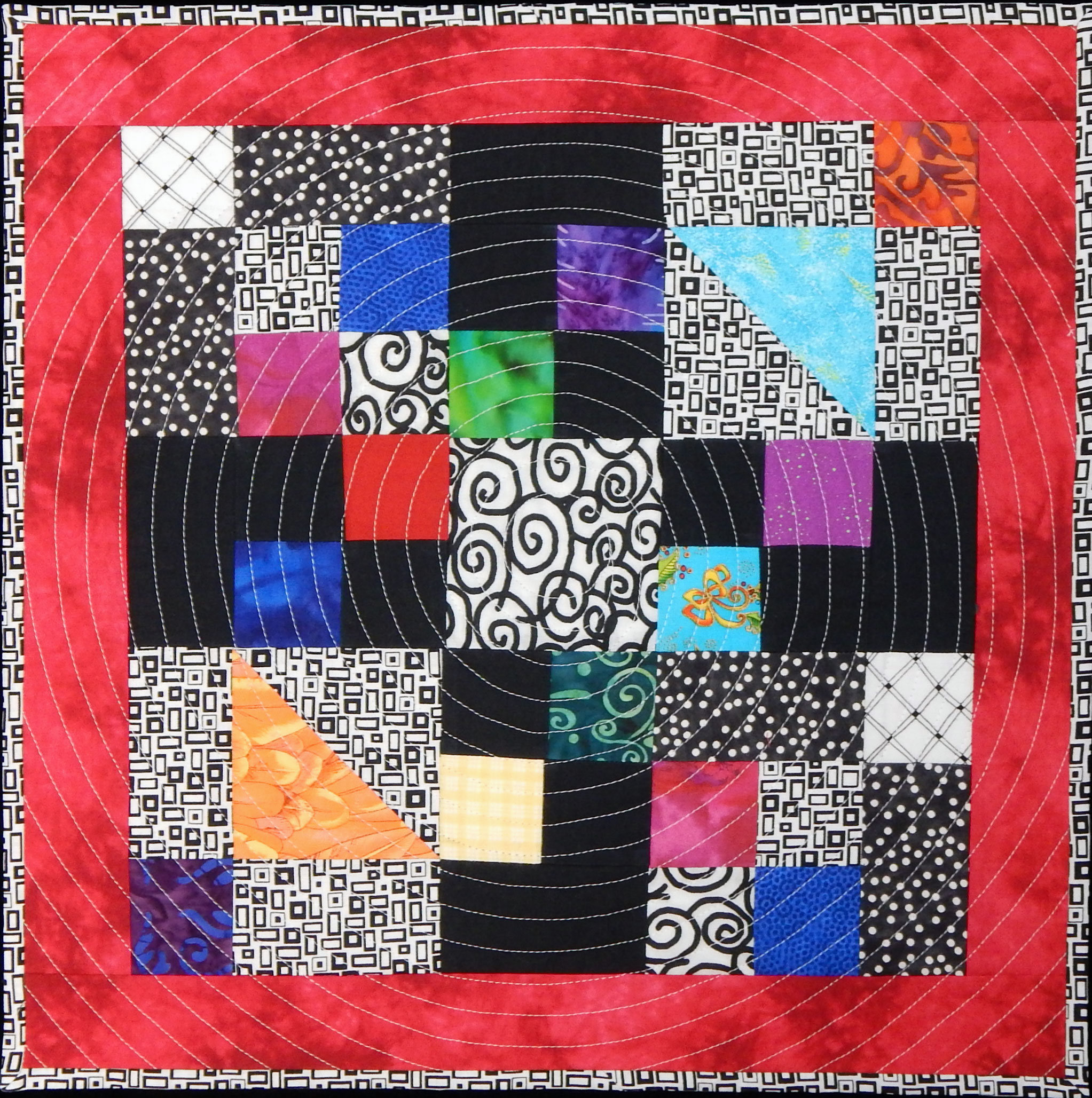
Aha! Orphan blocks can be cut up to make new blocks, as I did with my Giant Circles quilt, here

There are lots more fun patterns out there. Stick to the ones that look easy and your stash will diminish more quickly–if that’s your goal.


Trying a Couple of Things

A few weeks ago two events occurred serendipitously: The final challenge for Project Quilting was “Conquer A Fear”, and a friend helped me try ruler quilting.

Practicing on a piece of fabric where mistakes can’t be seen!

In fairness, I tried ruler quilting a couple of years ago and decided it wasn’t for me–seemed like just FMQ (free-motion quilting) with complications. So maybe I was scared because I wasn’t immediately good at it?

Anyway, after some instruction from my friend I made several practice pieces, then this round quilt for Project Quilting.

It’s not perfect. Not even close. But good enough for now.

And then something else interesting happened. I had recently cut some striped binding at 30 degrees instead of 45 degrees and found that I got the same diagonal stripe effect with less of the stretchy-wobbly-crawly stuff that happens with true bias binding. It worked very well on this quilt:

So I had a little of that striped binding left and decided to use it on the Project Quilting circle. Turns out a 9″ circle really could have benefitted from fully bias (45 degree) binding.

Just look at all I learned in a 9″ circle 😀  Mission accomplished!

And one more thing…finding that striped binding reminded me that I never showed one of my favorite quilts from 2022:

Quilt Stats

Name: Rock Star Granny

Source: Rock Star Granny pattern from Crystal Manning, available here

Finished size: 62″ x 62″ (smaller than the pattern size)

Made by: me

Quilted by: Linda Nichols

Tessellations again!

In a moment of madness, I agreed to do a program on tessellations for my MQG in Greensboro.  I’ll be posting the same information here so we can all share it and so that these blogs can serve as “handouts” for my presentation.  To start, here’s a blog written by my friend Jean Larson, who has designed and made several award-winning tessellation quilts.  To view some of Jean’s quilts, click HERE.  –MJP

Tessellating designs make me happy.  Tweaking those designs is even more fun.   I want to share the joy of starting with a very, very simple design and watching it blossom.  

Start with a simple gridded block and create a light/dark design.  Here, I’ve started with a 3 x 3 grid.  Then re-color the same block with the lights and darks reversed

.The grid lines are only for design purposes, and each block can be constructed with a single square block with 2 corner triangles attached using any method you prefer.

Here are some design possibilities…Quilt_1A simple “cat head” quilt using only 2 colors.

Different looks can be achieved with variations in the color placement.

Blocks can be inverted and turned for even more quilt designs.

Just imagine all the possibilities with color in these!!!!!

It’s even more complex when you design with a 6×6 grid.  Here are the positive and negative versions of another block.

These blocks can be constructed using half-square triangles integrated with larger fabric pieces.  If these blocks were to finish at 6 inches by 6 inches.  The center column on each block would be a single 3.5 inch wide by 6.5 in long piece of fabric.  The side strips would include some half-square triangles.

A couple of the quilts that can be made:

Looks like spools, some gray, some white, all standing up.  Same quilt with alternate blocks turned a quarter turn yields a different  clearly recognizable tessellation.  Reminds me of tessellating doggie rawhide chews 😉

Now back to the spool quilt from above.  The “thread” areas have been colored in.  No blocks have been turned.

Jean spool 5This shows the power of color and value (lightness and darkness).   The colored part, being next to the gray and being closer in value to the gray, unites those parts of the block, and gives the illusion that we have all gray spools on a white background, some standing up, some lying down.

I hope these examples can be the seeds to sprout some design experimentation with tessellating shapes.

  1. Start with 2 square grids
  2. Create a positive design, and its negative design
  3. Alternate them in a quilt layout
  4. PLAY!
  5. And play more with color!

Happy Quilting (and Designing)!!   –Jean Larson


Guest Blogger: Linda Reviews Rulerwork Quilting!

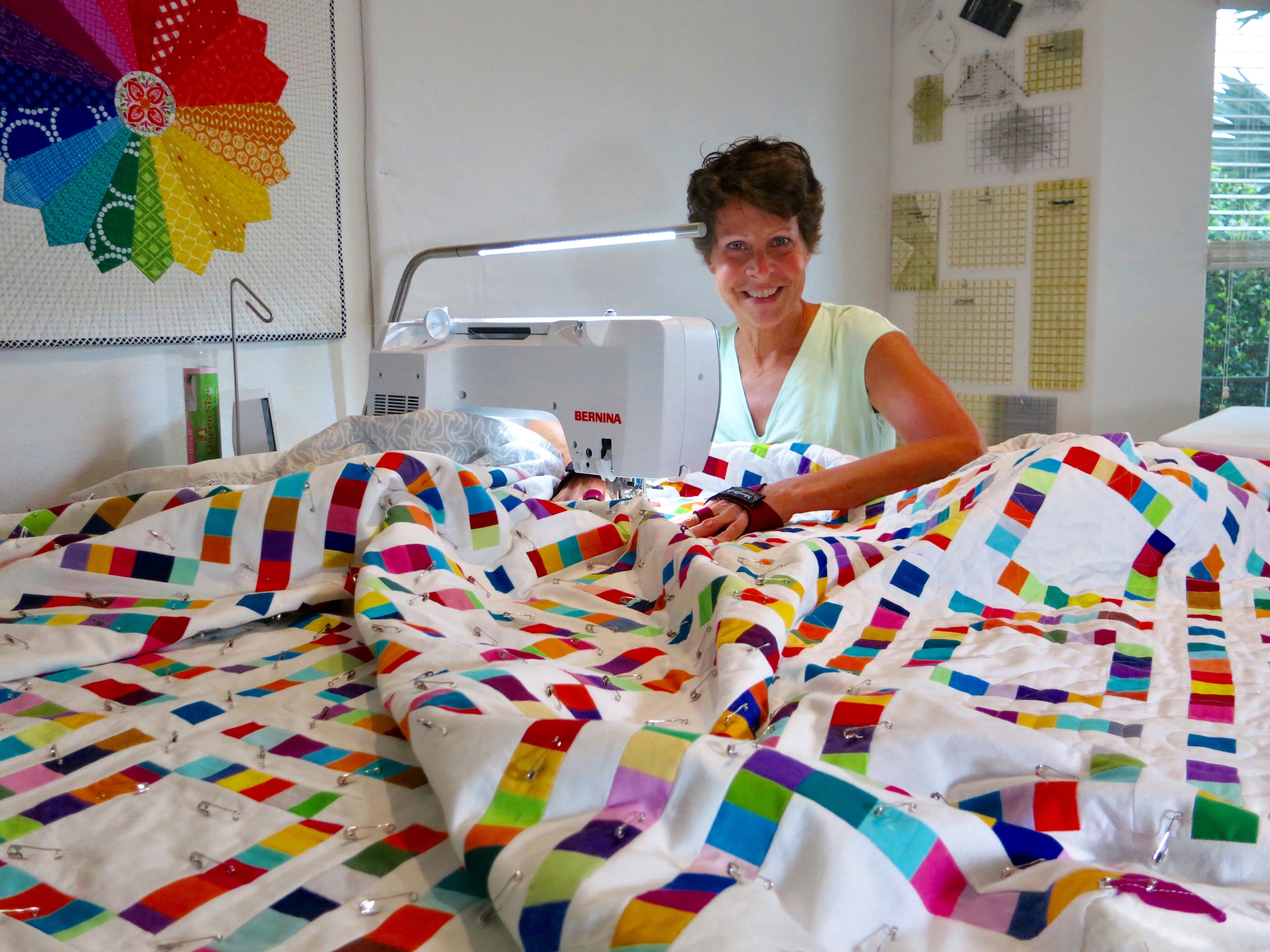
This is a guest post by my blogging friend Linda Hungerford (flourishingpalms.blogspot.com).Linda at her machine; photo courtesy of Linda Hungerford


This post is to review a new book published by C&T: The Ultimate Guide to Rulerwork Quilting by Amanda Murphy.

Photo courtesy of C&T

Mary invited me to review the book knowing I’m an avid domestic machine quilter who began quilting in 2000, and started quilting with rulers in 2011.

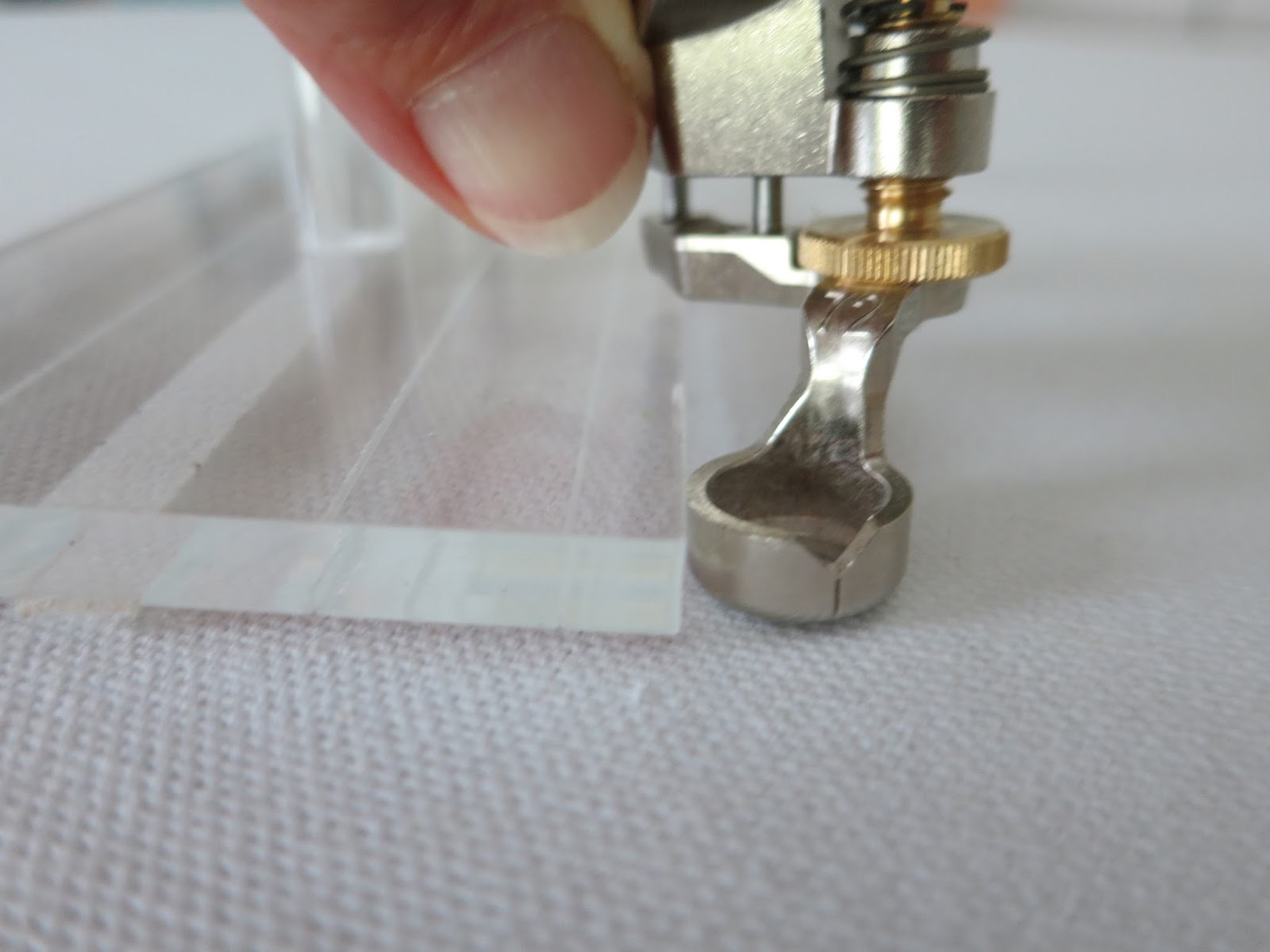
Here’s one of my first rulerwork attempts – doing a no-no by using a regular free motion quilting foot against a Fine Line brand quilting ruler.

Ruler work quilting with the WRONG machine foot!

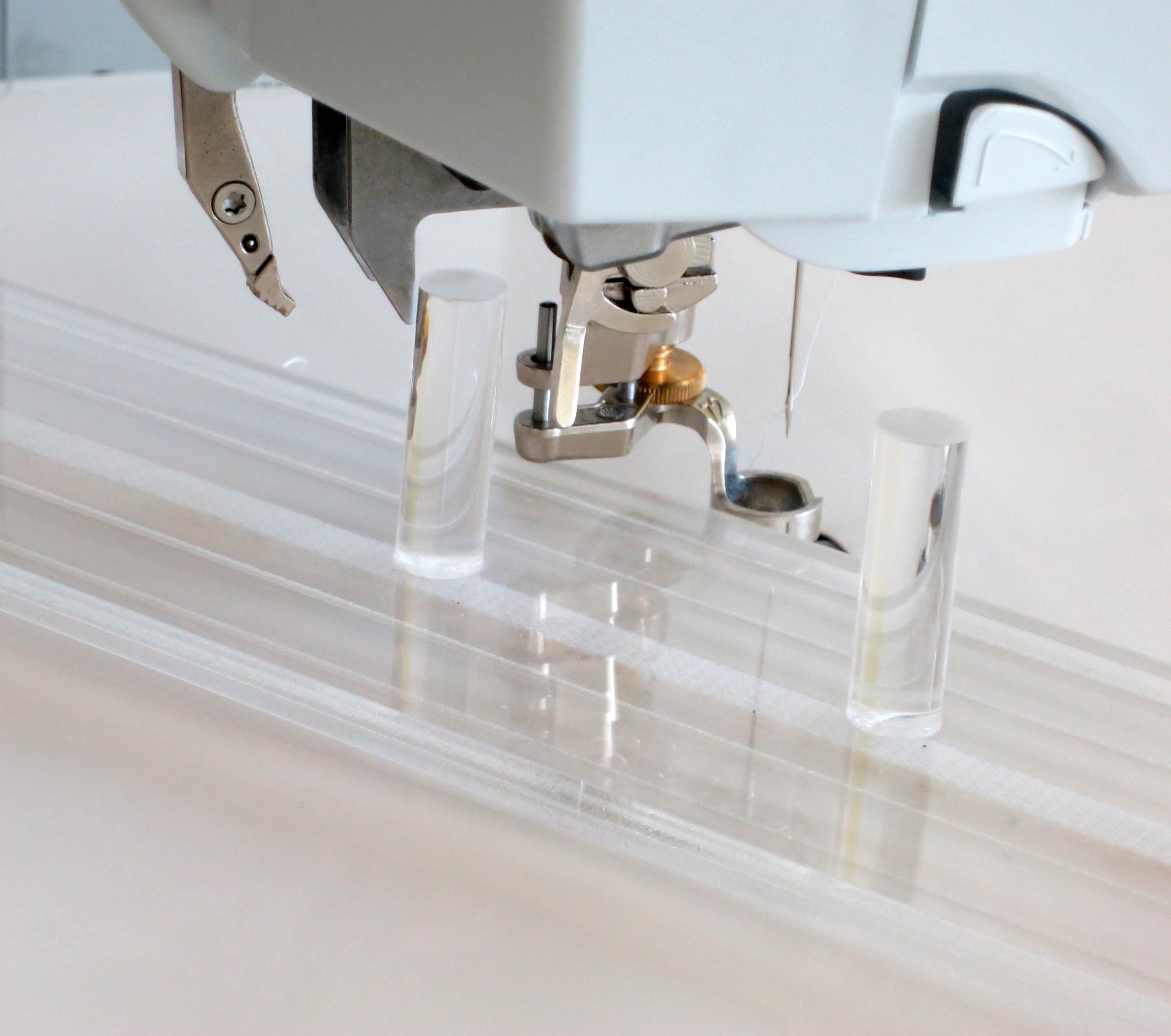
And here’s a picture showing how it should be done 🙂

This is the Bernina #72 foot.

For ruler work quilting, a quilter should use a ruler work quilting foot with a quarter-inch heel.
Two overall observations about the book:

  • Because Amanda quilts on a Bernina (both a domestic machine and a longarm machine) the book focuses on how to rulerwork quilt on a Bernina. One page is devoted to: “What if you don’t own a Bernina?”
  • Pages 29 to 102 of the 127 pages having photos of rulers being used on a Bernina longarm.

Amanda states: 

“As a Bernina expert I am very familiar with the machines in the Bernina line, so that is what is shown here.  There are obviously a lot of other machines on the market, too.  If you have questions about any of them and their suitability for ruler work, please consult your local dealer.”

For me, currently using a Bernina 770QE for quilting, (I do not own a longarm), I was able to apply much of the information to my own Bernina experiences. She references using a stitch regulator, but those of us who quilt on a domestic machine with a stitch regulator, are unable to use the stitch regulator and a ruler work foot at the same time.

Interestingly, she mentions that rulerwork quilting is better for distributing quilting evenly across the surface because of being able to quilt in all directions:

“When you quilt with a ruler, you naturally change directions more easily than you would with a walking foot, and quilting in many directions generally ensures a squarer top than quilting in just one.”

This made me smile because Jacqui Gering, a renowned walking foot quilter with two quilting books under her belt, says precisely the opposite! According to Jacqui, there’s no need to change directions when quilting. Is it any surprise that two quilters have differing views? And doesn’t that make you feel better about how you quilt?

Amanda covers these important topics:

  • thicknesses and shapes of rulers
  • ruler work quilting table set-up
  • sewing machine settings
  • needles

I concur with these points covered in the book:

Ruler thickness is important, and which thickness ruler to buy depends on whether your machine’s ruler foot is high shank or low shank

Each sewing machine brand needs its appropriate high shank or low shank ruler work foot.

Buy a ruler you will use most often

Though Amanda mentions that different ruler brands are available, she definitely focuses on and uses her own line of Good Measure rulers made by Bernina.

Photo from the book showing one of Amanda’s rulers. Photo courtesy of C&T

Just as a quiltmaker invests in one or two most-used rotary cutting rulers, a rulerwork quilter need only invest in one or two rulers. Begin rulerwork quilting with a straight edge and/or gentle curve ruler and you’re good to go – like the Good Measure straight edge/curved edge ruler (shown in the book), or Westalee straight edge/curved edge ruler (shown below).

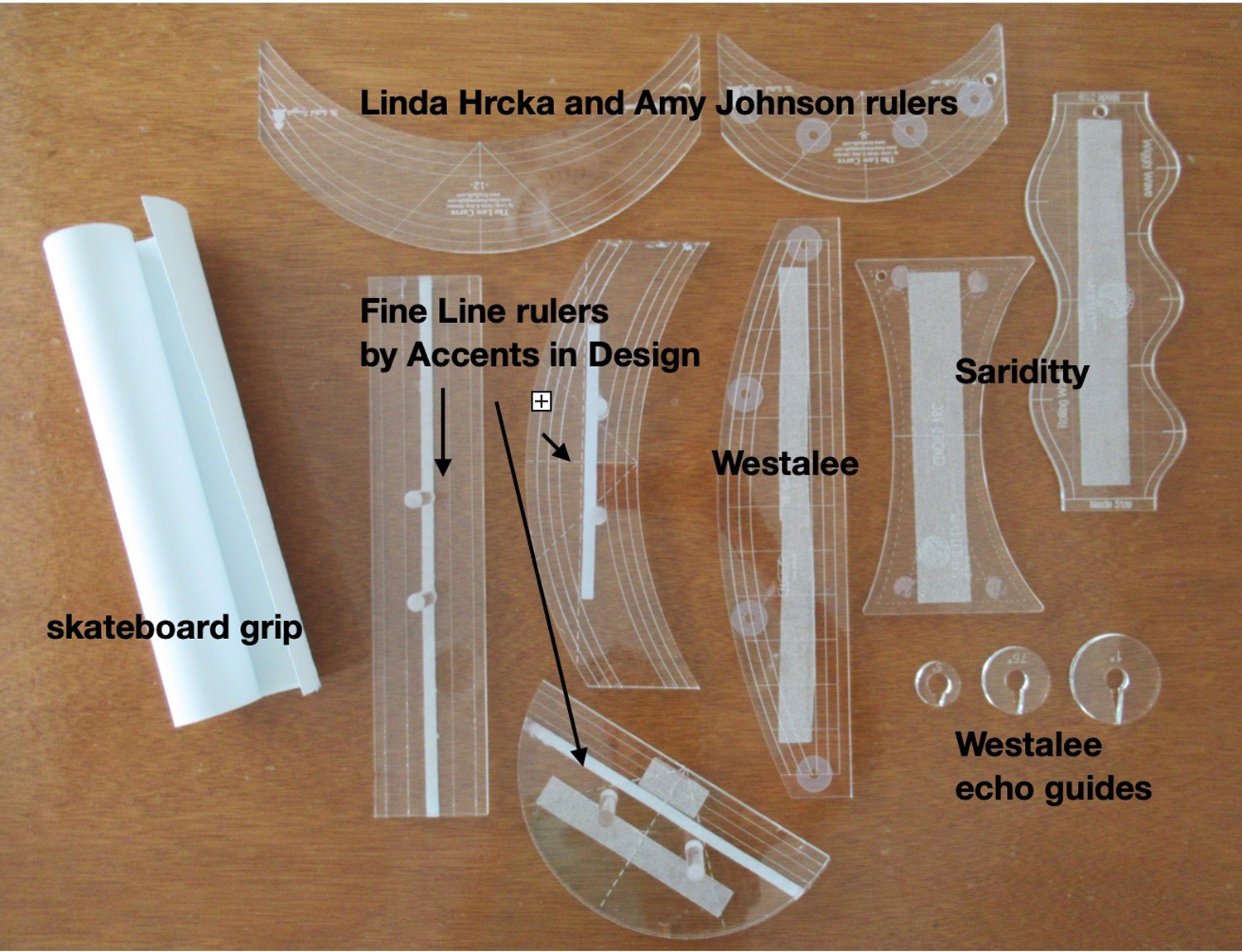
These are some of the brands of rulers I’ve accumulated in the past nine years, with Fine Line rulers being the ones I use most often… probably because that’s the brand I started with. I don’t own any Good Measure brand rulers.

Photo by Linda Hungerford

My ruler photo includes a picture of a roll of skateboard grip – a sort of sandpaper that’s grittier than sandpaper with an adhesive back. It’s the best product I’ve found for the bottom of the ruler, to make it “stick” to fabric while quilting. Amanda suggests putting blue painter’s tape or Stable Tape (by Westalee) on the bottom of the ruler.

A bit about Fine Line rulers… They’re different – made with two vertical posts to “hang onto” when quilting (see first blog picture). However, after buying a sewing machine with the dual feed feature, I quickly learned that these ruler posts bump into the dual feed! I can’t use the ruler on the back of the ruler foot, so that’s something to keep in mind when considering a Fine Line brand ruler.

Fine Line ruler posts bump into dual feed mechanism

Amanda mentions Bernina’s echo clips, something I frequently use, though the brand I own is made by Westalee. Each slips on/off the ruler foot, and has different spacing, so you can choose how far away to quilt from the previous line of quilting. It’s well worth $10 for the Westalee set!

Westalee Echo Clips

Set-up is important: have a flat work surface with a means for easy quilt gliding

Amanda recommends the Sew Steady table, and that’s exactly what I have. Top it with a Supreme Slider (or a Queen Supreme if you have a large machine harp), and you’re good.

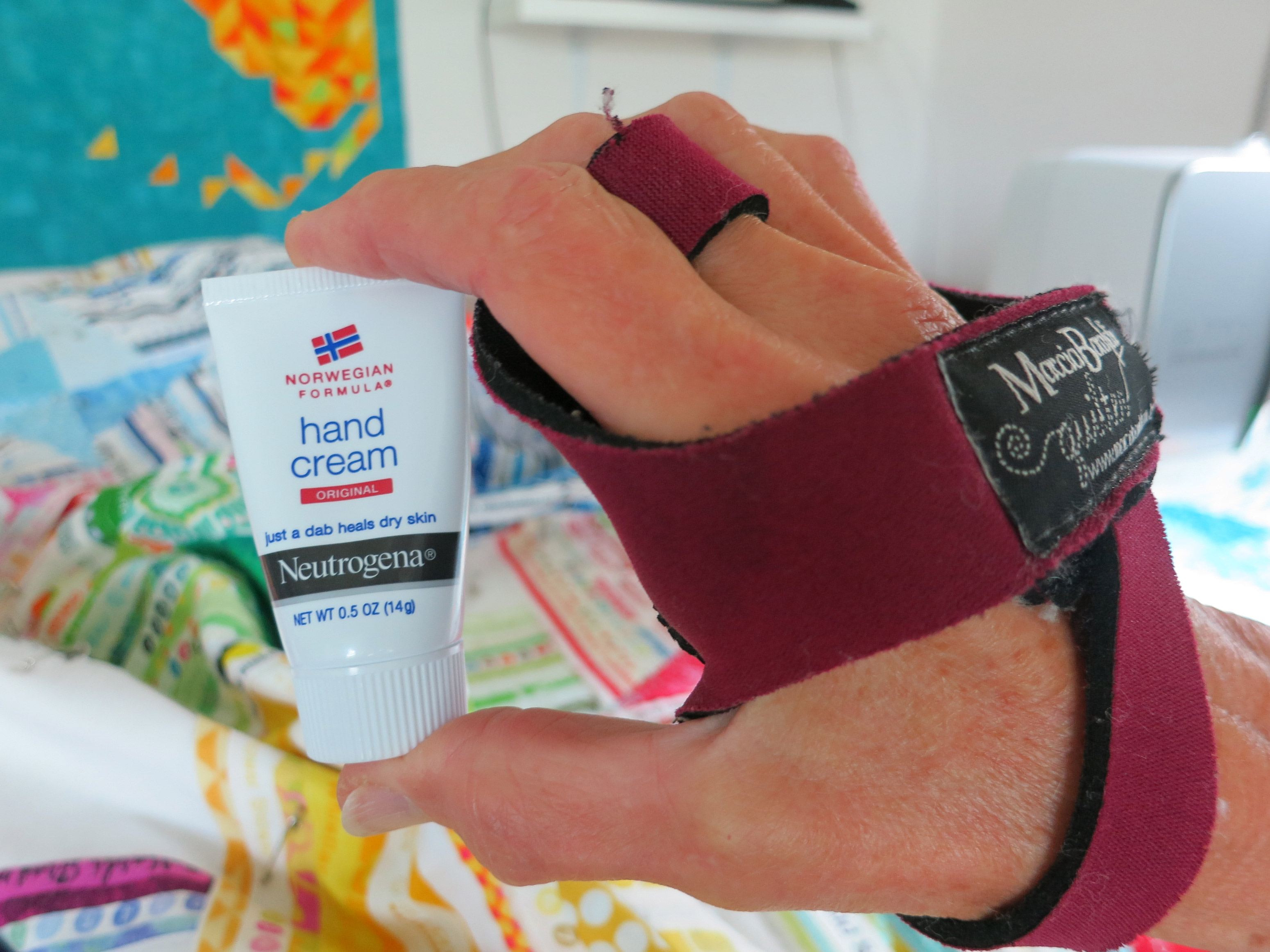
Here’s my quilting set-up contrived by placing two hollow-core doors across four IKEA adjustable-height Finnvard trestles.Amanda mentions wearing quilting gloves for rulerwork quilting. Personally, I prefer rubbing Neutrogena original formula hand cream on my hands, and then donning a pair of Marcia Baraldi Quilting Grip Gloves. It’s the perfect combo because my fingertips are  “grippy” and yet free to grab threads, tie knots, and even change a bobbin! (Neutrogena hand cream won’t harm your quilt.)

Although I have my favorite methods for rulerwork quilting, I also learned a thing or two in the book. The tip that meant the most to me is this one…

“Machine baste all the way around the sandwich through all layers, about 1/8″ from the edge of the quilt top.”

I’ve heard of taking a final “lap” around the outside of a quilt top, but I’d never heard of stitching around the perimeter of a basted quilt sandwich. I tried this on my latest quilt finish, my “Hole Punch Ribbon” quilt, and it worked to help keep my quilt “on the square!”  I blogged about this quilt here.

Amanda concludes the book with 31 pages of colorful quilt examples, showing different quilting designs on real quilts including quilt-as-you-go; followed by 14 pages about domestic machine quilting and troubleshooting; and 10 pages on longarm quilting and troubleshooting.

One of Amanda’s pretty examples from the book  Photo courtesy of C&T

All in all, this book is a good resource for a thorough introduction to rulerwork quilting, and is especially worthwhile if the quilter quilts on a Bernina. Then, it’s a must-buy!

Linda


For a Good Time…and OMG

For a good time, see if you can visit your local quilt shop! I was able to visit Studio Stitch last week because they are observing strict social distancing and mask guidelines, including limiting the number of people in the shop at a time. It was SO MUCH FUN to get to shop for fabric after being quarantined for 6 months!  I appreciate the care the staff are taking to try to keep everyone safe.

I should mention that I also checked the public health report and noted that COVID was trending down in Greensboro before going there.

Here’s the haul from one visit to the shop:Yes, the gray and white fabrics are metallic! And the fat quarter at the far right just jumped into my basket while my other fabric was being cut.  (Not my fault!!)

Which leads me to the OMG part.  For the first time, I am joining the One Monthly Goal challenge.  I’ve seen several blogging friends doing this for quite some time but haven’t joined up.  So, here is my OMG for September:

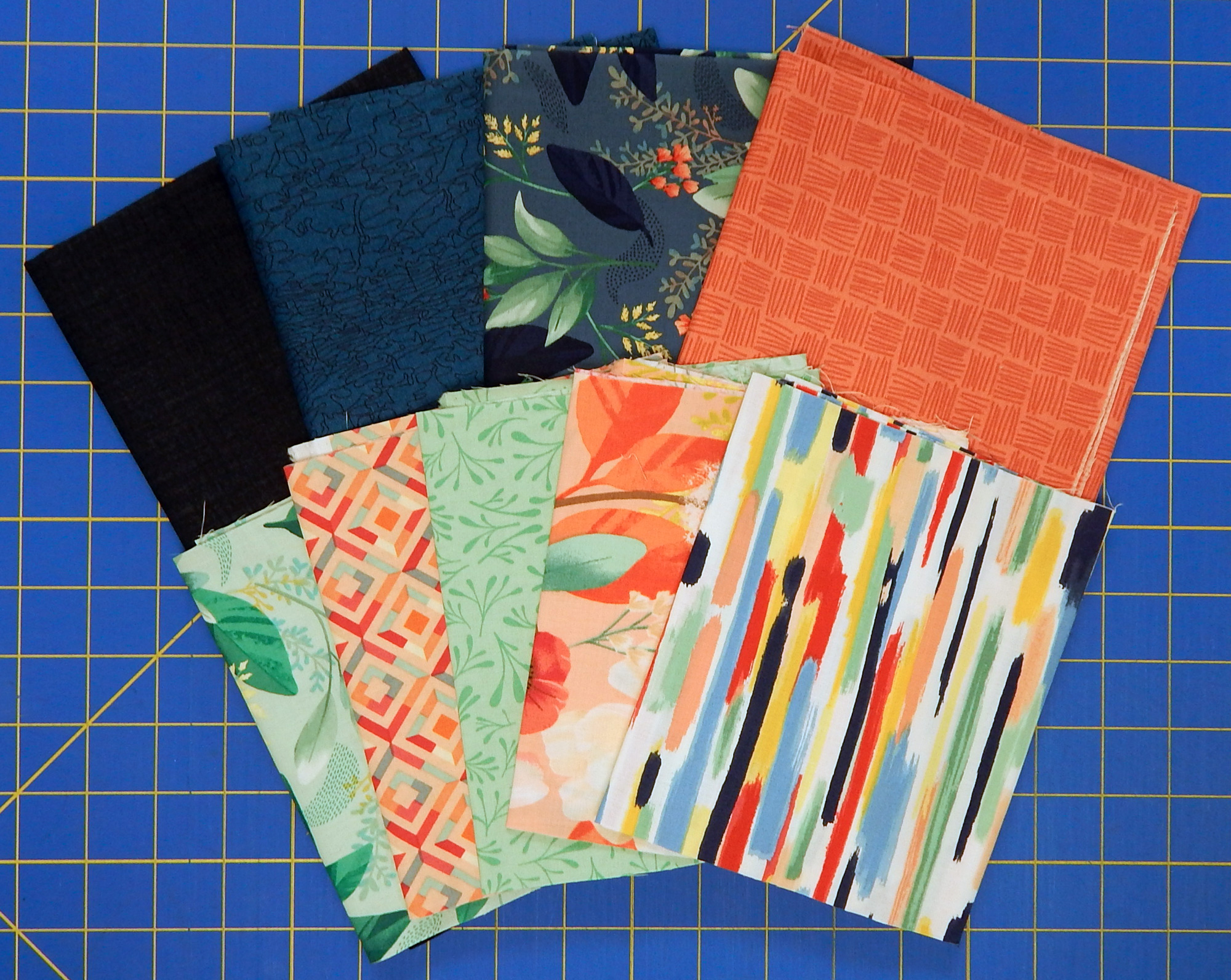
In September my goal is to make a quilt from these fabrics and write a pattern for that quilt.

These lovelies are from Studio Stitch, too

The pattern will be available through Studio Stitch when I finish it.  If you subscribe to their free newsletter (subscription form is about half way down their home page) you will see a picture and information on getting the pattern when the time comes. And of course I’ll show the quilt here when it’s finished!

That’s all the excitement for now.  Has anybody else been able to visit a shop in person with precautions in place?  Thanks for reading, and stay safe!

Triangle Variations Finished!

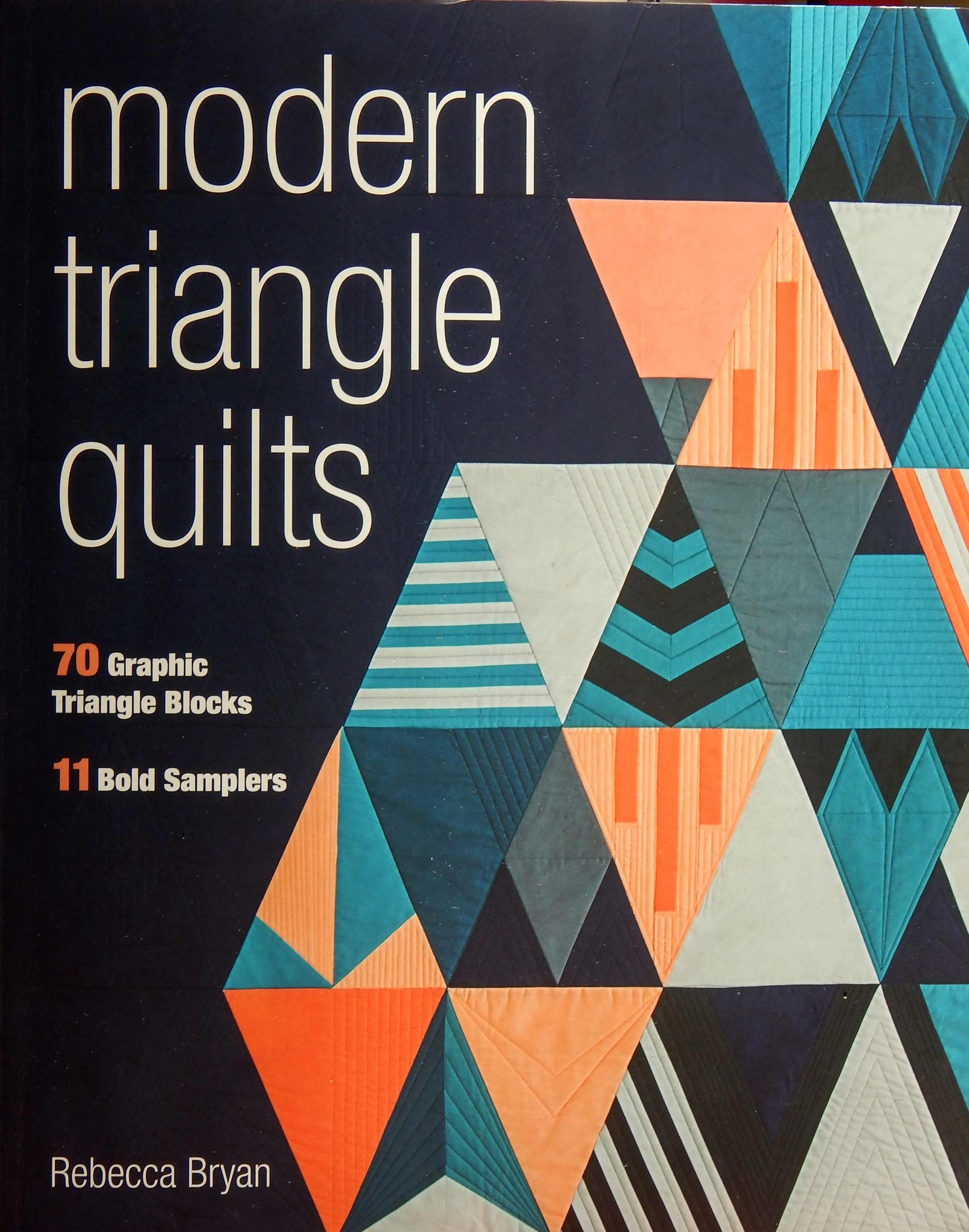
I’ve made multiple triangle quilts this year, and this final one is my favorite. It all started when I saw this book:

Modern Triangle Quilts,, published by Stash Books

The book presents variations on 3 different types of triangles (equilateral, right, isoceles), with multiple options for each type.  You know I don’t like to make the same block twice, so the variety of these triangle blocks seemed perfect!  (The cover states there are 70 different blocks!)

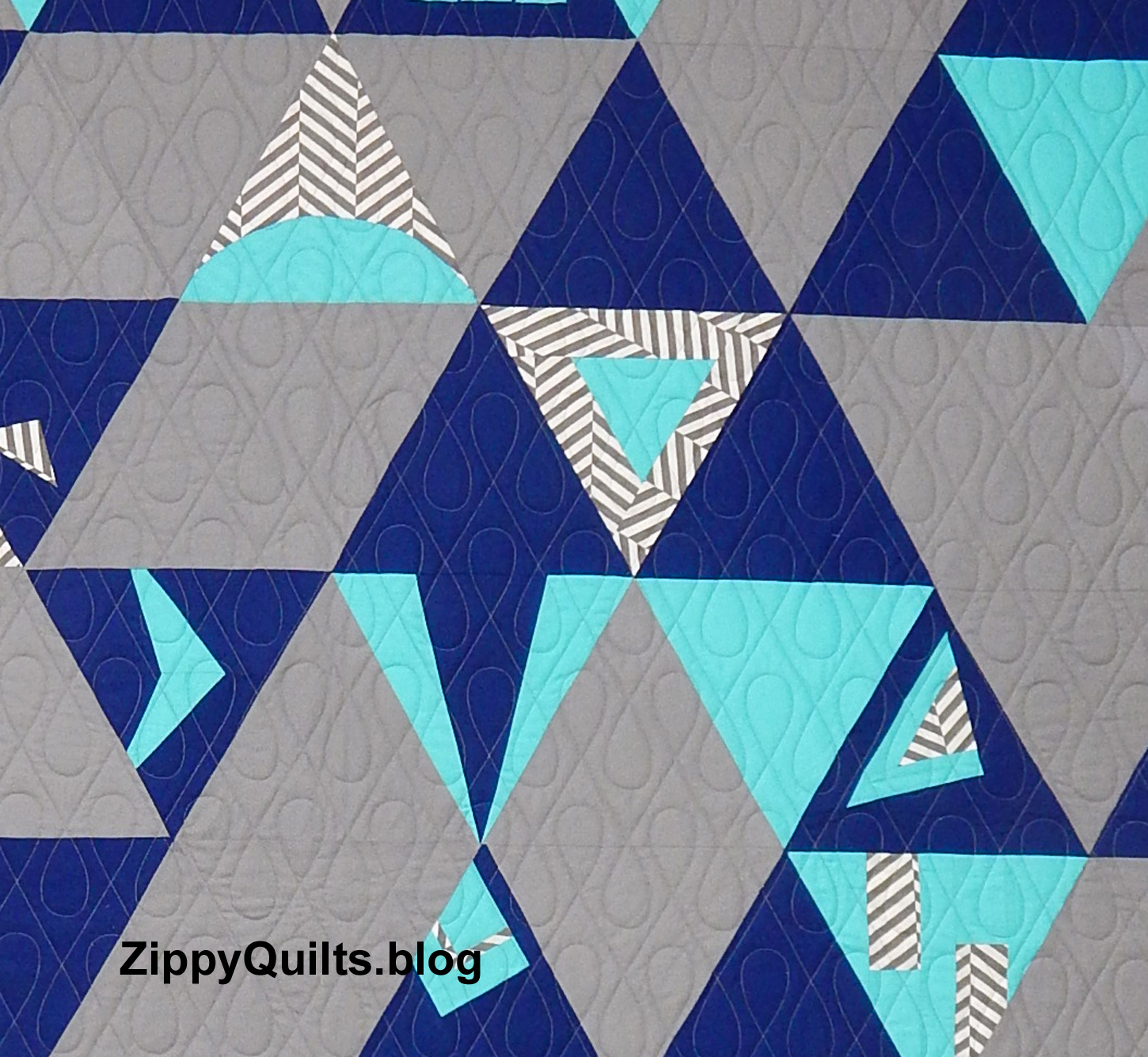
I chose the equilateral triangles and a limited color palette.  And of course I changed some of her patterns and improvised a few new ones.  That said, her instructions were excellent.  (You may take excellent instructions for granted when you’ve paid for a book, but don’t.  Enough said.)

So here’s my finished quilt! There are 11 different layouts for the blocks; this isn’t one of them 😉

The quilting was done by my friend Andrea Walker.  Andrea does beautiful custom quilting, but she is understanding when I want edge-to-edge quilting instead (because I want the quilt to be about my design rather than her quilting).  

And here’s the back:

Quilt stats:

  • Name: Triangle Variations (Hmmm…boring.  If you have a more creative idea please let me know.)
  • Finished size:57″ x 66″
  • Source: Inspired by Rebecca Bryan’s book Modern Triangle Quilts, and most of the blocks are from that book.  (Book available here.)
  • Quilted by: Andrea Walker.  (You can see her website by clicking on her name.)

This quilt went together well (due to the excellent instructions) and it is unique even though most of the blocks came from patterns.  Try it!

Note: The links here are for your convenience; I do not make money if you buy from them.

Two Threads for Machine Quilting

Quite a while ago one of my blogging friends (was it you, Clare?) commented that gold quilting thread blends well on most any quilt top, so I tried it. Here’s one quilted for me by Julia Madison. It has gold in it, of course, but I thought the gold thread worked out quite well. It shows up on the solid fabric but blends with the prints.

Same here:

I didn’t realize I used gold in my quilts so often!

On this more recent quilt, I asked Julia to use a thread recommended by another blogging friend, Elizabeth.  It is 40 weight polyester but looks metallic.  If you’ve ever tried quilting with metallic thread, you know what a find this is!  Julia said she had no trouble quilting with it.  Here’s what it looks like on the quilt:

Meanwhile, I made a Christmas table runner for a class I’m going to teach.  I quilted it myself using another recent find, InvisaFil thread. This thread is very thin, intended to show the quilting but not necessarily the stitches.  I did some stitch in the ditch with it and found it much better for that purpose than regular thread I have used in the past.  I also did some quilting that was meant to show, and that worked out equally well.

I will continue to use many other threads for quilting, but I’m pleased with these two new ones.  What thread do you quilt with?

Donation Quilt Catch-Up

I now belong to THREE groups that make donation quilts, and it may be a bit much.  I’ve decided to focus on the group I’ve been working with the longest, both because it was the original and because we donate the quilts locally.  (I fear there’s some truth to Garrison Keillor’s quip that most donation quilts sent to other countries go to hot climates where their best use is as compost.)

I see from my notes that I fell behind on donation quilts over a year ago due to being over-committed.  Duh.  Anyway, here are my recent attempts to catch up.

I found this panel in the SCRAP BIN at a shop where I teach, so I got it for $1 an ounce! The finished quilt is 34″ x 44″.

This top was started over a year ago when I wanted to experiment with half-rectangle triangles. The finished quilt is 40″ x 48″

This was made from slabs swapped in one of my groups. I spy some orphan blocks incorporated into slabs!

This one was done for leaders and enders, and is going to have to be entitled “Nobody’s Perfect”! Finished size is 34″ x 39″

I made this after starting the blocks as a class demonstration last time I taught “Twinkle”. Finished size is 40″ x 40″

I can just hear somebody saying, “Well!  That certainly is a variety!”  It would be more efficient to make the same pattern multiple times, but I just can’t do it.

What are your favorite donation quilt patterns?


Twinkles All Around

Twinkle is an attractive and easy quilt by Swirly Girls Design, and I taught it recently at Studio Stitch in Greensboro. We used the Tucker Trimmer for the half square triangles (HSTs) and everyone seemed to have a good time.

First, here’s my shop sample in a glamour shot:

Twinkle, a pattern by Swirly Girls Design, was made because I had some fabulous leftover fabric

Then, here are some of the wonderful blocks made by the people in class.  I’m sure I took more pictures, but apparently my camera quit part way through!

This one was two-color instead of scrappy and it worked quite well

BJ got several blocks made. Look closely and you can see the astronaut near the upper right corner

Arranging the stars on a design wall before sewing them together was very helpful–I don’t think anybody made a mistake!

And a few more for good measure!

Isn’t it fun to see everyone’s individual choices!

My next class at Studio Stitch is basic binding on March 14.

What Did I Learn in 2018?

My friend Melanie recently listed some (quilty) things she learned or re-learned in 2018, and it seemed like a good idea! So here goes…

And while I’m at it, I’ll re-introduce a few of the quilts I finished in 2018.

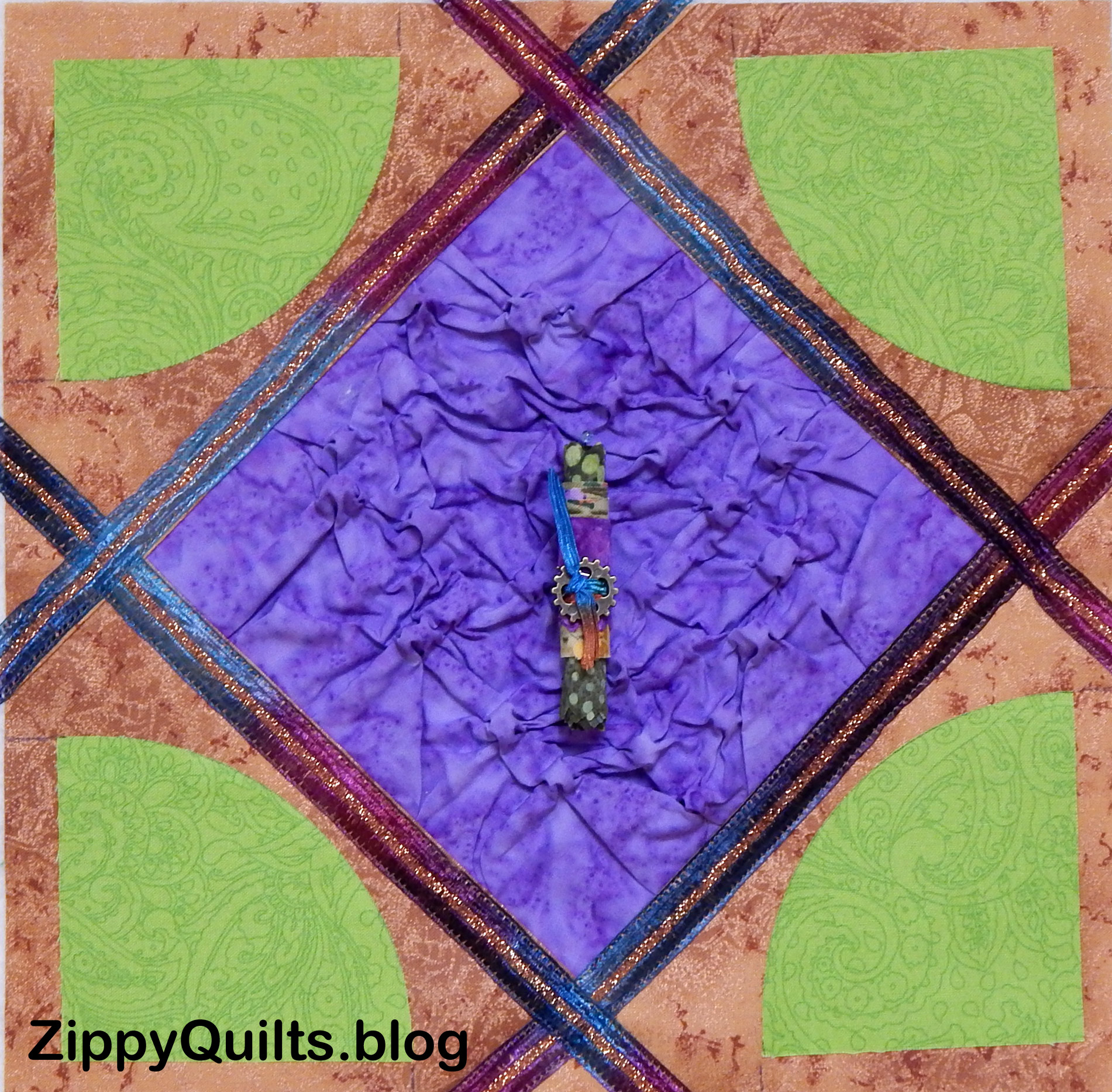
The center piece is a fabric”jewel” made in the same guild workshop as the block

1. Despite my history of using high-loft batting, I learned that it is much easier to neatly trim, square up, and bind a quilt made with LOW loft batting!

Mini-Quilt for Jill made from an orphan block

2. Deb Tucker’s “Tucker Trimmer” is the bomb for making half square triangles!  A friend introduced me to this tool.  I have used at least 3 other methods for trimming HSTs, and this is by far the best.  Much better than the (considerably more expensive) Bloc Loc tool, more accurate than my slotted square-up ruler, faster and easier than just using a regular ruler.

art quilt

Small quilt for a challenge with my local MQG

3. After many years of quilting, I have LOTS of small pieces of fabric but not many big pieces. I went to pull blue fabric for a quilt from my blue drawer.  I thought I had plenty since the drawer is full, but most pieces were less than half a yard!  So…

donation quilt

Donation quilt: The concentric squares are pieced; the other pieces are a print from Michael Miller

4. When I buy fabric for stash now, I often buy 3 yards at a time because that’s likely what will be needed for a single fabric in a planned quilt.

Gypsy Wife quilt

Finished Gypsy Wife; it was made from a couple of FQ bundles but the background required yardage

5. I want to do everything, but I’m going to have to choose and prioritize or nothing gets done.  Maybe a little of everything???

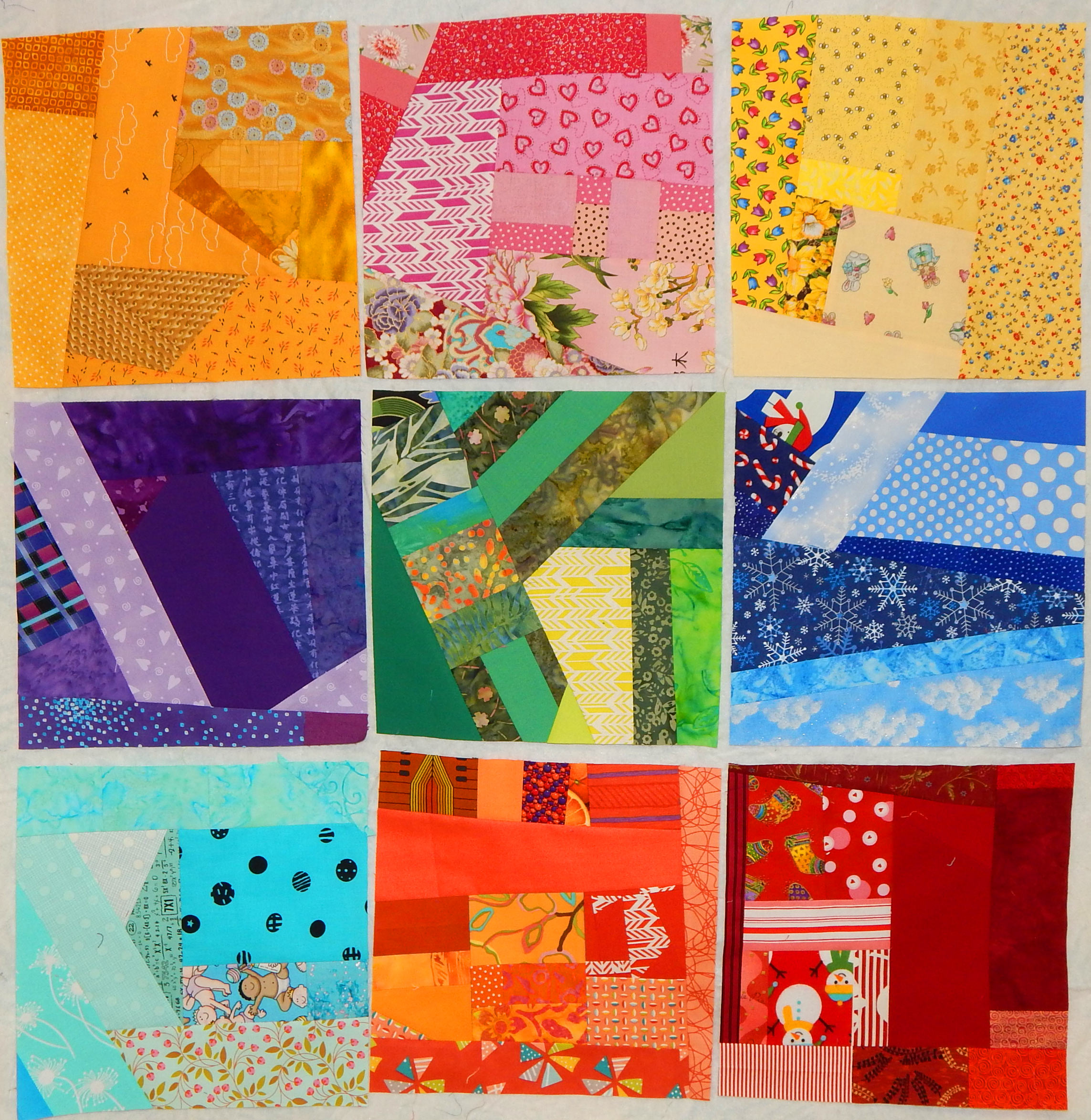
slabs, scrap blocks, scrap quilt

Donation quilt from single-color scrap blocks

6. Some projects just need to go in the fizzle drawer!

One for the fizzle drawer, but I have taken it apart and will re-purpose the fabrics in 2019

And a few opinions I haven’t changed my mind about:

  1. Almost all quilts need some purple in them somewhere!

    Block made in a workshop with Rosalie Dace

  2. Superior So Fine is a great thread for piecing, resulting in very little lint in my machine.

    I will be teaching this triangle quilt in March at Studio Stitch in Greensboro

  3. Almost any day is a good day if I learn something new

As always, these opinions are my own and I have received no compensation for sharing my favorite tools.  Your opinions and results may vary 😉