Quilt Alliance Contest

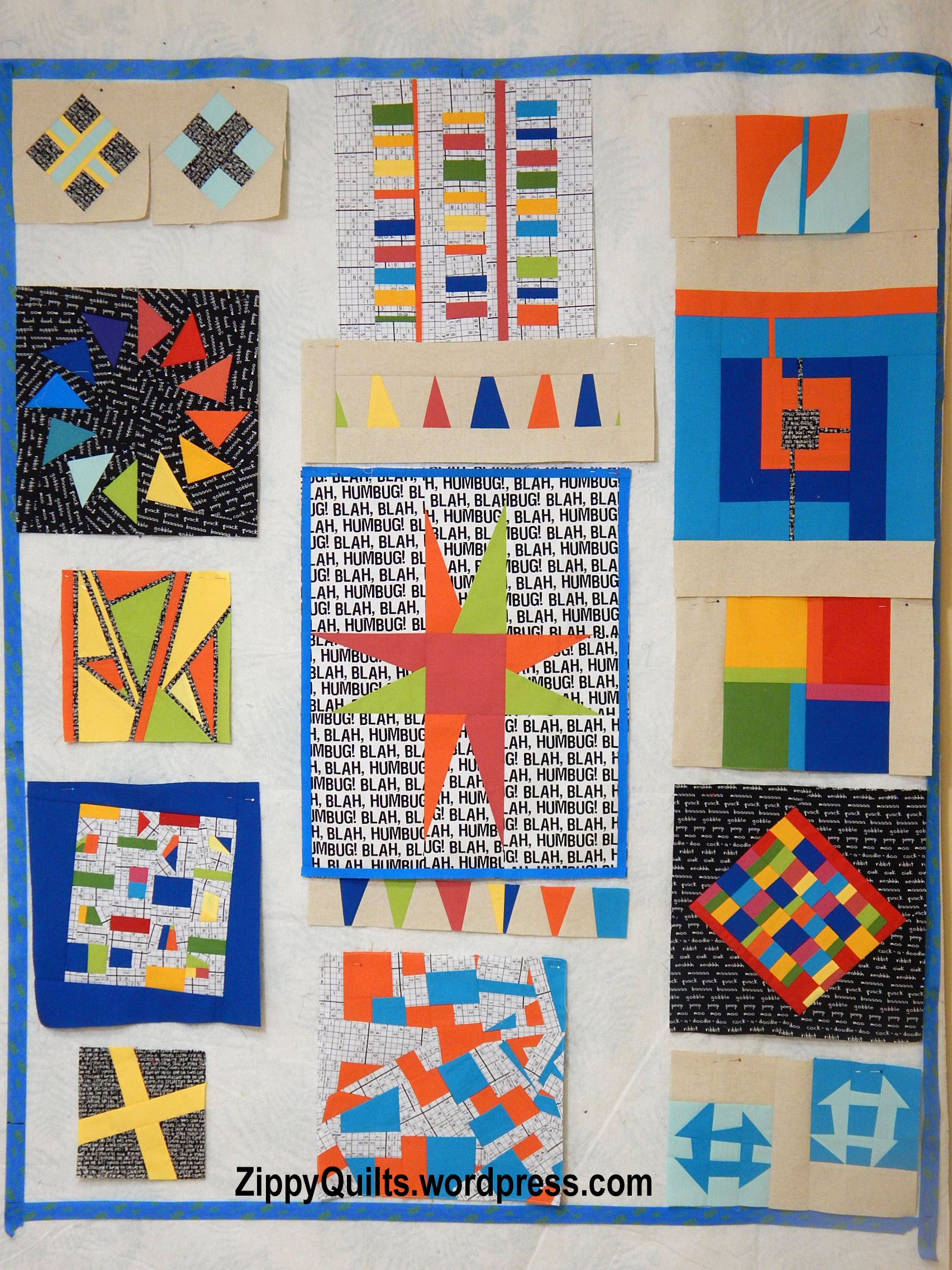
Here’s my entry for the 2016 Quilt Alliance contest, “Playing Favorites “. The design is inspired by Gwen Marston’s work, and the piece is titled “Gwen Visits the Farm”. The black fabric has animal sounds printed on it: “peep” etc.

improvisational quilt

“Gwen Visits the Farm”

The “Playing Favorites” theme of the 2016 Quilt Alliance contest is intended to capture a picture of quilting in 2016 by asking contestants to make quilts using their favorite techniques.  I love improvisational quilting, and Gwen Marston was doing it long before anyone thought of the “modern” quilt movement!

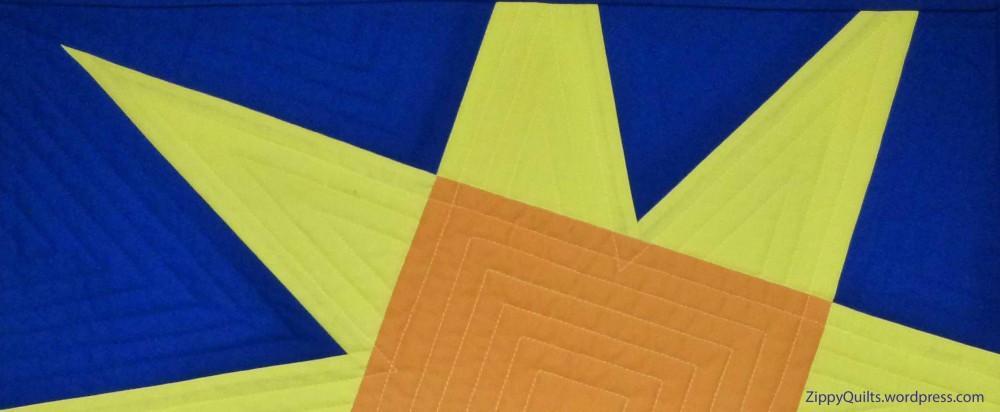
In addition to making the quilt in Gwen Marston’s improvisational style, I quilted it using decorative stitches.  I’ve used several of the decorative stitches on my machine for quilting for a long time now.  However, I recently took a Craftsy class in which Jackie Gehring suggested using even more of the decorative stitches.  I think the stitching reflects the state of the art of quilting in 2016, as well.machine quilting

I’ve been thinking for YEARS of doing a series of quilts in the styles of my favorite quilt designers, so this is the first in that series. Please stay tuned!

Layer Cake Quilt

I bought a terrific layer cake was bought a couple of years ago and it has been “waiting”, along with its solid coordinates, for inspiration to strike.

quilting storage

Future projects are stored in boxes…oops, sometimes for years! (Found a nice set of these at Costco.)

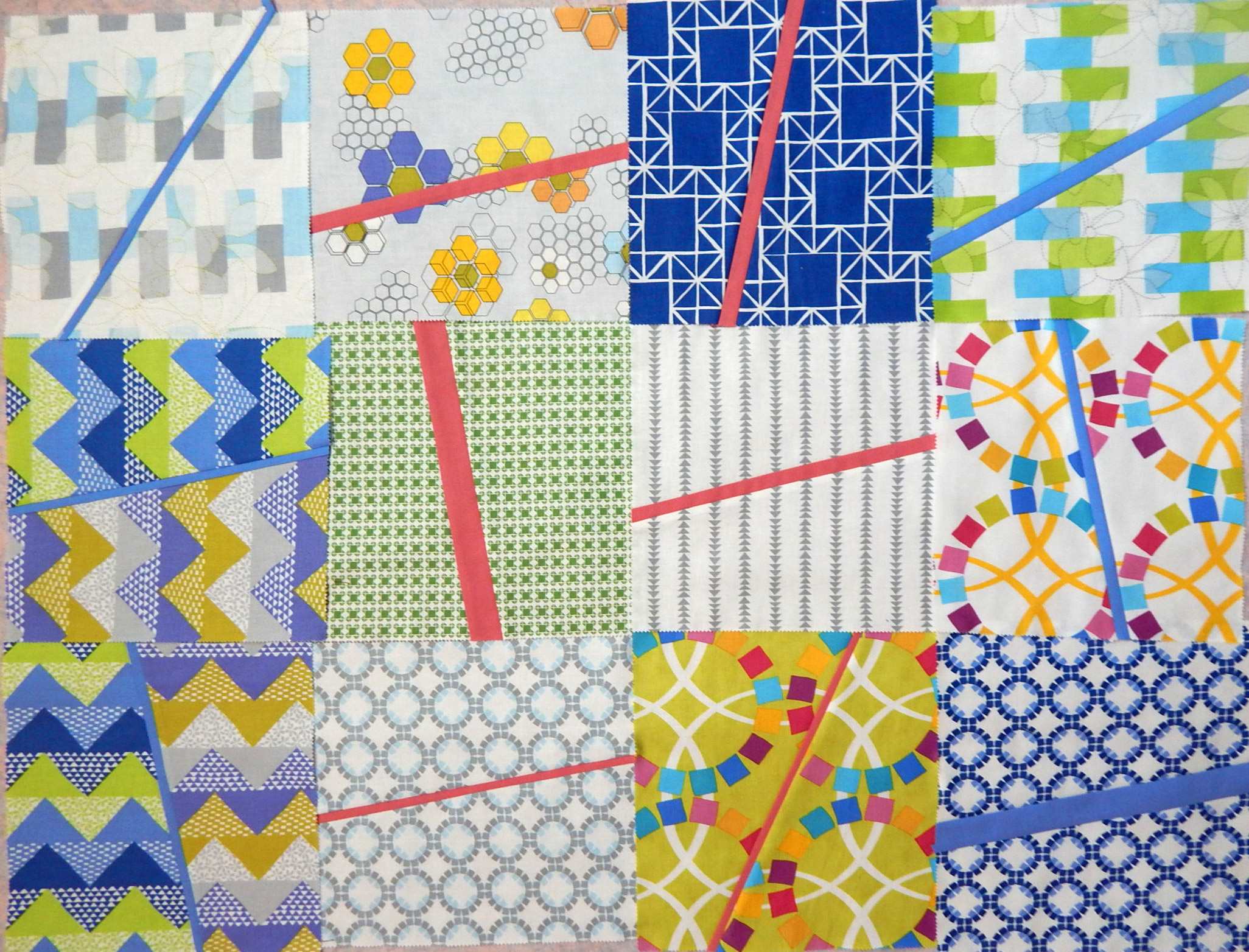
Then the other day I decided I wanted to insert strips of the coordinating colors into the squares. As you probably know, a layer cake is a stack of 10″ x 10″ squares. That means fat quarters (18″ x 22″) of solids will work well for insert strips.

I started by sorting the layer cake squares into stacks with the solids I wanted to use with them.

layer cake quilt

Layer Cake and Coordinates

Then I cut strips of various widths from the solids.The strips varied from 1″ x 18″ to 2″ x 18″, in 1/4″ increments. I cut a variety of widths from each solid color.

insert strips into quilt blocks

Strips ranging from 1″ to 2″ wide in 1/4″ increments

I had NO idea what I was going to do with these blocks once I got them modified; I just liked cutting them up and inserting strips–it takes very little to entertain some of us 😉 Then I remembered John Cage’s “prepared piano”.   So I called these “prepared fabrics”.

I did the inserts in several ways, still working on this just for fun:

When I looked at my “prepared fabrics” together, it was apparent I wasn’t going to just sew them together along the edges (for several reasons)!Retreat18

So the next step was to go to EQ (Electric Quilt, a computer program for quilt design) and make some designs:

Quilt from layer cake

Option #1. I’ve always loved concentric blocks, and alternating them like this produces a nice design easily.

modern quilt design

Option #2. Concentric blocks off-center are even better!

layer cake quilt design

Option #3. Flying geese are always a lively design element, and I just bought a special ruler for trimming!

modern quilt design

Option #4: I haven’t done anything with gentle curves for a while. These look like flags to me.

What do you think?  Anybody have a strong preference for one of these designs?  Whatever I do, I think it will be fun to see how the inserted strips turn out in the final design 🙂


Quilt of 5496 Pieces!

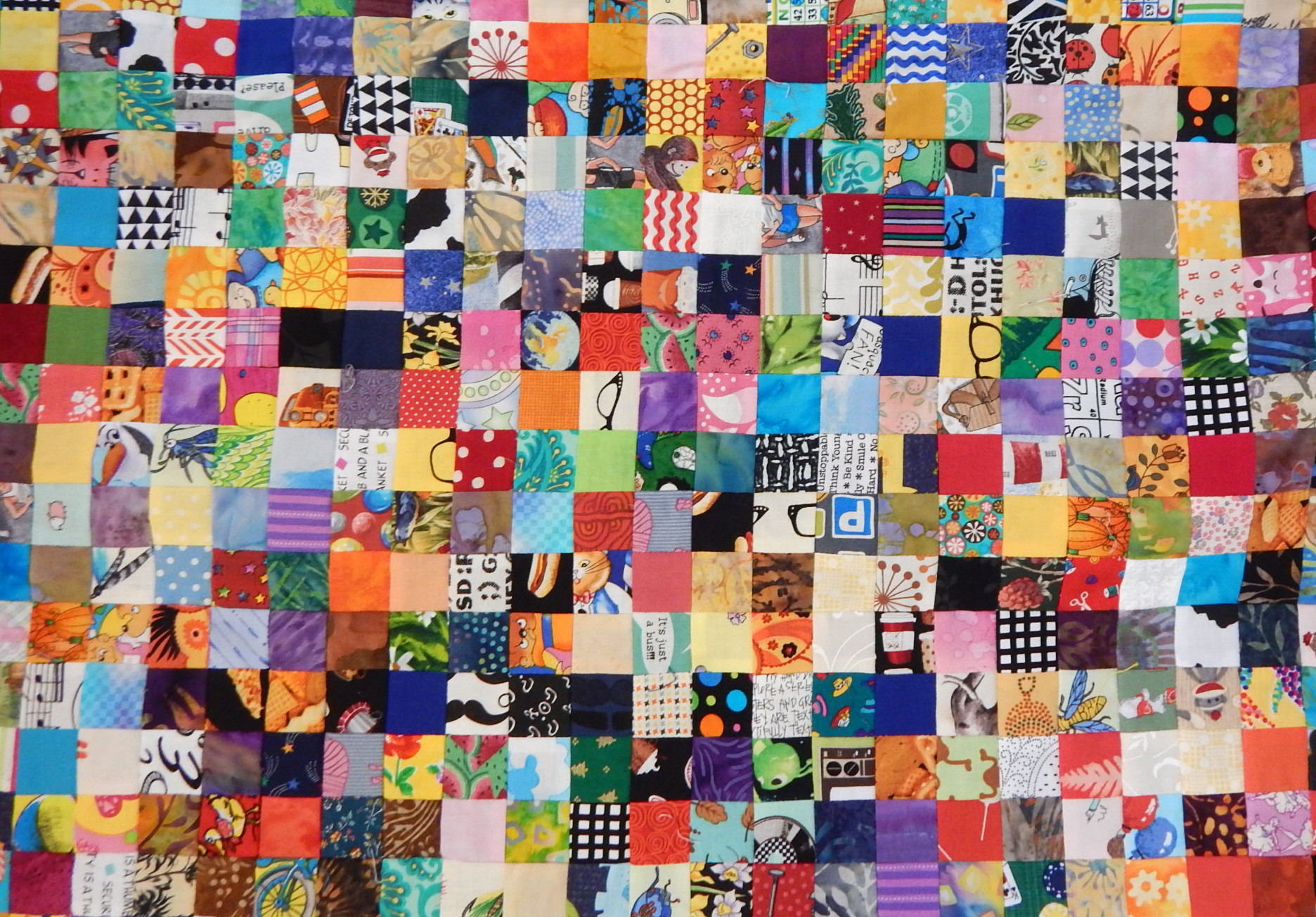
A friend who loves TINY things recently finished this postage stamp quilt of 5496 one-inch squares!!!  She will donate it to be raffled as a fundraiser at the retirement home where she works.

postage stamp quilt

Postage stamp quilt–all 1″ squares!  Made by Jerri Szlizewski

Jerri says this is “the ultimate I-Spy quilt”.  She has found many, many, little novelty prints to put in the little blocks.  She even has Elvis, though I didn’t get him in this close-up.

postage stamp quilt

A close-up showing a few of the little designs in the quilt

Here are just a few of the projects from the design walls at a recent quilt retreat at a “secret” hideaway:

slabs, quilt slabs

One retreater came up with this design to use slabs we had swapped previously

One person made several dozen of the cute half-circle napkins that fold into a Christmas tree.  She made a lot of place mats, too, but I didn’t get a picture of those.

quilt retreat

Christmas Tree Napkins

Retreat16

Working on a quilt from Scrap Quilt Sensation, by Katharine Guerrier

Here are a few more works in progress from various people:Retreat15Retreat18Retreat-4And finally, here are some of the quilts we made for Ronald McDonald House:

Only as Good as Your Last Quilt?

There’s a cynical phrase, common in professional sports, that is used often in other arenas as well: You’re only as good as your last game. It’s a commentary on public opinion. Unfortunately, there’s a corollary in our everyday judgments of ourselves.

Michael Miller Challenge 2013

This little quilt, “Packet of Posy Seeds”, did NOT win anything.

One of the modern guilds I belong to had an interesting discussion last meeting about which quilts are selected for QuiltCon, and why.  We pretty much all agreed that the show is used to further the MQG’s own definition of modern quilting rather than to reveal the depth and breadth of the modern quilt movement.

modern quilt

This little quilt was published, along with an article I wrote

So, am I a good quilter because my quilt was juried into an AQS show? Or a poor quilter because SEVERAL quilts were rejected for a QuiltCon show? A good quilter because I’ve designed quilts that were published?  Or a bad quilter because every magazine doesn’t love every one of my proposals?  There’s a temptation to feel great when a quilt wins a prize and to feel a bit down when one is rejected.  But does that make sense?

modern quilt

Happy Squares, designed and made by me. I love it, but nobody wants to publish the pattern.

Of course there are some “competitive quilters”, but most of us quilt because we enjoy it. My quilts are made to please myself, not to please other people.  Even when I make a quilt for a challenge or show, I make it the way I want it, and I expect that is true for most people.  I doubt that quilting is a road to fame and fortune for most of us, and that’s fine.

Modern Quilts Unlimited magazine

Zippy Star quilt for Modern Quilts Unlimited. I won a contest with this design.

So, if QuiltCon didn’t accept my quilt, it is NOT a personal judgment about me, it is a programmatic judgment about where the MQG folks want the definition of modern quilting to go. And if some of my quilts are published or win prizes, that’s dandy, but I still made them to suit myself.

improvisationally pieced quilt

“In Fairyland” has been in 2 shows but won no prizes.

So much of life involves following other people’s rules, sometimes for good reason and sometimes not.  Although I’m a serious quilter, I want to do it by my own rules.  I’ll still submit to shows because I like to see my quilts displayed.  But really, the quilt is an end in itself.

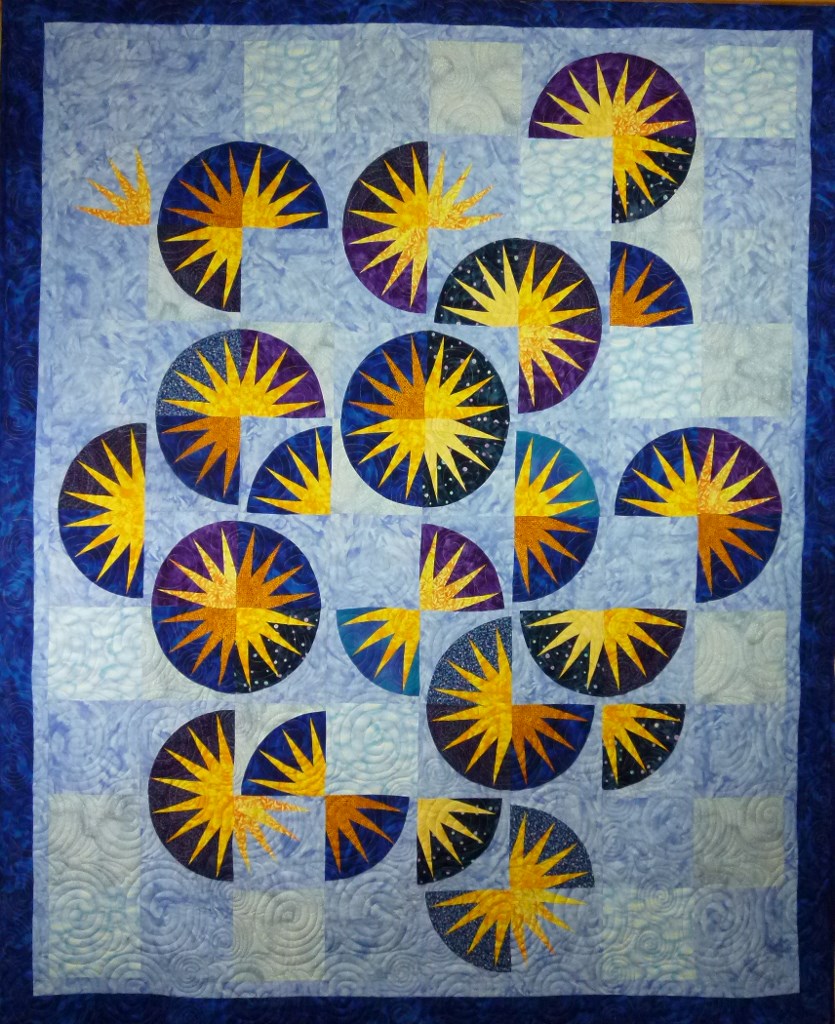
Spring Sun, a design by me, using blocks paper pieced from a totally different Judy Niemeyer pattern!

I designed Spring Sun using blocks paper pieced from a totally different Judy Niemeyer pattern. It was juried into an AQS show.

My friend Melanie has written a couple of posts on why we quilt.  You might enjoy them:

Make Good Art

Saturation Point

KonMari in the Studio

Because I had seen so many reviews of it, I recently read The Life-Changing Magic of Tidying Up. It is very Japanese in character: there is a right way to do everything, and KonMarifollowing the rules brings good fortune. I’m a little surprised at how much it has caught on in the West. The author, Marie Kondo, calls her method for “tidying” KonMari, a combination of her names.

I was unexpectedly convinced by reading her book that I can, indeed, get rid of a lot of my “stuff” and be happier for it!  And I thought I’d start in my studio, since that won’t involve anybody but myself.

My studio is pretty neat, with almost everything stored away.  And when I see pictures of other people’s studios, I realize that my stash is minimal by many standards!

KonMari recommends dealing with things by category, and in a strict order. There are no categories for a quilt studio, so I made my own categories and ordered them like this:
1. Fabric
2. Tools, such as rulers and scissors
3. Notions, such as thread and ric-rac
4. Published materials, such as books and patterns
5. Sewing and serging machines
6. Everything else

The method requires gathering all items of a particular category in one place. ALL must come out of their drawers, boxes, etc. Ms. Kondo says to pile it all on the floor, but you know THAT’s not happening!

studio organization, stash

Some of the stash laid out on tables–and some bins on the floor, too

The next step is to handle each piece and decide whether it gives me joy. If it does, it stays. If not, it GOES!

studio organization, stash managemengt

The stash from another angle

This may, at first, seem like a waste. After all, I paid for that fabric, washed, ironed, and stored it. But after reading the book, I believe the true waste is being weighed down by things I’m hoarding because I “might need them” or “intend to use them” in the mythical “some day”.  And really, do I want to work for hours on a quilt made with fabric I don’t love?

I’ll let you know how this first step turns out 🙂  How are you managing your stash?

Finished Tops!

After much deliberation about layout, I got my Modern Sampler quilt put together last week and sent it off to be quilted.  Here’s the final top:

modern sampler

My Modern Sampler top is ready for quilting!

Then, for good measure, I put together the batik blocks from a swap I was in several years ago and sent that top off to be quilted, as well.

batik quilt blocks

Group batik blocks, put together and ready for quilting

Yes, the sashing DOES vary a bit, because the blocks do.  That’s the way it goes with a block swap.  I love the variety of the blocks and, of course, the batik fabrics.

I’m sending this to Aunt Marti’s UFO challenge, which helps keep me motivated.  What are you up to?

2013: The Quilts

Most of the first post about 2013 showed special projects.  Here are the quilts.

This quilt, made from a Batavian Batiks pattern, hangs in my husband's office

This quilt, made from a Batavian Batiks pattern, hangs in my husband’s office

quilt, donation quilt, bright quilt, blended border

And here is a donation quilt made from extra blocks. I used it to try out blended borders.

Here are two more donation quilts, made for Ronald McDonald House in 2013:

Happy Plaids is my own design, but there are MANY similar quilts out there

Happy Plaids is my own design, but there are MANY similar quilts out there

Twinkle, a pattern by Swirly Girl Designs, was made because I had some fabulous leftover fabric

Twinkle, a pattern by Swirly Girl Designs, was made because I had some fabulous leftover fabric

The first post about 2013 projects included a table runner made from leftovers after I finished this next quilt:

improvisational quilt

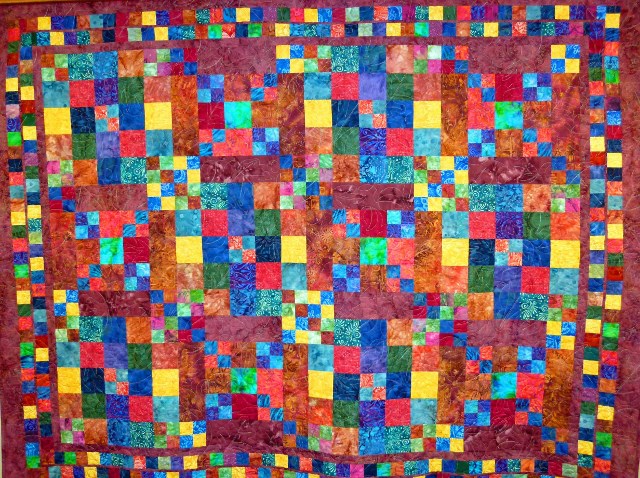
This quilt, pieced improvisationally from bright batiks and black, is one of my all-time favorites.  

This quilt was for a special baby; and yes, that’s me with my beautiful daughter 🙂

baby quilt

Quilt for a special baby!

I found a pattern for this little miniature while on a trip, and just couldn’t resist making it–all from scraps, of course.

miniature quilt

Miniature quilt–I’m sorry I don’t recall the name of the designer.

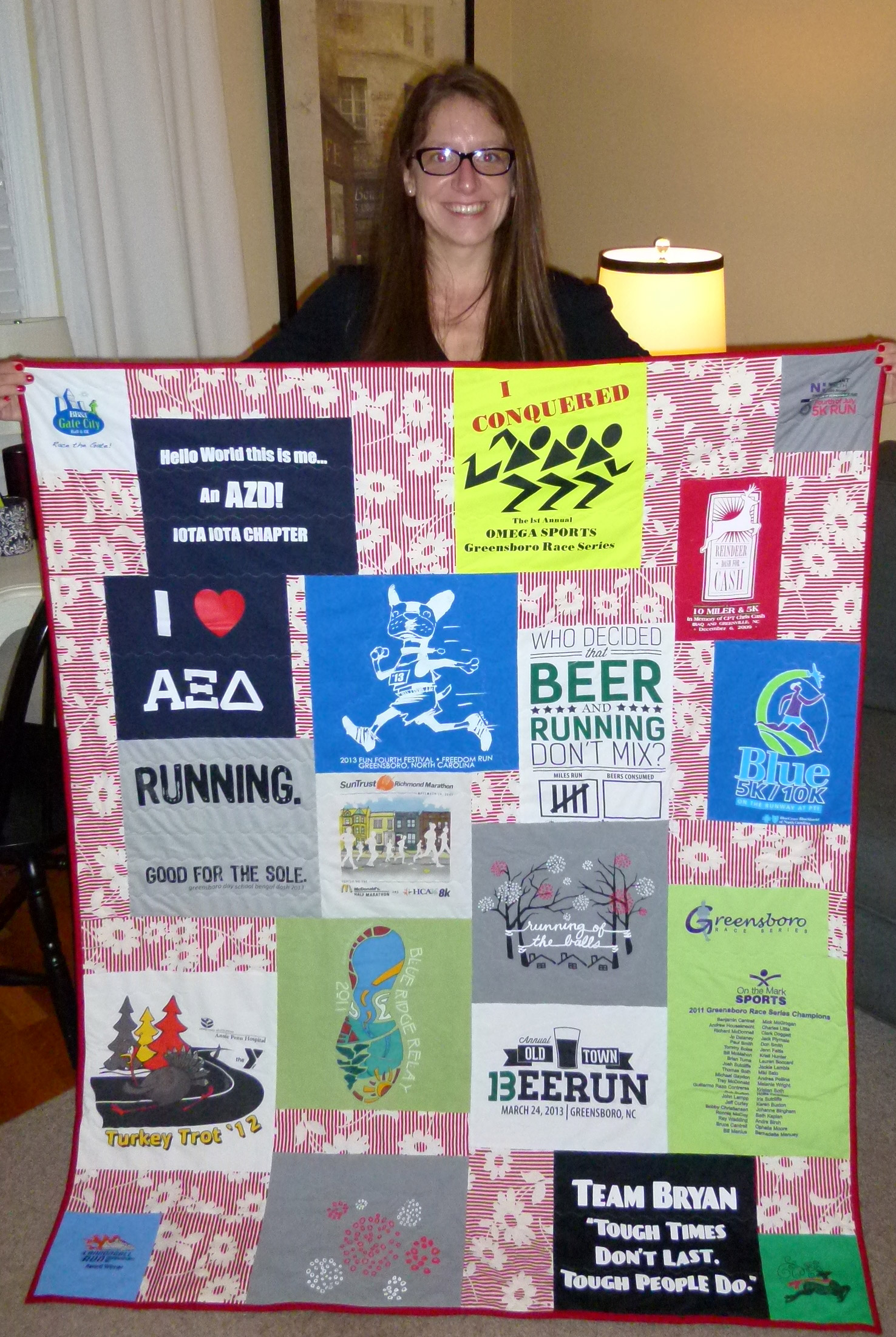
Here’s an improvisationally designed T shirt quilt I made for a friend:

Improvised T shirt quilt

Modern T Shirt Quilt, using my favorite method of designing as I go

And finally, the last Ronald McDonald quilt for 2013, made from blocks that were just too wild without solid sashing!

Ronald 1 2013That’s what I could find for 2013!  More years later.

My Modern Sampler: Using Linen in Quilts

After finishing the blocks for my modern sampler, I ordered several shades of Essex linen/cotton blend to consider for the background. I know I said I’d never use linen again after the last struggle, but I’ve learned several things since. So, if you’re thinking of using linen in your quilts for its nice texture, read my tips at the end of this post.

Here I’m trying various layouts on two different potential background fabrics.  I hung the ironed fabric and pinned the blocks to it, trying out various layouts and different colors of background fabric.

essex linen

Here is the Pewter background

modern sampler

Here is the Natural background, with a different attempt at layout

I decided I liked the natural background better than they gray.  Then I took it all down and made a rectangle on my design “wall”, outlining the approximate finished size with blue painter’s tape.

modern sampler

Here is the layout I decided to use, with some of the sashing in place

And here are my thoughts on using linen in quilts:
–The linen I used the first time was “real”, 100% linen. Remember that from your childhood, when summer clothes were supposed to be linen? Think wrinkles! And avoid 100% linen for your quilts
–The “linen” of the Essex brand actually is a linen/cotton blend, so it has a nice texture but is less wrinkle-prone and tighter woven than the linen I used previously.
–Pre-wash the linen blend, even if you don’t pre-wash anything else. Wash in warm water and dry on warm so it will get its shrinking done and be more dense and stable.
–Before you pre-wash, serge or zig-zag the raw edges together to prevent fraying! This worked great and “wasted” only about 1/4″ on each raw edge, much less than would have frayed. And there was no mess of threads in the washing machine.

How have you done with using fabrics other than quilting cotton in quilts?


Projects 2013–Part I

For some time I’ve been meaning to add to my blog with a gallery of projects for each of the past several years.  I’ve been held up in part by the variable quality of my photography over the years, but I’ve decided to just start anyway.  Here are some projects from 2013.

I entered several national contests in 2013, the year I also started this blog.  Here is the quilt I made for the Quilt Alliance TWENTY challenge and chose as the header for my blog:

Rising star art quilt

Rising Star, made for the Quilt Alliance TWENTY contest in 2013

I made this quilt for the Michael Miller challenge in 2013:

Michael Miller Challenge 2013

Packet of Posey Seeds

And I made this little quilt for the Pantone Challenge:

Applique quilt

Radiating Orchid mini-quilt for the Radiant Orchid Challenge

I attended some wonderful classes with Laura Wasilowski in 2013, and made this little art quilt:

applique art quilt

Leaf, made in class with Laura Wasilowski

I did some “crafty” things in 2013, including chambray shirts decorated with orphan blocks and matching T shirts for a special baby and his special Dad:

Here are a set of placemats and two table runners from 2013:quilted placemats

leaf runner

table runner

Table runner made from a strip of leftovers

Also in 2013, I made an apron for a special friend and a caddy for carrying my iron to classes and retreats:

2013 was also a good year to make pillows for friends and to use up orphan blocks:

Well!  That’s it for special projects from 2013.  The actual quilts from 2013 are up next–more to come!

Connie Brown, A North Carolina Quilter

Connie Brown quilter

Connie Brown 

Connie Brown and I met at the Modern Quilt Guild of Asheville.  She has been juried into membership in the Southern Highland Craft Guild, a prestigious organization promoting fine Southern Appalachian crafts.  I thought you would enjoy meeting her.

Give us the quick tour of your quilting career.  How did you get started?

My husband, son, and I moved to Asheville in 1989.  I knew no one in the area, so I signed up for a quilting class at Asheville-Biltmore Technical College.  The instructor, Mary Field, was the best.  Along with quilting basics, she taught me many sewing skills and shared her knowledge and love of antique quilts and quilt history.  By the end of the class she had encouraged me to join the Asheville Quilt Guild and a weekly bee. The first few meetings I attended featured presentations by quilt historians.  I really enjoyed quilt history, so I started studying antique quilts.

When/how did you decide to “go pro” by studying quilt history and appraisal, judging shows, and joining the Southern Highland Craft Guild (SHCG)?

Connie Brown, hand quilting

Connie demonstrates quilting at a Southern Highland Craft Guild event

After a few years of making quilts and entering them in both local and national shows, I put a couple in a gallery exhibit.  To my surprise, one sold and visitors were interested in my other quilts.  I knew about the SHCG, with its shops, marketing, and educational opportunities.  After selling that quilt in the art gallery, I decided to apply for membership and was juried in during 2000.  I have my quilts in their shops and participate in several of their events, including Fiber Day and Heritage Day (where I share my beekeeping), as well as others.

When people started calling me about the value of antique quilts, or what value to place on a quilt they were entering in a show, I saw a need for a local certified quilt appraiser.  I put my years of studying quilt history and my knowledge of local quilt sales to use and focused on becoming a certified quilt appraiser.  In 2009, I was certified by the AQS (American Quilters Society) as an Appraiser of Quilted Textiles.

What is your favorite of the quilts you have made?

I love making circles and Drunkard’s Path units!  My 3 favorite quilts so far are:

Connie Brown quilter

Color Cascade

“Color Cascade aka Prints Charming”  includes more than 500 scraps.  The pattern for this quilt is in the September 2012 issue of American Quilter Magazine.  This is machine pieced and machine quilted.

Connie Brown quilt“V-Spot Target Attack” is also made entirely by machine.

Finally, “Tiffilippa” was inspired by a Tiffany lampshade.  I couldn’t throw away the trimmed off “waste”, so I used it as a border.

How much time do you spend quilting?  How do you have time to quilt, participate in guilds, keep bees, substitute teach, and still eat and sleep?

Every day I do something quilt related, whether it’s making quilts, studying, visiting an exhibit, or writing appraisals.  I always carry something to work on in my down time when I substitute teach.

How far do you travel with your quilt activities?  And what do you have coming up?

I’ll be at the Folk Art Center (on the Blue Ridge Parkway near Asheville) for National Quilting Day (March 19, 2016).  I’ll be hosting a quilt sharing day with an exhibition of 4 or 5 antique quilts, and people are invited to bring older quilts they have questions about.  I won’t be doing appraisals that day, but it’s a free event and a good opportunity for people who may have quilts they wonder about.  It can help them decide whether the quilt needs a formal appraisal.

This year I will be offering appraisals at the AQS shows in Paducah and Chattanooga as well as in Mt. Pleasant, South Carolina during the Cobblestone Quilt Show.  My fees for written appraisals are $75 per quilt, but during these events the charge is $50 per quilt. Each appraisal takes a minimum of 2 hours, including meeting with the client, travel, research and preparation, and typing the report.

To see more of Connie’s quilts, visit her webpage at southernhighlandguild.org/conniebrown

You may email Connie at mail2thebrowns@juno.com