Another UFO Bights the Dust!

I’m making a concerted effort to get rid of more UFOs (UnFinished Objects) this year. Of course, the real challenge is to avoid creating new ones!

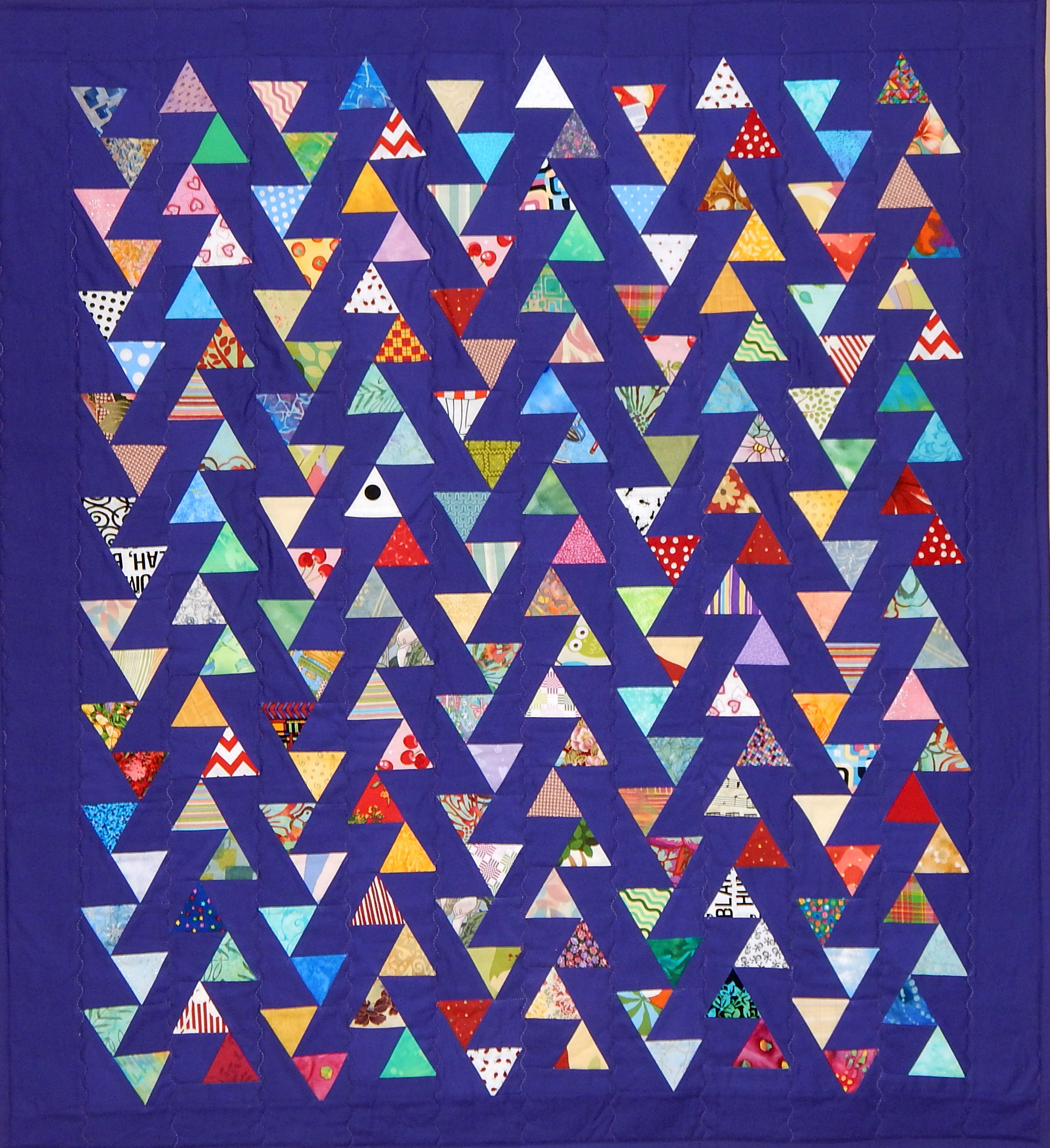
This is the third time I’ve made the Lombard Street pattern by Sassafras Lane Designs.  This shows how much I love the design–usually I make any pattern only once.  Here are the previous quilts:

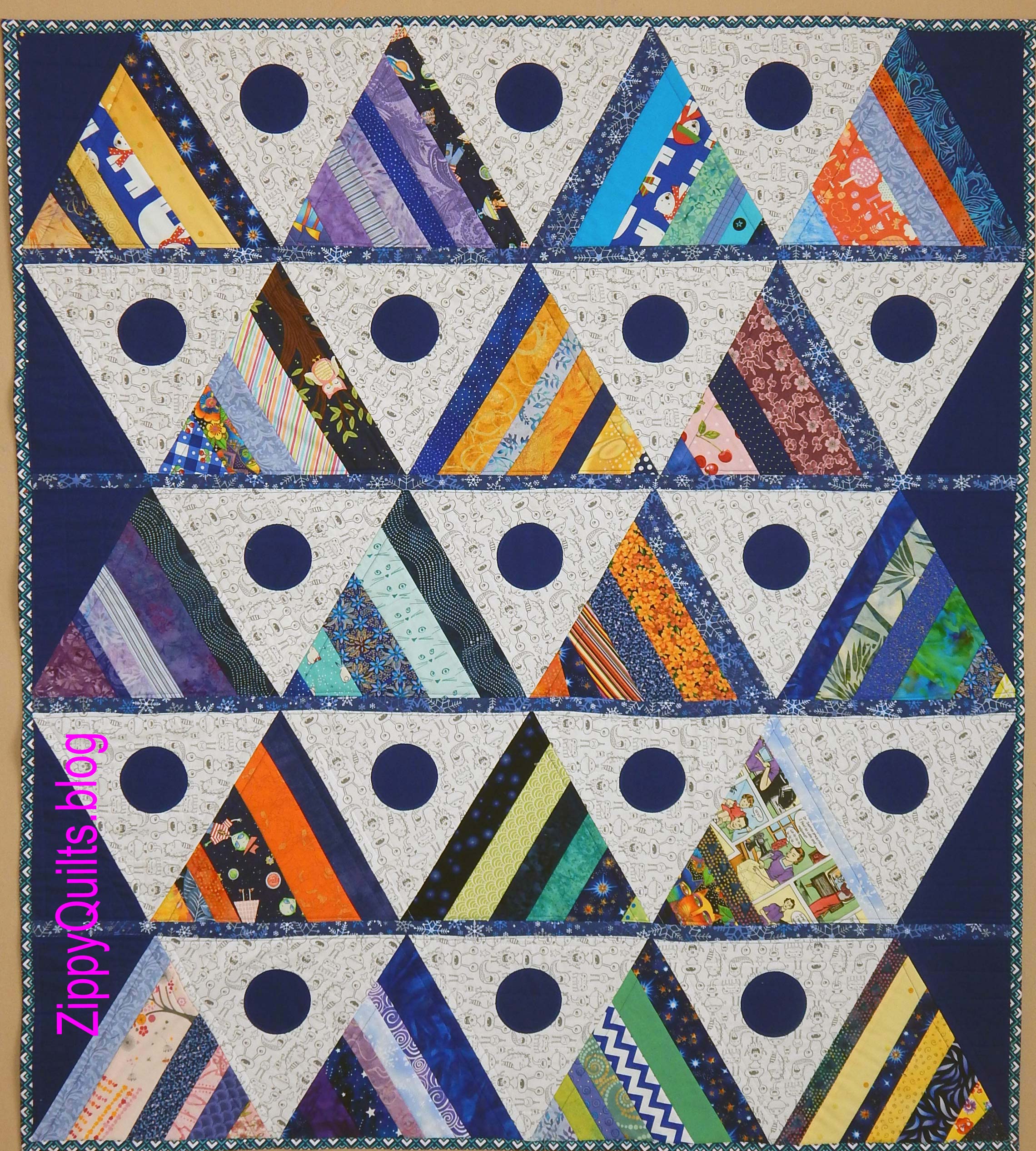
And here is the completed UFO, ready to be donated at the next retreat with my donation quilt group:

Quilt Stats

Pattern: Lombard Street by Sassafras Lane.  This is the smallest of 3 sizes.

Finished size:  39.5″ x 43.5″

Fabric is scraps for the triangles and solid from stash for the background and binding.

Pieced by me, though it took over a year.

Quilted by me.

If you want to make one, you can get your own copy of the Lombard Street pattern here.

Serendipity Quilt

I love this quilt because it gets rid of both a UFO and some scraps!

I had this great backing fabric with all the color names you can imagine written on it, and I had just finished backing a quilt with it. Did NOT want to put the scraps in a scrap drawer if I could help it–those are overflowing!

Blocks finish 6″, so this is an 18″ square section to show fabrics

At the same time, I had these great little sew-and-flip stars from a block swap and needed to do something with them. Serendipity!

Here is a single block showing the quilting:Here is the finished quilt:

QUILT DETAILS

Name: Serendipity

Finished size: 42” x 42”

Alternate blocks are Windham Fabrics Modern Hand fabric

Sew and flip stars from a group swap

Designed, made, and quilted by me

Current Series: Blue Ridge

My first Blue Ridge quilt just returned from the Vermont Quilt Festival and will next go to the Asheville Quilt show.

art quilt

Meanwhile, Maria Shell published a tutorial on how she makes flying geese blocks for her quilts, so of course I had to try it.The result is Blue Ridge II.

The colors of the quilt blended with the colors of my chimney, where I stuck it up to be photographed

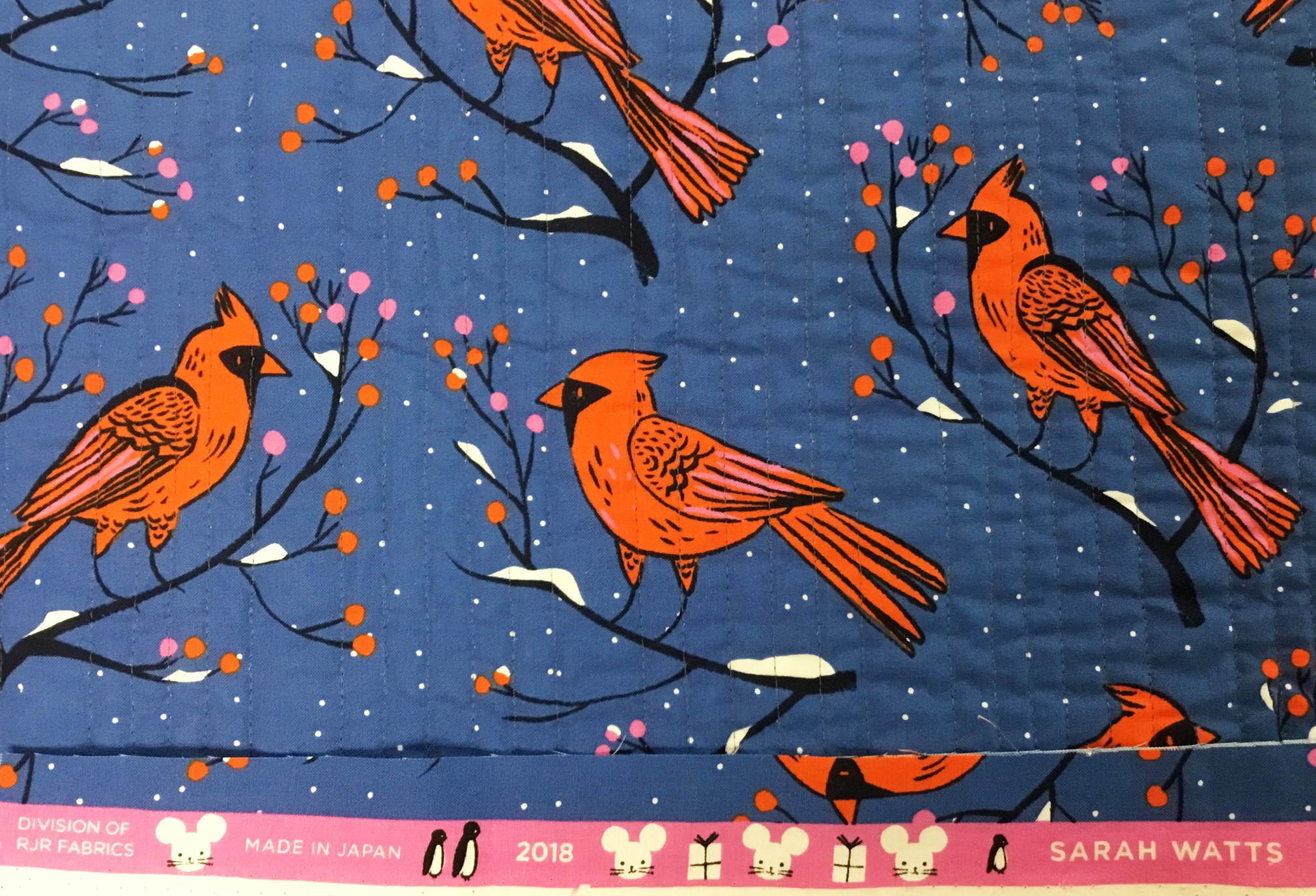
In case a viewer doesn’t get why there is a red triangle among the earth-sky-water tones, I backed the quilt with cardinal fabric 🙂 The fabric is from Cotton + Steel in 2018, before they left RJR.

The quilt is faced using the technique from Terry Aske’s tutorial, which worked very well.  Here are the quilt stats:

Blue Ridge II

  • 28.5 inches wide, 26.5 inches tall
  • The fabrics are batik scraps left from other projects
  • The backing is from RJR, a Cotton and Steel fabric from 2018
  • The piecing was inspired by Maria Shell’s tutorial on flying geese (link above)
  • The facing was done using Terry Aske’s tutorial (link above)
  • Quilt was pieced and quilted by me.  The batting is Quilter’s Dream Cotton, Request loft.


Little Green Man Quilt

This block has been floating around on Pinterest for some time, and I really like it so It’s been on my to-do list.

This is a copy from Pinterest, where the block has been widely shared without attribution

I don’t like to borrow things without attribution, so I went in search of just who designed this.  Luckily, my friend Elizabeth was in a bee that used this block, so I learned from her blog that the block was designed by Kylie Kelsheimer.  A friend of Elizabeth’s located the original post for her through the wayback machine.  You can find Elizabeth’s post about all this here (you’ll have to scroll down quite a bit) and the original pattern here.  I see from Elizabeth’s latest post that the pattern is now available through PayHip, but that was not the case when I first investigated it a year ago and started this project.

Which brings me to why I changed it all up.  The original block is small and paper pieced–not my style!  I wanted to make it big and make the stars wonky.  Therefore, the instructions here are NOT for Kylie’s block, though the idea is based on her original block as noted above.  In fact, the block as shown on Pinterest is really 4 blocks, each rotated so that they fit together as shown in the pin.

I drew the block with Electric Quilt so that it finishes 18″ square.  Here it is showing fabrics.

My wonky star block, drawn with Electric Quilt 8

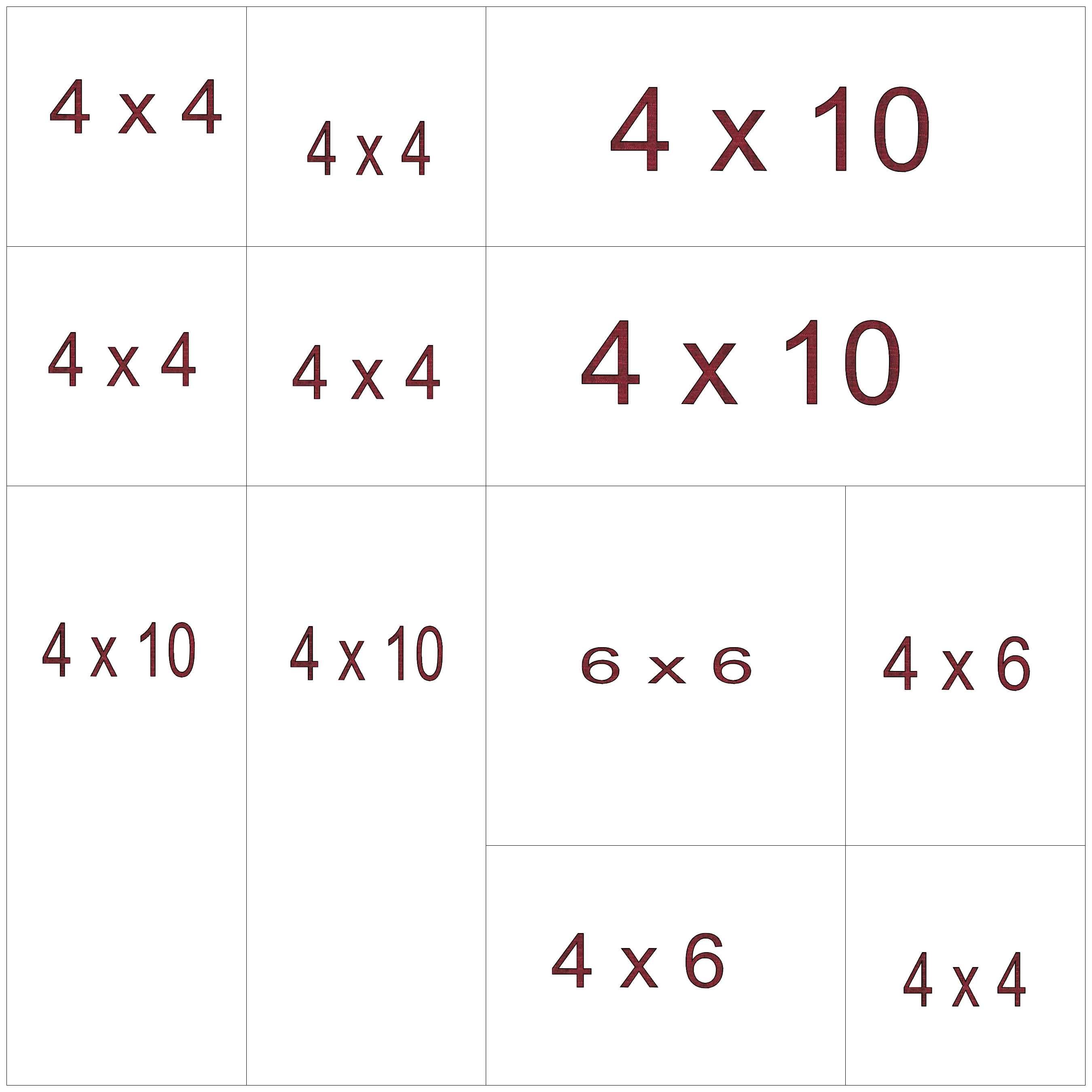
And here is the base block in case you want to make it yourself:

Star base block, drawn with Electric Quilt 8

Here is my tutorial on making sew-and-flip stars, in case you’ve never done it before.

As you can see, I substituted my Little Green Man for 4 of the blocks–those would be the 4 in the lower right-hand corner looking at my layout above.  You will see that I rotated the blocks various ways, which is how Little Green Man ended up in the lower left corner after I substituted him in the lower right.

You can find my instructions for making the LIttle Green Man here.

And here is one of the finished wonky star blocks.

The finished quilt:

QUILT DETAILS

Little Green Man

Finished size: 54” x 72”

A variety of fabrics from different manufacturers

The pattern is outlined in the blog above, but is not available commercially

Quilted by Julia Madison, except for the Little Green Man block, which she left for me because I wanted to avoid any extra holes in the Kraft-Tex I used for applique.

Now, does anyone else recall the “Little Green Man” song from the 1950s?

Linda Hahn: New York Beauty Expert (from Florida)

Linda Hahn is best know for her simplified method of making the New York Beauty block, one of quilting’s more elaborate and spectacular-looking designs.  She describes her New York Beauty method as, “one pin, no puckers, no cussing, and they come out perfect.”  Gotta love that!

Linda’s First New York Beauty Book

Linda also has a number of lovely individual patterns, including some that have nothing to do with New York Beauty. (Her patterns are available through QuiltWoman.com)  I have enjoyed making and teaching her Bermuda Sunrise pattern, so I looked her up while at the North Carolina Quilt Symposium, and she graciously agreed to an interview.

Bermuda Sunrise, one of Linda’s earlier designs that I enjoyed making and teaching

Linda’s workshops now focus mostly on her New York Beauty techniques, since this is a challenging block that many quilters would like to make.  Currently her most popular workshop is called “Feeling Crabby”.

Linda has written multiple books published by AQS. Her latest, New York Beauty Electrified, is due out this month.

When I interviewed her, Linda took the unusual step of leaving the room for a few minutes so I could ask students in her workshop to give their honest opinions!  They were enthusiastic about her teaching and seemed to be enjoying “Feeling Crabby”.  They described Linda as an even-tempered instructor who “lets you do it your way but comes right away if you need help.”

Image from Linda’s iquilt class

Linda teaches all over the country as well as on cruises, but if you want her workshop and can’t find a convenient location, I noticed her New York Beauty instruction is also available through iquilt, the AQS online class site.

Now that I’ve seen more of her beautiful work and met her, I want to take a New York Beauty class with Linda.  I went to her site, and she really, really, does have classes in a variety of locations!  You can find her schedule on her website.  I have enjoyed her patterns (yes, I’ve made more than just the Bermuda Sunrise!) and look forward to trying those elaborate spiky blocks.

Have you made New York Beauty blocks yet?

Augusta Cole: Variety is the Spice of Life

Augusta Cole’s motto is “Variety is the spice of life” and she travels with a lovely quilted wall hanging bearing that motto.  You can see the wall hanging and a good picture of her on the front page of her website.

Augusta designs and teaches beautiful scrap quilts that I’ve admired for years, and certainly scrap quilts have plenty of variety!.  She was one of the instructors at the North Carolina Quilt Symposium, so I took the opportunity to interview her.  I’ve been following her online ever since I found her Snappy, Scrappy Stars quilt pattern many years ago.  Here is one of the multiple versions I’ve made of that quilt (her version has a much fancier border):

I was unable to lift pictures from her site–which usually is how people want me to get pictures to go with my interviews–due to the format. These pictures of some of her quilts are those I took at the quilt symposium. 

Augusta says she has a lifelong history of crafting and keeping her hands busy.  She took up quilting after her second child was born, and “it came very naturally.”  A class with Karen Pervier was especially influential, and Karen remains a good friend.

After living in New York state and North Carolina, Augusta now lives in the Richmond (Virginia) area.  Since retiring from her career as a physical education teacher, she travels to teach quilting.  Her husband is supportive and even keeps the books for her!

I was unable to fit in a class with Augusta, but a friend who took her class really enjoyed it.  She reports Augusta is a lively and engaging teacher.  Augusta’s patterns are  available on her website.  (Go look at her pretty quilts even if you don’t need a pattern!).  I continue to be inspired by her many variations on scrap quilts.

Addendum: Here is a picture from Augusta’s Cutting Bee class, kindly provided by Chris Crouch:


Kraft-Tex Appliqué ! Woo!

Appliqué and I have a love-hate relationship.  I love the look of appliqué sometimes, and I’ve tried several methods, from needle turn to fusible and most things in between.  No method is perfect.

And just to show that I really have tried, here are some samples:
Machine appliqué of these circles was done after the quilting, so the backing and batting acted as stabilizer

The petals were fused on with Heat’n’Bond, and then I buttonhole stitched around them after doing the rest of the quilting, again eliminating the need for stabilizer
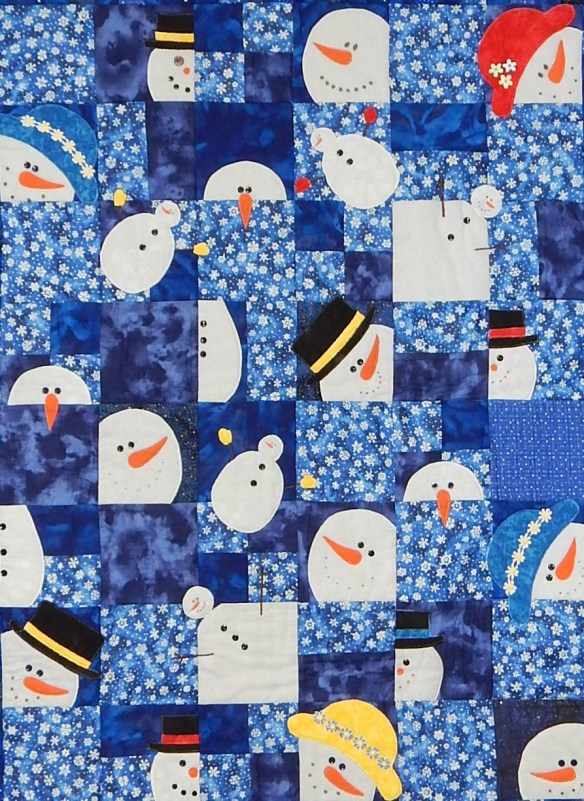
The snowmen and noses were a combination of fusible appliqué and Eleanor Burns’s appliqué with fusible interfacing.  I have washed this and it held up fine.

Sunbonnet Sue

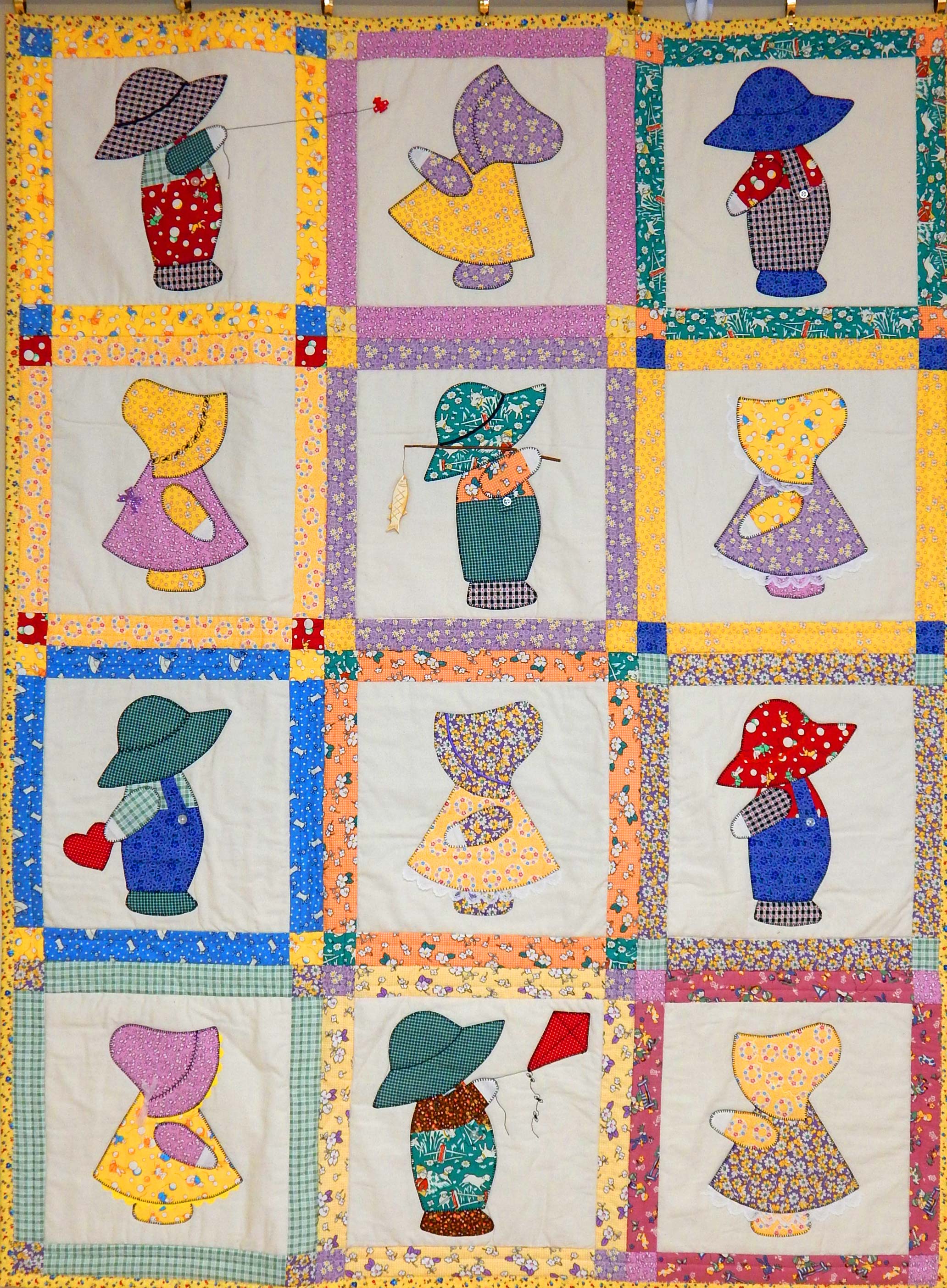
Sunbonnet Sue Visits Quilt in a Day was done with Eleanor Burns’s method using fusible interfacing to produce turned edges

So, when I wanted a space alien to go on a quilt recently, I gave the appliqué process some serious thought.  This fabric is part of the background for a wonky star quilt I’m making, and I wanted one block to be a space alien to go with the theme.

Unfortunately, I have not saved the selvage from this fabric, so I don’t know who made it

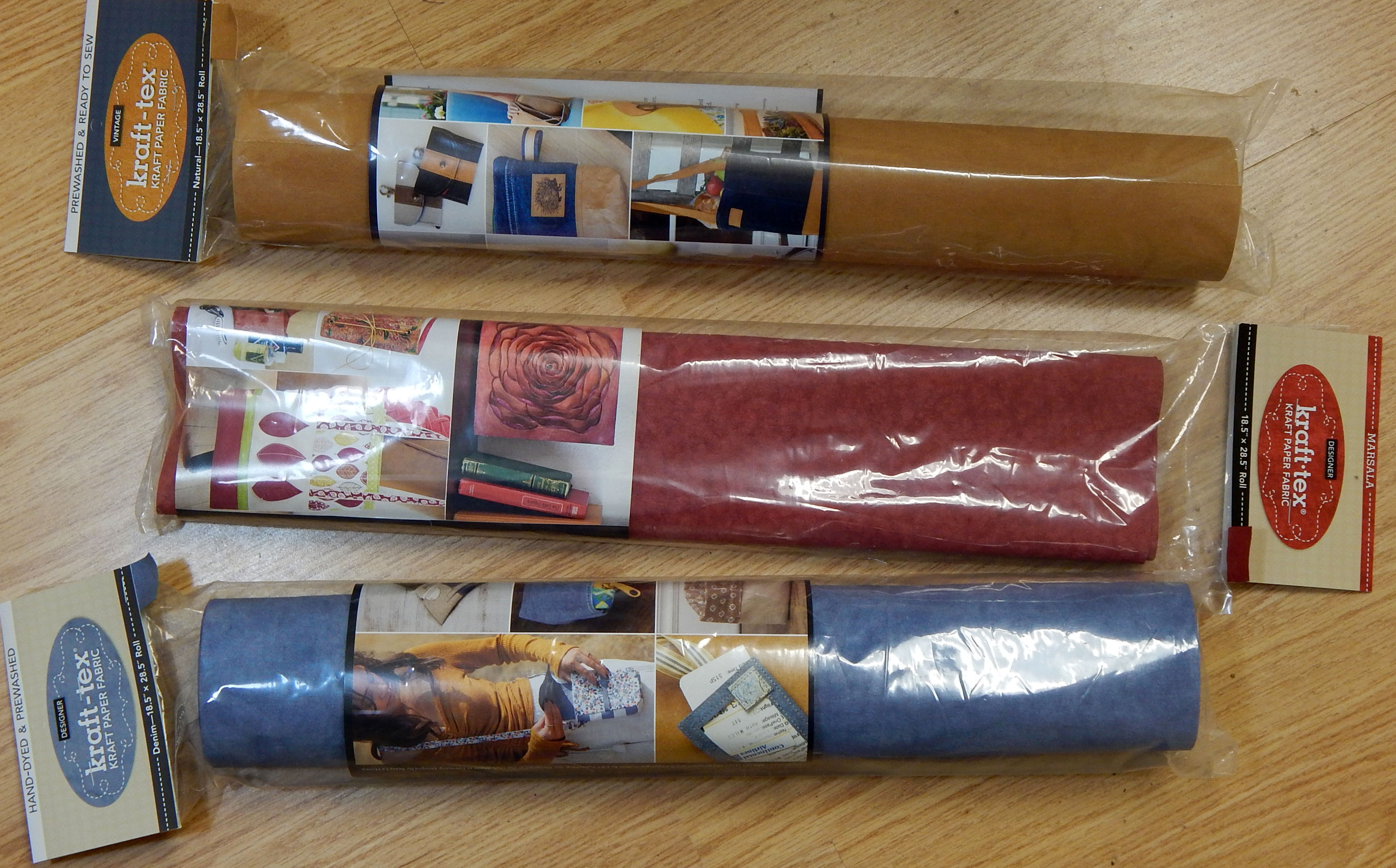
Then I had an idea (drum roll, please).  The folks at C&T recently asked me to be an ambassador for Kraft-Tex, and since I was already a Kraft-Tex user and had blogged about it 3 times, I agreed.  They sent me some free Kraft-Tex!
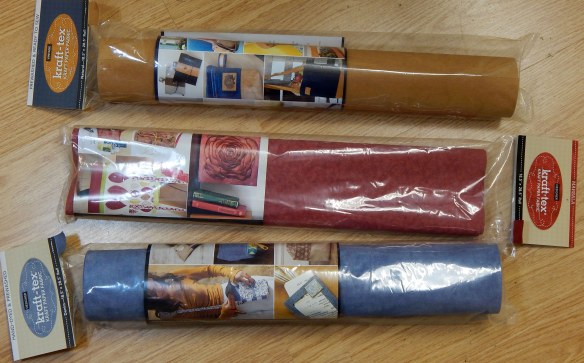
I chose Marsala, Denim (hand dyed and prewashed), and natural prewashed for my free Kraft-Tex

Actually, I had already bought this black Kraft-Tex for another project, but I just want you to know that, for the first time ever, I have accepted a donated product for use in my blog.

I’ll have a tutorial on this whole quilt when it’s finished, but here’s an overview of how I used Kraft-Tex to avoid traditional appliqué .  I cut out the alien’s head using one of my circle cutters and attached it to the block with washable glue stick. Then I cut the outline from black Kraft-Tex and put it over the raw edge, with the raw edge kind of centered underneath.
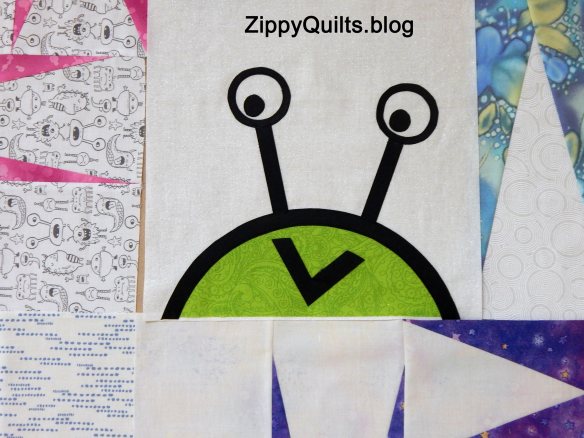
Here is the alien on my design wall

The eye stalks and eyes were cut from Kraft-Tex and all the Kraft-Tex was glued down with the same washable glue.  That all worked well.  I then machine-stitched near the edges of the Kraft-Tex using a size 70 needle and matching thread.  Voila!  I didn’t have to fool with fusibles, bias strips, or much of anything at all.

Kraft-Tex is washable, and I’ll be interested to see how it does in this quilt.  It is stiffer than fabric, but I think that will be OK given the small amount I used on this twin-size quilt.

I can especially see using Kraft-Tex this way in art quilts very soon!

I’ll let you know how this all turns out!
Meet Cheryl Brickey of Meadow Mist Designs

You already know that I took an excellent class with Cheryl Brickey at the North Carolina Quilt Symposium recently.  She kindly agreed to an interview, as well.

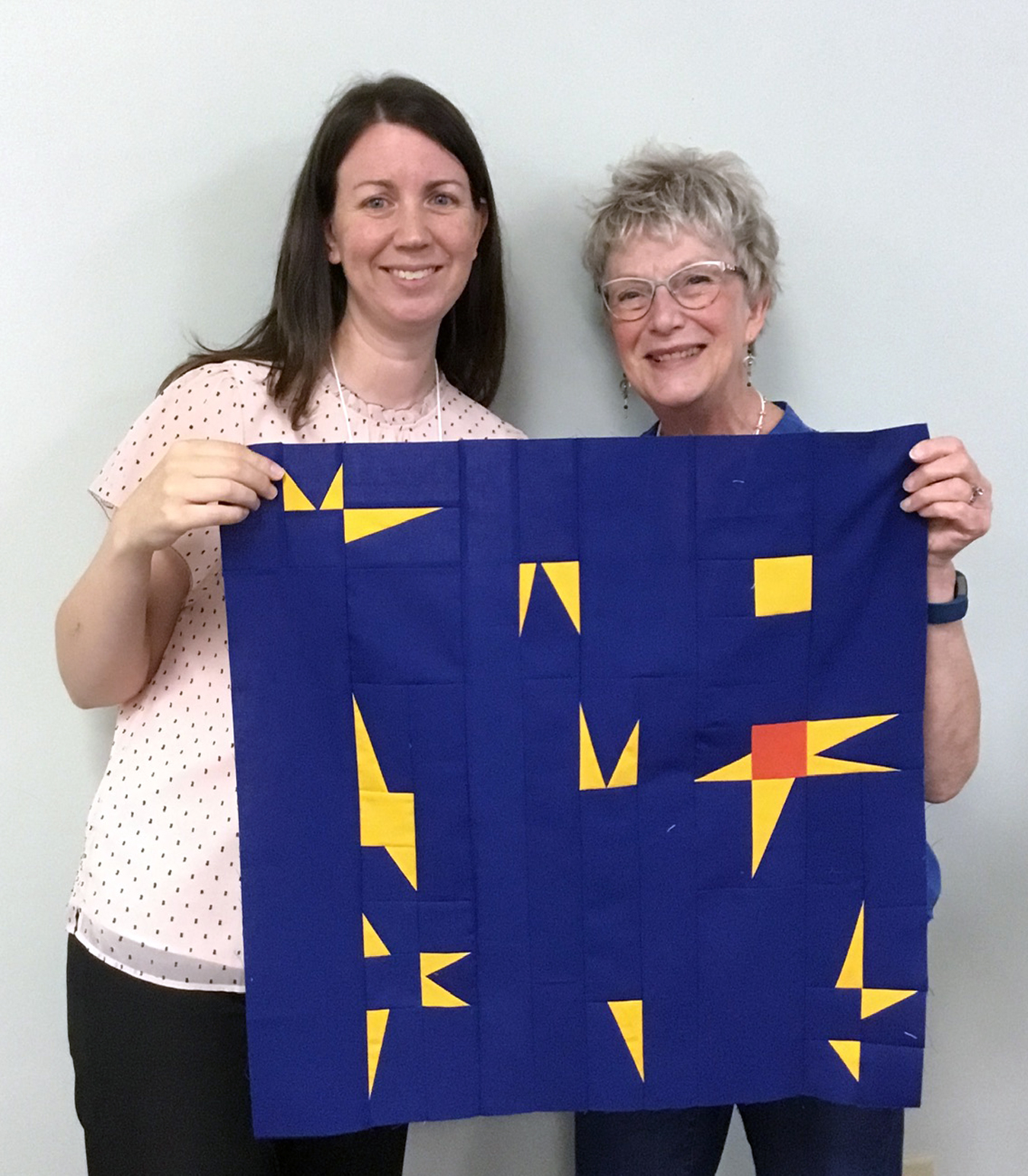
Cheryl and me with the partially completed quilt I designed and made in class

Cheryl has written a book and numerous patterns; all are available on her website.    She is an engineer and works 3 days a week writing patent applications for high-tech textiles used in things like tires and military applications.  On top of all that, she has two children and a very busy life, so I asked for her top time management tip.  Her answer: “Don’t have any [time].”  She explained that, because her time is so limited, she knows exactly what she needs to do when she enters her studio and gets right to it.

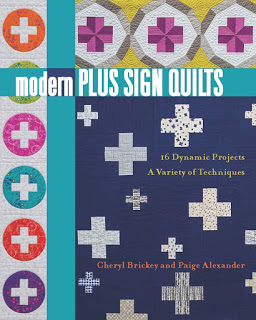
Cheryl’s book, which she wrote with her friend Paige Alexander

Cheryl started quilting when her children were small.  She had always been involved in crafts, but started making quilts because it was something that “stayed done”, unlike the dishes, the laundry, etc.  I think we can all understand that!  She says she read somewhere that a woman should do something every day that can’t be undone.  Both she and I have searched extensively for that quotation without finding it, so I think we’ll just attribute it to Cheryl!  Anyway, quilting meets that need for her.
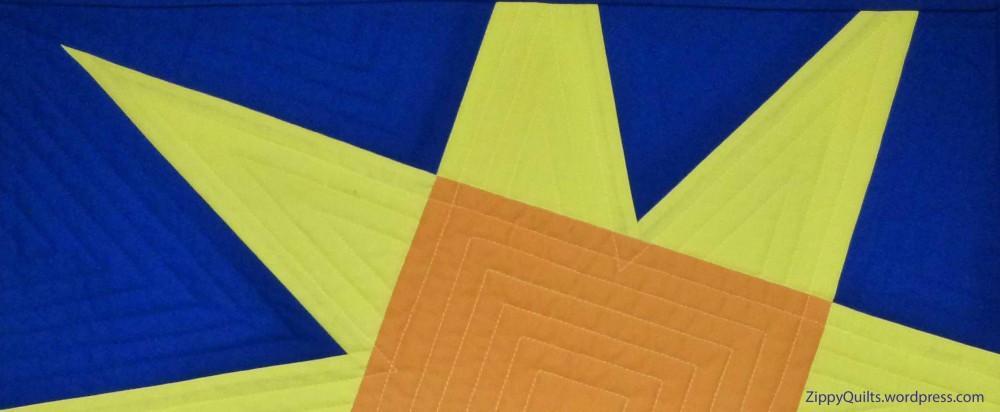
Cheryl identifies “modern traditional” as her style of quilting, and you can see what she means from the pictures below of some of her designs.

Samples for Cheryl’s class on minimalism in design

She blogs at Meadow Mist Designs, where she has just announced her next free mystery quilt.

Click here to be taken to Cheryl’s blog, where you can read about her mystery quilt

This mystery quilt will start in July of this year and run through April of 2020.  She will post a new set of directions the first Thursday of each month.

Cheryl says there is a non-mystery option, and about 25% of those who sign up for the mystery quilt elect to get a picture of the finished product from the outset!  (This meets her “engineer need”, she says.)  The only caveat is that those who elect to see the design from the beginning have to keep the secret so as not to ruin it for others.

Cheryl was a delight to meet and interview.  Her workshop and lecture were very well organized and presented.

Here are two of my favorite patterns from Cheryl, because who can resist pretty pictures?

You can check her out here.

North Carolina Quilt Symposium

I recently spent 2 weeks mostly doing quilty things rather than cooking, doing laundry, hanging on the internet, etc. The time ended with the North Carolina Quilt Symposium at Lake Junaluska, NC.

View from the hotel at Lake Junaluska

This was one of the best events I have ever attended in terms of the quality of instruction. The friends who went with me agree, so it wasn’t just me in my little bubble 🙂

I took a class with Cheryl Brickey (see her website here), who was a wonderful instructor and showed us her personal method of designing modern-traditional quilts using EQ8 (Electric Quilt).  I have used EQ for ages (OK, since EQ5, and they are now up to EQ8) but she showed me some cool new tools I had never discovered.

Cheryl and me with the partially completed quilt I designed and made in class

My second class was with Lyric Kinard.  (Her website is here.)  I learned a lot about creating portraits in fabric.  Here is one that was done for practice at the beginning of the class.  It’s supposed to be the woman who was sitting across from me, but I did not take a photo of her for comparison 😀

This was just a quick practice piece; I promise the woman didn’t really have blue skin!

Lyric went on to teach a much more elaborate and realistic way to do a portrait in fabric, but mine isn’t even far enough along to show.  The whole class was useful and Lyric is an encouraging instructor.

The details of next year’s NC Quilt Symposium are not finalized, but if you want to know more about the symposium and what was available this year, visit the website at NCQSI.org.  I hope to see you there next year, especially, because I have agreed to help recruit teachers!  Come join the fun!

I was able to interview 3 of the teachers at NCQS, so look for posts about them coming up in the next few weeks.

I Dislike Quilt-As-You-Go

Quilt-as-you-go (QAYG) has been around at least since the 1970s, and I have tried it in several forms.  Back when I wanted to use high loft batting, I made this quilt in sections and joined them using Georgia Bonesteel’s method.  The backing seams were sewn by hand.  It worked out fine, but that was a lot of hand stitching.

Queen size quilt made by qultl-as-you-go method

Jewel Box, queen size, made in 2003

More recently I read about using thin batting so pieces can be joined with batting in the seam.  Unfortunately, this method suggests quilting the front pieces WITHOUT backing, then tacking on a back after assembling the front.  That means most of the quilting is hidden from the back; the only thing that shows is the stitching used to attach the back over the actual quilting!

I’ve also seen QAYG done by using batting rather than batiste as a base for string piecing.  This means no quilting shows on the front!

The more I read about QAYG methods, the more I didn’t care for any of the options.  I decided to re-visit it anyway because students had asked for a QAYG class.  I chose the string piecing on batting option, but made the blocks with the backing included so the quilting would show on the back.

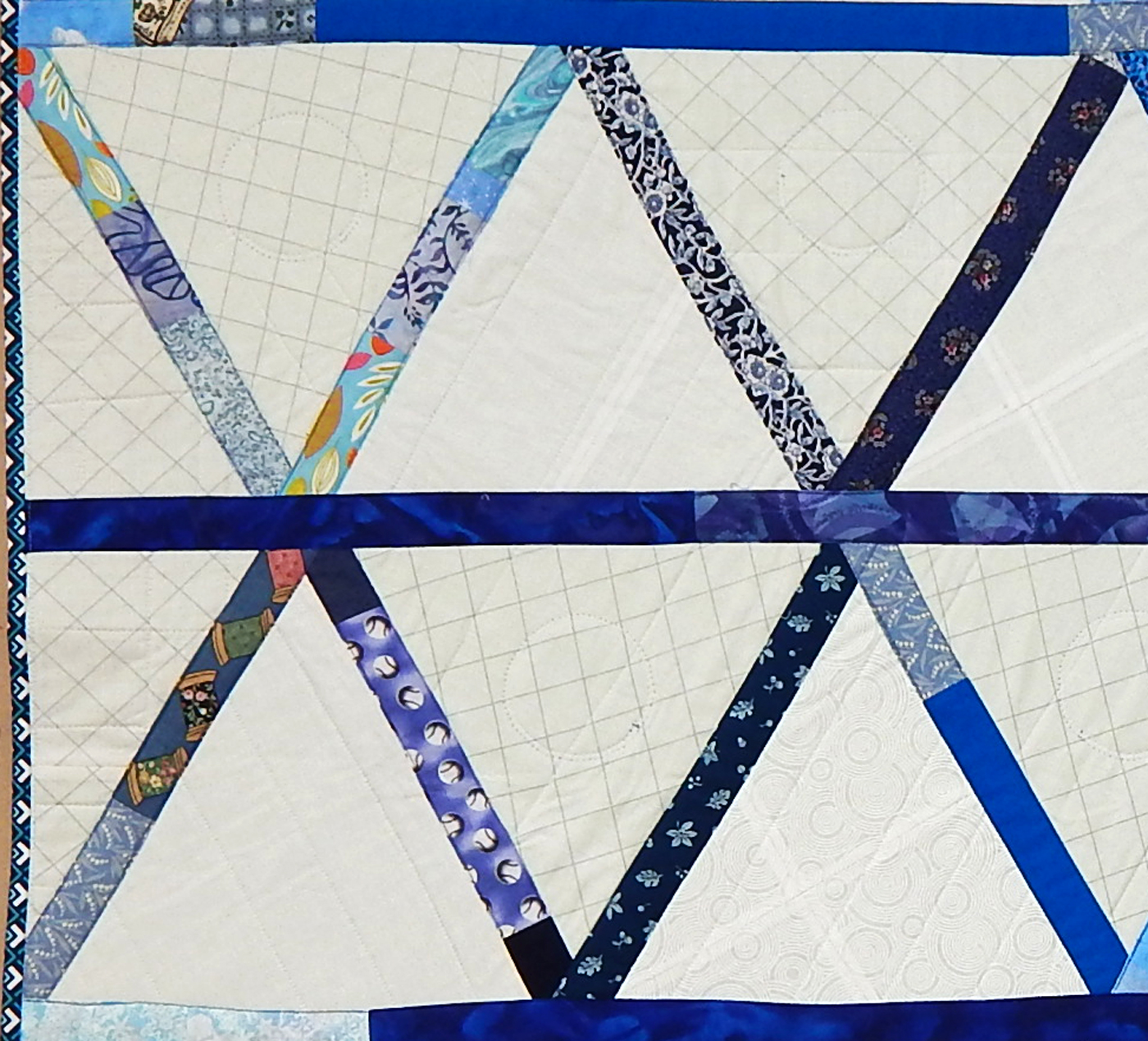
Back of quilt, showing quilting lines

The quilting is meant to show on the back, though white thread on white fabric doesn’t show much!

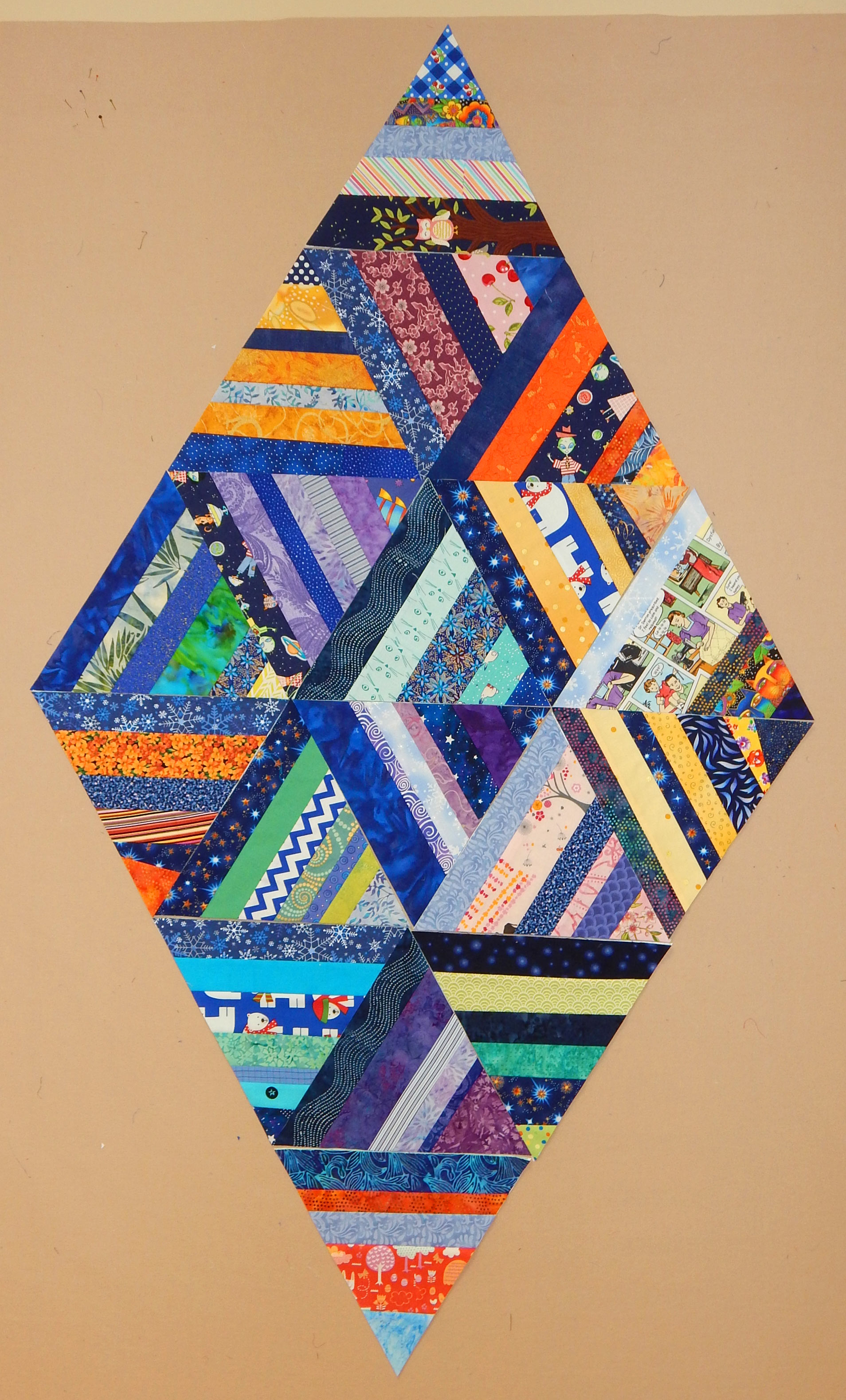
I kind of liked the triangles arranged like this on the design wall, but decided to save this option for when I can make the whole thing look 3-D by careful placement of color.

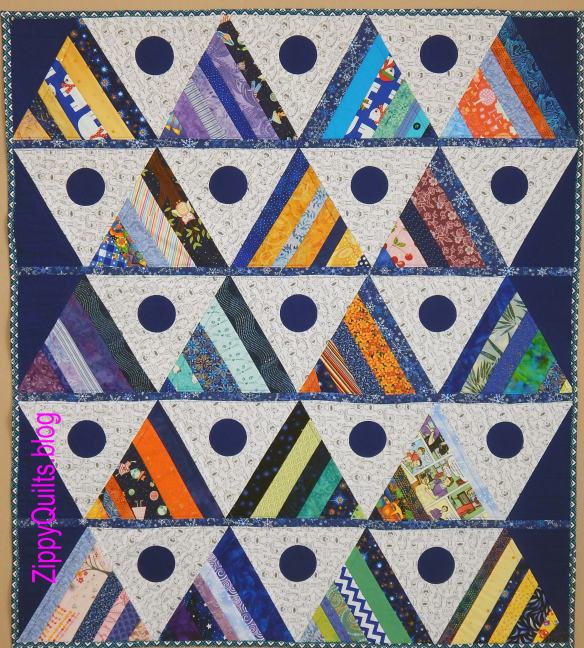
Here is the front of the finished quilt:

After joining the triangles with seams that included front, batting, and back, I covered the seams in back with fabric strips.

The result was awfully bulky.  Next time I may just settle for the “new” method that doesn’t show much quilting on the back.

Well, another lesson 😀  The next attempt will be closer to perfection!