The Rest of the Story

Here are the other two quilts I made while doing the Gwen Marston class on iQuilt.

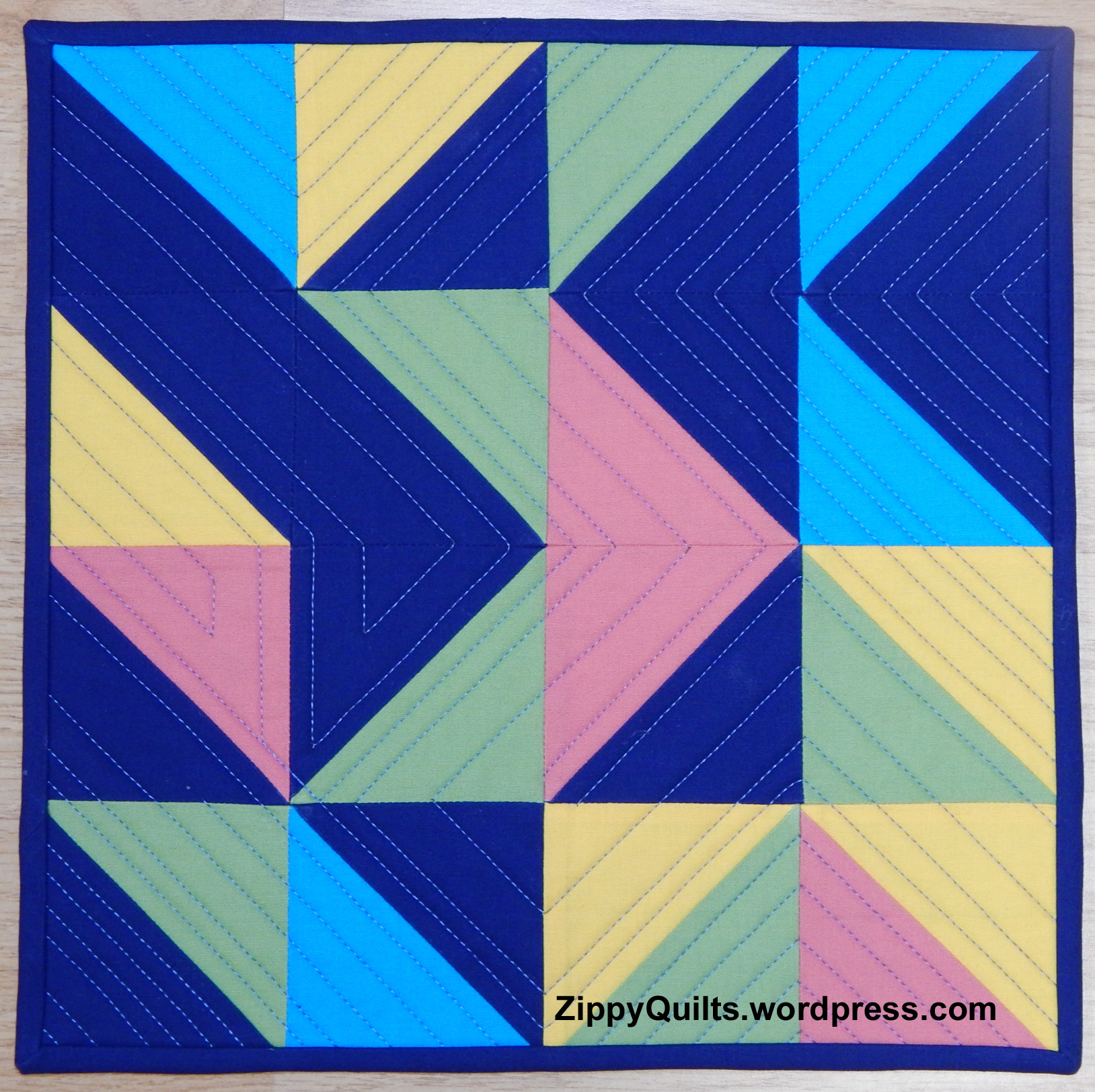
This first one is my version of one of her quilts, and again I made it 12″ x 12″.  I faced it, which I don’t usually do, so that was a learning experience.  I like the way it turned out.Gwen Marston iQuilt class

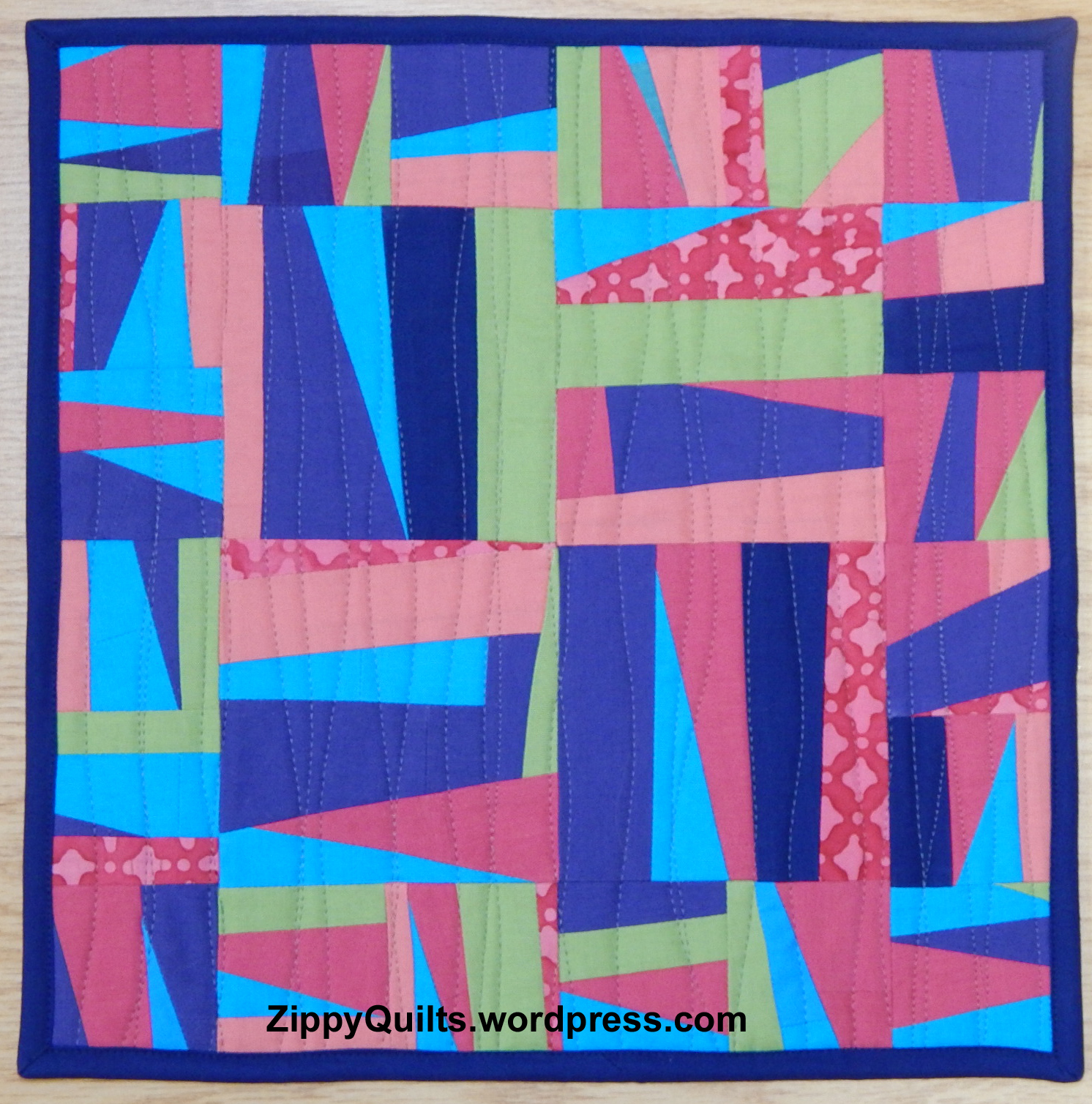
This second one was made of scraps from the other quilts in the series, which makes me happy.  Marston2

This started as a liberated Roman Stripe design, with a center of 4 larger blocks and a “border” of smaller blocks.  The size of the blocks worked out fine, but the pieces got more and more “liberated” so that I’m not sure it looks much like a Roman Stripe any more.  Which is fine, actually.

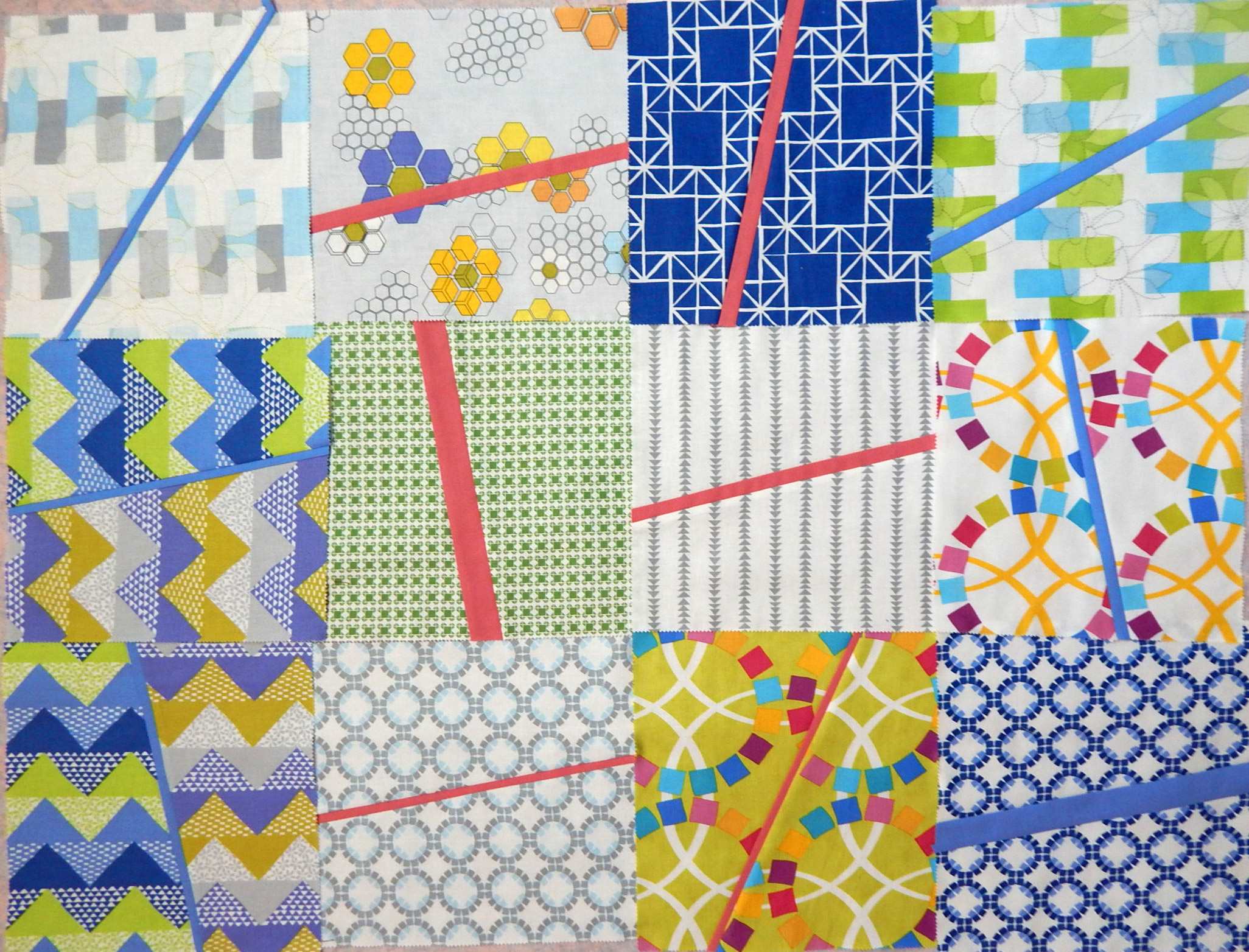
I quilted it using a pattern of wandering lines, all in one direction, and I like the result. After considering several threads, I used a thin medium grey polyester.  I think it blended well so that the quilting didn’t obscure the design.  Here’s my “trial” of several threads.Marston1

How do you choose your quilting thread for a project?

More Inspiration

I bought two of Gwen Marston’s books some time ago…

and have been channeling her in my designs for over a year (you can click on the pictures below to see their captions):

Recently I saw that the (relatively) new iQuilt platform had two video classes taught by Gwen Marston.  The class I chose was quite short–a little over 2 hours–and I decided to watch the class over a weekend and make several little quilts using her techniques.

I’d already made a refrigerator quilt in Gwen’s style for an upcoming guild challenge,

art quilt, gwen marston

Refrigerator quilt inspired by Gwen Marston. Bev Manus came up with the idea for refrigerator quilts.

so I decided to make the new quilts 12″ x 12″ as well.  This is a great size for trying new things because there isn’t too much commitment of time or materials.

The first quilt was composed of half square triangle blocks, so I was able to try out the (fairly expensive) Loc Bloc ruler I recently bought to make trimming these blocks to size easier.  The ruler worked great with just a little practice, and I got to practice my machine quilting on the finished quilt.

refrigerator quilt

Quilt Front

Gwen’s instruction was to pair the triangles up into squares just as you picked them up, with the caveat that the pairs should have contrast between the fabrics.  Then the squares were to be sewn together into rows just as they were picked up.  She did allow that it would be OK to lay the rows out and look at them before sewing them together, but advised against spending a lot of time fussing over the exact layout.

Refrigerator Quilt

Quilt Back

I was pleased with this result.  The class doesn’t really cover anything that isn’t in her books, but I was happier watching a little and sewing a little than I am to just sit down and read a book.  I made a couple of other quilts, too, and I’ll show them next week.


Fixing an Oops

I’m quilting a lap size quilt on my home machine. I’m not fond of the process, but custom quilting isn’t in my budget, so here I go. About half way through the process, I discovered a loose seam where, despite paper piecing, one seam allowance had been TOO small and the seam had opened up.  There wasn’t enough fabric to allow me to just overlap and top stitch the seam.  The edges barely met and, while one was a folded edge, the other was a raw edge.

fixing a quilt mistake

The opening was about an inch long

Luckily, I have a tool from garment sewing I used to fix it.

using stitch witchery to fix a quilting mistake

Stitch Witchery is a heat-activated glue in a strip

I used the Stitch Witchery to bond both sides of the seam to the batting.  This also stabilized the edges so they won’t fray.  Then I zig-zagged across the place.  Thank goodness it was a black-to-black seam so there’s no problem of one side of the zigzag showing on a colored block.

Fixed with minimal fuss

Fixed with minimal fuss

I’m not glad it happened, but I’m satisfied with the fix.  I will NOT be pointing it out to anyone looking at the finished quilt 🙂

Now I’m back to the quilting.  The piece is about half done.  I’ll show it to you when I finish.

Refrigerator Quilt

A very artistic quilter in one of my guilds is making a series of “refrigerator quilts” as a challenge to herself. They are 12” x 12” and intended to be displayed on her refrigerator for one week, until she finishes the next one!
The guild took her idea as the challenge for May, so I’ve been making a little refrigerator quilt myself. I took my inspiration from Gwen Marston (again) and made a bunch of little freeform stars.

art quilt, gwen marston

Refrigerator quilt inspired by Gwen Marston. Bev Manus came up with the idea for refrigerator quilts.

The best part is that, because it is small, it was made almost entirely from scraps. I had enough scraps to make all the stars different yellows and all the backgrounds different blues.
The back is a piece of fabric I dyed in a class many years ago.

hand dyed fabric

Quilt back. This was dyed with Setacolor dyes

And I used it to practice my circular quilting.
Done!

Quilt Alliance Contest

Here’s my entry for the 2016 Quilt Alliance contest, “Playing Favorites “. The design is inspired by Gwen Marston’s work, and the piece is titled “Gwen Visits the Farm”. The black fabric has animal sounds printed on it: “peep” etc.

improvisational quilt

“Gwen Visits the Farm”

The “Playing Favorites” theme of the 2016 Quilt Alliance contest is intended to capture a picture of quilting in 2016 by asking contestants to make quilts using their favorite techniques.  I love improvisational quilting, and Gwen Marston was doing it long before anyone thought of the “modern” quilt movement!

In addition to making the quilt in Gwen Marston’s improvisational style, I quilted it using decorative stitches.  I’ve used several of the decorative stitches on my machine for quilting for a long time now.  However, I recently took a Craftsy class in which Jackie Gehring suggested using even more of the decorative stitches.  I think the stitching reflects the state of the art of quilting in 2016, as well.machine quilting

I’ve been thinking for YEARS of doing a series of quilts in the styles of my favorite quilt designers, so this is the first in that series. Please stay tuned!

Layer Cake Quilt

I bought a terrific layer cake was bought a couple of years ago and it has been “waiting”, along with its solid coordinates, for inspiration to strike.

quilting storage

Future projects are stored in boxes…oops, sometimes for years! (Found a nice set of these at Costco.)

Then the other day I decided I wanted to insert strips of the coordinating colors into the squares. As you probably know, a layer cake is a stack of 10″ x 10″ squares. That means fat quarters (18″ x 22″) of solids will work well for insert strips.

I started by sorting the layer cake squares into stacks with the solids I wanted to use with them.

layer cake quilt

Layer Cake and Coordinates

Then I cut strips of various widths from the solids.The strips varied from 1″ x 18″ to 2″ x 18″, in 1/4″ increments. I cut a variety of widths from each solid color.

insert strips into quilt blocks

Strips ranging from 1″ to 2″ wide in 1/4″ increments

I had NO idea what I was going to do with these blocks once I got them modified; I just liked cutting them up and inserting strips–it takes very little to entertain some of us 😉 Then I remembered John Cage’s “prepared piano”.   So I called these “prepared fabrics”.

I did the inserts in several ways, still working on this just for fun:

When I looked at my “prepared fabrics” together, it was apparent I wasn’t going to just sew them together along the edges (for several reasons)!Retreat18

So the next step was to go to EQ (Electric Quilt, a computer program for quilt design) and make some designs:

Quilt from layer cake

Option #1. I’ve always loved concentric blocks, and alternating them like this produces a nice design easily.

modern quilt design

Option #2. Concentric blocks off-center are even better!

layer cake quilt design

Option #3. Flying geese are always a lively design element, and I just bought a special ruler for trimming!

modern quilt design

Option #4: I haven’t done anything with gentle curves for a while. These look like flags to me.

What do you think?  Anybody have a strong preference for one of these designs?  Whatever I do, I think it will be fun to see how the inserted strips turn out in the final design 🙂


Quilt of 5496 Pieces!

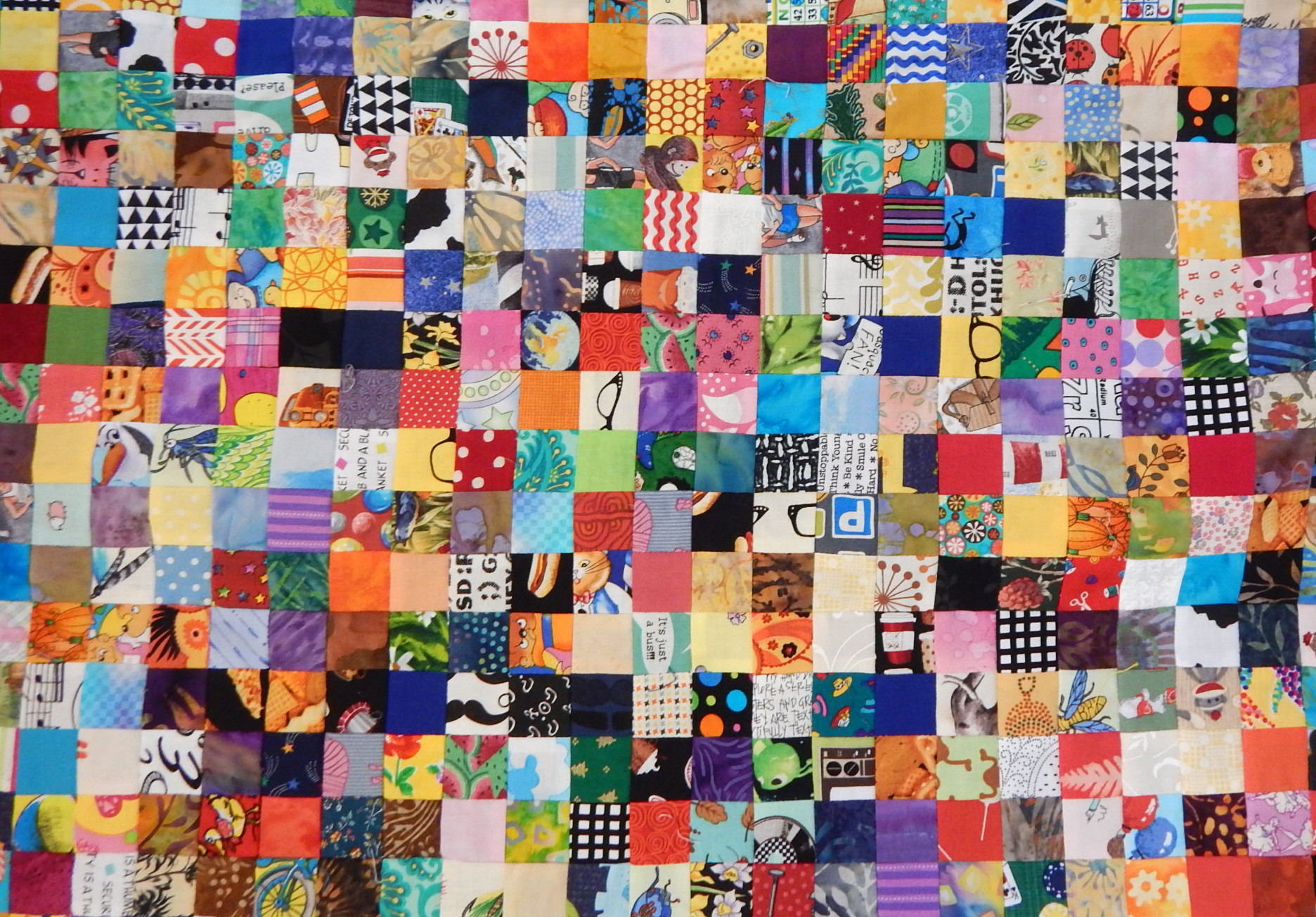
A friend who loves TINY things recently finished this postage stamp quilt of 5496 one-inch squares!!!  She will donate it to be raffled as a fundraiser at the retirement home where she works.

postage stamp quilt

Postage stamp quilt–all 1″ squares!  Made by Jerri Szlizewski

Jerri says this is “the ultimate I-Spy quilt”.  She has found many, many, little novelty prints to put in the little blocks.  She even has Elvis, though I didn’t get him in this close-up.

postage stamp quilt

A close-up showing a few of the little designs in the quilt

Here are just a few of the projects from the design walls at a recent quilt retreat at a “secret” hideaway:

slabs, quilt slabs

One retreater came up with this design to use slabs we had swapped previously

One person made several dozen of the cute half-circle napkins that fold into a Christmas tree.  She made a lot of place mats, too, but I didn’t get a picture of those.

quilt retreat

Christmas Tree Napkins

Retreat16

Working on a quilt from Scrap Quilt Sensation, by Katharine Guerrier

Here are a few more works in progress from various people:Retreat15Retreat18Retreat-4And finally, here are some of the quilts we made for Ronald McDonald House:

Only as Good as Your Last Quilt?

There’s a cynical phrase, common in professional sports, that is used often in other arenas as well: You’re only as good as your last game. It’s a commentary on public opinion. Unfortunately, there’s a corollary in our everyday judgments of ourselves.

Michael Miller Challenge 2013

This little quilt, “Packet of Posy Seeds”, did NOT win anything.

One of the modern guilds I belong to had an interesting discussion last meeting about which quilts are selected for QuiltCon, and why.  We pretty much all agreed that the show is used to further the MQG’s own definition of modern quilting rather than to reveal the depth and breadth of the modern quilt movement.

modern quilt

This little quilt was published, along with an article I wrote

So, am I a good quilter because my quilt was juried into an AQS show? Or a poor quilter because SEVERAL quilts were rejected for a QuiltCon show? A good quilter because I’ve designed quilts that were published?  Or a bad quilter because every magazine doesn’t love every one of my proposals?  There’s a temptation to feel great when a quilt wins a prize and to feel a bit down when one is rejected.  But does that make sense?

modern quilt

Happy Squares, designed and made by me. I love it, but nobody wants to publish the pattern.

Of course there are some “competitive quilters”, but most of us quilt because we enjoy it. My quilts are made to please myself, not to please other people.  Even when I make a quilt for a challenge or show, I make it the way I want it, and I expect that is true for most people.  I doubt that quilting is a road to fame and fortune for most of us, and that’s fine.

Modern Quilts Unlimited magazine

Zippy Star quilt for Modern Quilts Unlimited. I won a contest with this design.

So, if QuiltCon didn’t accept my quilt, it is NOT a personal judgment about me, it is a programmatic judgment about where the MQG folks want the definition of modern quilting to go. And if some of my quilts are published or win prizes, that’s dandy, but I still made them to suit myself.

improvisationally pieced quilt

“In Fairyland” has been in 2 shows but won no prizes.

So much of life involves following other people’s rules, sometimes for good reason and sometimes not.  Although I’m a serious quilter, I want to do it by my own rules.  I’ll still submit to shows because I like to see my quilts displayed.  But really, the quilt is an end in itself.

Spring Sun, a design by me, using blocks paper pieced from a totally different Judy Niemeyer pattern!

I designed Spring Sun using blocks paper pieced from a totally different Judy Niemeyer pattern. It was juried into an AQS show.

My friend Melanie has written a couple of posts on why we quilt.  You might enjoy them:

Make Good Art

Saturation Point

KonMari in the Studio

Because I had seen so many reviews of it, I recently read The Life-Changing Magic of Tidying Up. It is very Japanese in character: there is a right way to do everything, and KonMarifollowing the rules brings good fortune. I’m a little surprised at how much it has caught on in the West. The author, Marie Kondo, calls her method for “tidying” KonMari, a combination of her names.

I was unexpectedly convinced by reading her book that I can, indeed, get rid of a lot of my “stuff” and be happier for it!  And I thought I’d start in my studio, since that won’t involve anybody but myself.

My studio is pretty neat, with almost everything stored away.  And when I see pictures of other people’s studios, I realize that my stash is minimal by many standards!

KonMari recommends dealing with things by category, and in a strict order. There are no categories for a quilt studio, so I made my own categories and ordered them like this:
1. Fabric
2. Tools, such as rulers and scissors
3. Notions, such as thread and ric-rac
4. Published materials, such as books and patterns
5. Sewing and serging machines
6. Everything else

The method requires gathering all items of a particular category in one place. ALL must come out of their drawers, boxes, etc. Ms. Kondo says to pile it all on the floor, but you know THAT’s not happening!

studio organization, stash

Some of the stash laid out on tables–and some bins on the floor, too

The next step is to handle each piece and decide whether it gives me joy. If it does, it stays. If not, it GOES!

studio organization, stash managemengt

The stash from another angle

This may, at first, seem like a waste. After all, I paid for that fabric, washed, ironed, and stored it. But after reading the book, I believe the true waste is being weighed down by things I’m hoarding because I “might need them” or “intend to use them” in the mythical “some day”.  And really, do I want to work for hours on a quilt made with fabric I don’t love?

I’ll let you know how this first step turns out 🙂  How are you managing your stash?
Finished Tops!

After much deliberation about layout, I got my Modern Sampler quilt put together last week and sent it off to be quilted.  Here’s the final top:

modern sampler

My Modern Sampler top is ready for quilting!

Then, for good measure, I put together the batik blocks from a swap I was in several years ago and sent that top off to be quilted, as well.

batik quilt blocks

Group batik blocks, put together and ready for quilting

Yes, the sashing DOES vary a bit, because the blocks do.  That’s the way it goes with a block swap.  I love the variety of the blocks and, of course, the batik fabrics.

I’m sending this to Aunt Marti’s UFO challenge, which helps keep me motivated.  What are you up to?