Designing to Avoid Intersecting Seams

My friend Chela asked about designing to avoid intersecting seams.  The goal is to make a quilt less “fussy” to construct. Here are 3 ways to do that. Thanks for the idea, Chela!

One of the easiest ways to avoid intersecting seams is to move alternate rows over 1/2 block. This can create interesting designs that you wouldn’t have suspected if you hadn’t tried it!

My most recent example is a quilt I designed for Studio Stitch:

Lightening. Read about it in last week’s post if you like.

Of course, many traditional patterns depend on the blocks lining up exactly to create visual interest.  They might not benefit from shifting half a block!  Just look at this:

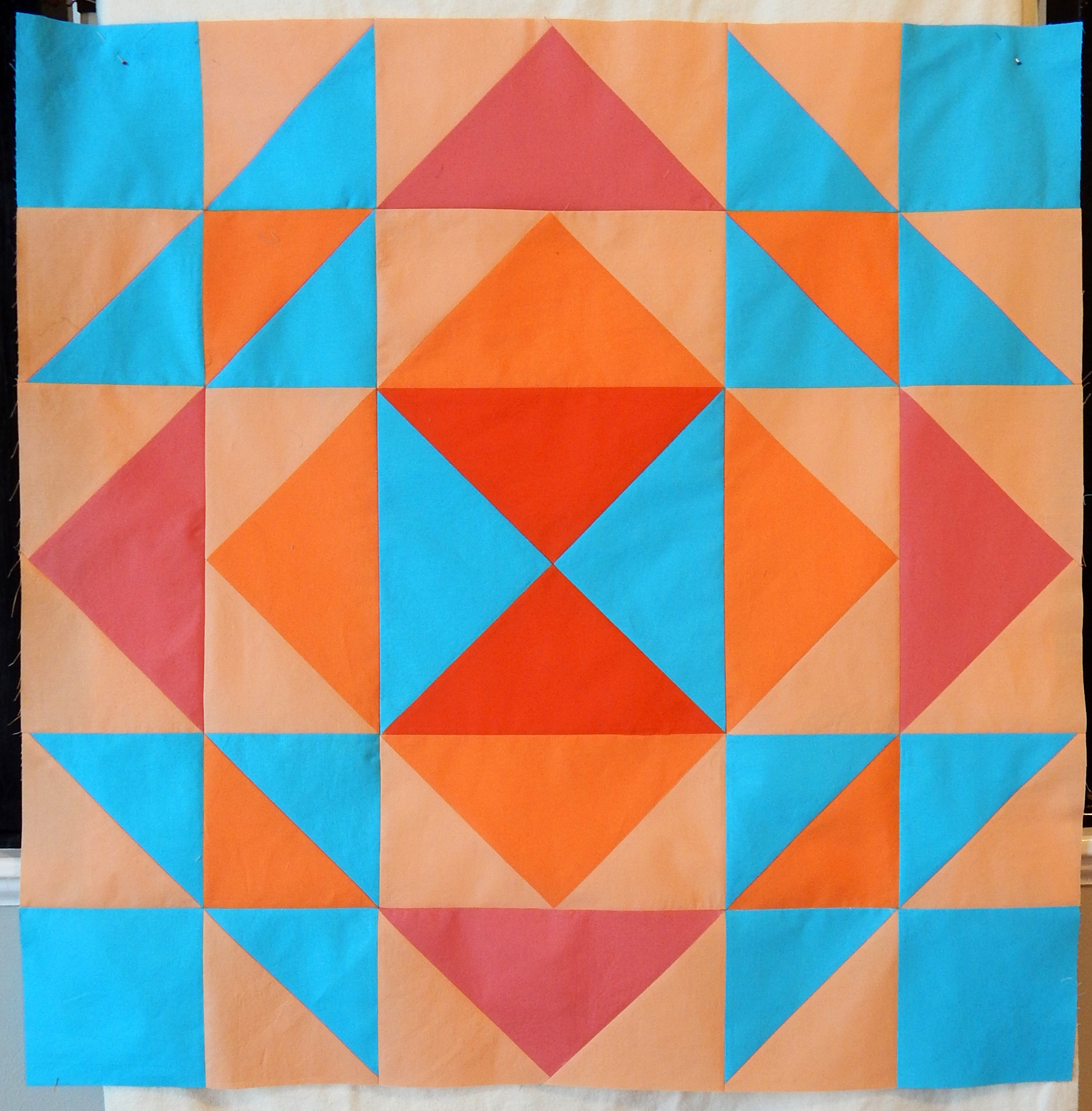
Another favorite way to avoid obvious intersections is to partially frame blocks so that they appear offset. The intersections get lost in the background and the design is much more interesting. One of my favorite examples of this is the BQ2 pattern by Maple Island Quilts. 

I taught a class with this pattern and called it “Easier Than It Looks” because it is! The design looks complex but in reality it is just a matter of framing and rotating blocks. Here’s the quilt I made as a sample for the class:

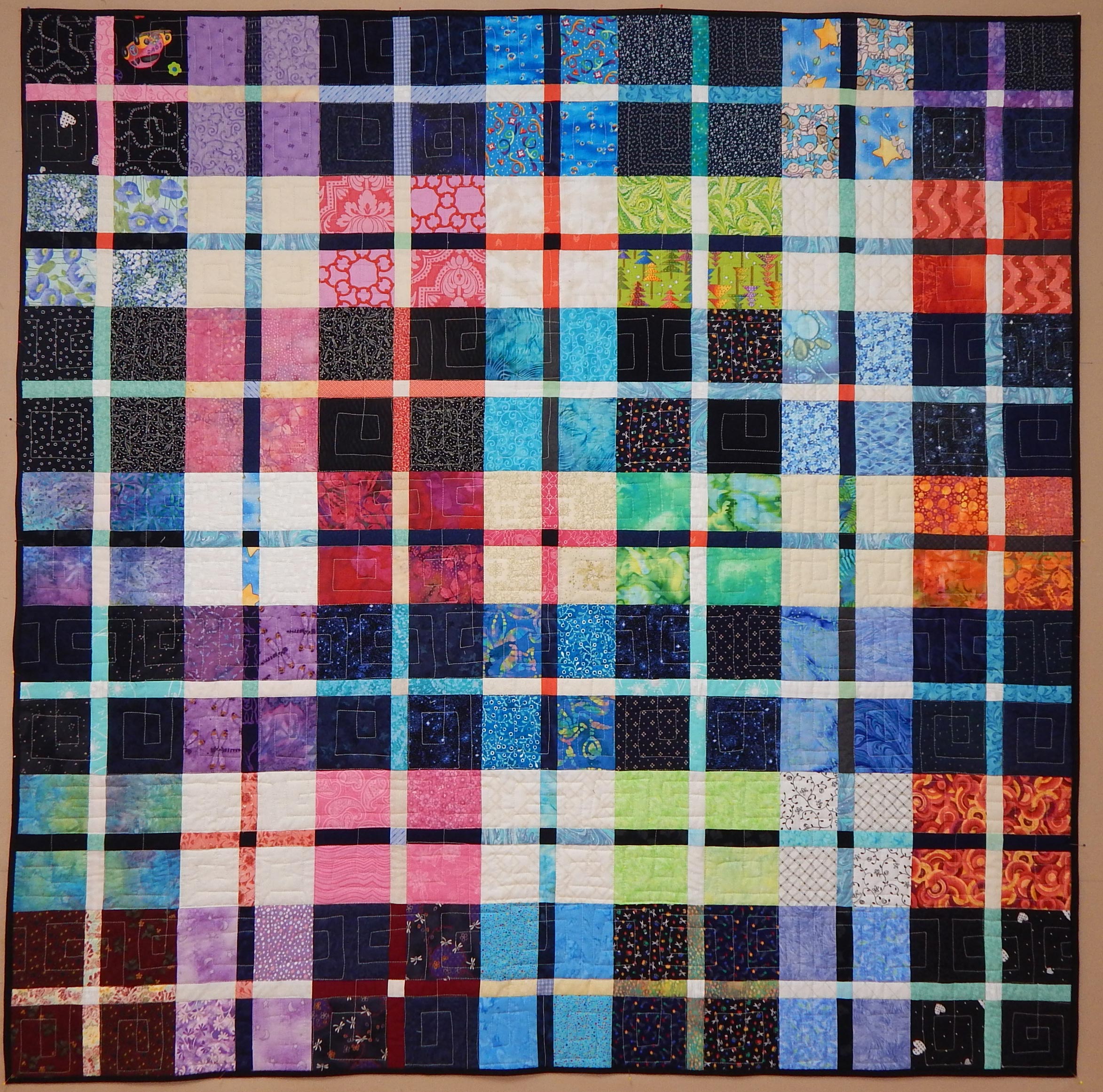
Another example of partially framed blocks is my recent “Little Jewels” quilt:

And good news!  I tracked down the origin of this design and you can find instructions for it free on this website.

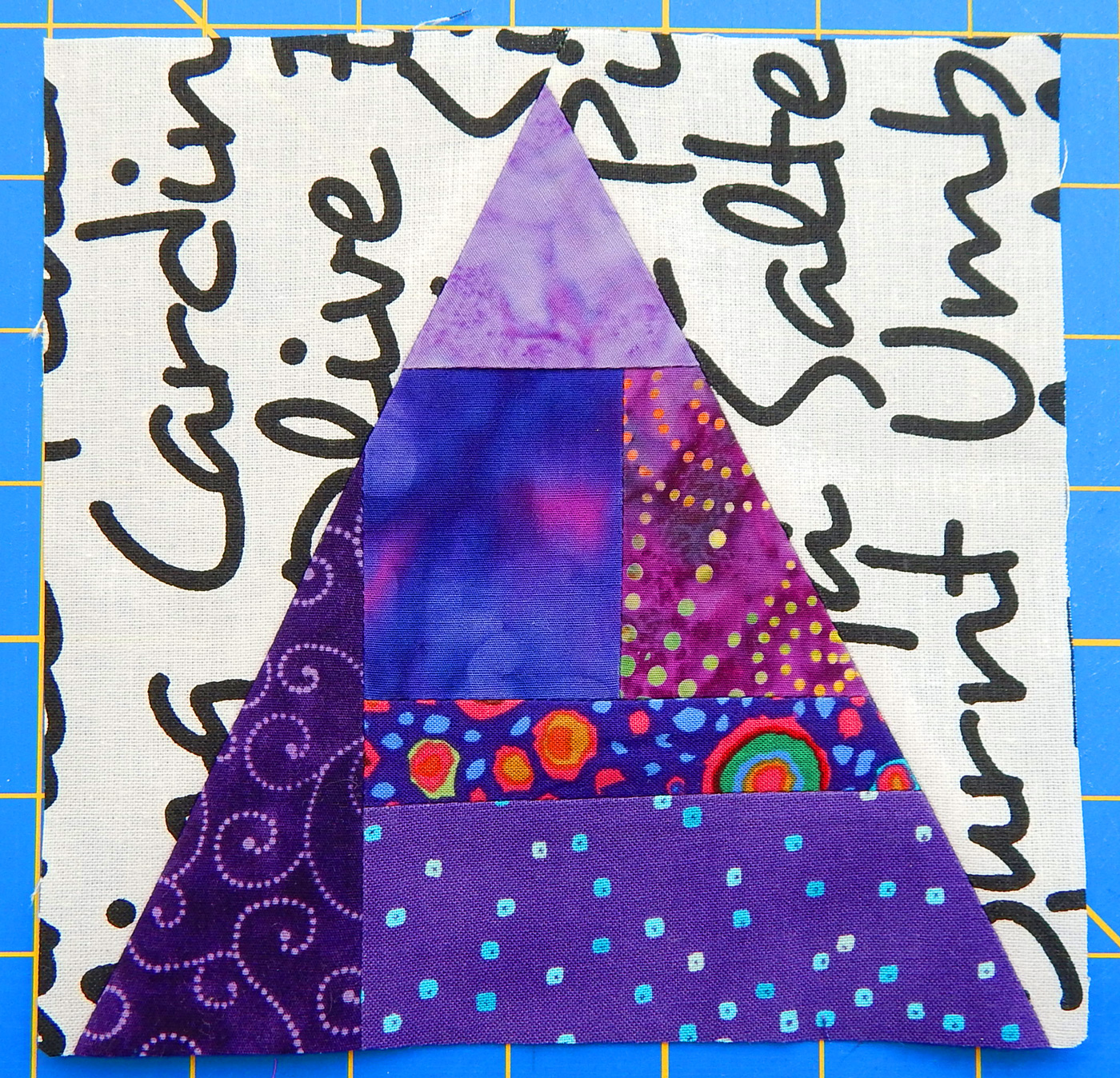
Here is an example of one block.

The “trick” is that each block is framed on two sides, making it asymmetrical.  Then alternate blocks are rotated 180 degrees so that any sense of quilt rows is lost!  Make a couple of scrap blocks and try it–it’s magic!  In truth, there are the usual intersections between blocks but the corners are almost impossible to see 😀

Finally, making blocks of different sizes certainly can be used to avoid intersecting seams. I consider this a design-as-you-go process and it does take both time and confidence, but it works well.  Here is one I made ages ago:

art quilt, gwen marston

Refrigerator quilt inspired by Gwen Marston. Bev Manus came up with the idea for refrigerator quilts.  Finished size 12″ x 12″

And here are some recent blocks up on the design wall to test a potential background fabric:

These blocks are all the same size (will finish 6″) but the sashing will be variable.  I’m setting them in vertical rows with variable distances between the rows, and variable distances between the blocks within each row!  No way will there be anything to line up 😀

Have a good week and share any tricks you have to avoid fussy intersections!

A Quilt for A Man (or anyone)

It’s sometimes difficult to think of a quilt design to make for a man, and can be even more difficult to find fabrics that don’t seem too “girly” or cute. Leaving aside the options of fabrics featuring beer labels or half naked women, I thought muted blue and brown would be a good option.

And of course, Studio Stitch had the perfect fabric collection! Here’s the quilt:

And here’s a secret:  I used flannel (the 108″ wide backing flannel) for both the batting and the backing!  As you can see, it drapes beautifully.  An added advantage was that flannel sticks to itself pretty well, so there was no trouble with layers shifting when I quilted it.

Having made it, I wrote up the pattern for Studio Stitch. They will be offering it free with purchase. I don’t know details, so if you’re interested, go to  their website  and sign up for the newsletter and they’ll let you know.  (Newsletter signup is just below the big picture on the front page).

Have a good Thanksgiving and STAY SAFE!

Little Jewels

I found a quilt like this somewhere online, and you know I love improvised scrap quilts, so I just had to make it!  (Sadly, I have lost the link, so if you know where this came from originally, please let me know.)

It’s always a great idea to offset the intersecting seams!

My quilter was able to use Minky Dot for the backing and quilt it with no batting. That makes the quilt nice and cuddly without being too heavy.

I have been informed that the grandchildren prefer the quilts backed with polyester fleece for cuddling. The lighter weight of the quilt without batting also makes it ideal for dragging around the house or building forts and tents.

Polyester fleece can be a challenge to quilt because it stretches in at least one direction. The quilter told me that a midarm or long arm quilting machine does not have feed dogs, so stretching was not a problem, though the tension was a problem at times.  I suppose I could do free motion quilting with the feed dogs down on my domestic machine, but walking foot quilting might stretch the back.

Minky backing with no batting allows the quilt to drape nicely

Quilt stats:

Name: Quilted Jewels

Pattern source: anonymous picture on internet

Finished size: 46″ x 62″

Quilted by: Julia Madison

Perfect! A Book Review

If you have something but can’t find it, do you really have it?                              –Lilo Bowman

Love Your Creative Space, by Lino Bowman, turned out to be the perfect book at the perfect time for me.. When I read the sentence quoted above, it struck a nerve!

Photo courtesy of C&T

Here’s my stash of backing fabric before:

The fabric was folded and stacked, which made it hard to see.

I’m pretty sure some of that fabric hadn’t been touched in several years because I couldn’t see it and therefore didn’t know it was there.

And here’s the after:Fabrics are rolled so I can see and pull them out easily, and they are tagged with the size!  Woo!

Lilo’s book is about both studio design and organization.  I loved every part of it, but here are some favorites:

There are ideas on organization and storage for many types of creative supplies, not just quilting things.  She has many photos from real studios to give the reader ideas.

Photo courtesy of C&T

Some of the studio photos look to me like they were done by a decorator, which I am not!  And some were very realistic-looking in my opinion!

Photo courtesy of C&T

The book also addresses ergonomic studio design, including sewing machine set-up, which I found especially helpful.

Photo courtesy of C&T

.In addition to studio ideas for “most people”, Lilo discusses adaptations that many of us will need as we age, or simply as a result of our physical limitations.  There is one especially nice chapter on how one woman adapted to being partially paralyzed after a stroke.  

This is not just a book for quilters, though I found it very helpful in my quilting studio.  There is an emphasis on making the creative space attractive “without breaking the bank”, as the subtitle says.  You can learn more about the book here.

Note:  C&T sends me lots of books and I review my favorites so you don’t have to hunt around to find the best books.  Of course, “best” is my personal opinion 😀

It Happened This Way…

A friend and I made Pat Sloan’s weekly blocks for her Going on a Picnic quilt. It gave us something to look forward to when the blocks came out each Wednesday and we enjoyed exchanging pictures of our blocks. Here’s my finished quilt top, though some of the blocks are NOT what Pat designed. If I didn’t like hers, I just made my own.

Meanwhile, my husband and I decided to lease a house for part-time use near where our grandchildren live. It’s a long story and not about quilting, so I’m not elaborating here. However, it came to mind that the house might not have window coverings. So all my quilt backs got packed to move in case we need temporary “curtains”.

And then I finished the quilt top, now known as “The Elvis Quilt”.

Elvis on The Elvis Quilt

There was no quilt back available, and I wanted to get it to the quilter before the moving van arrived. Therefore, I took all the leftover fabric from the quilt top and combined it with leftover pieces from a gray quilt back, and here it is.

It took all day to do this, with time out for packing, laundry, etc. Now I know why I buy the wide quilt backs. Anyway, a good quilt back is a done quilt back!

Hope you have a good week!

A COVID Swap

As for so many people, I have missed scheduled retreats with my usual group due to COVID. The situation appears set to drag on for a while more, so we decided on a monthly block swap to give us something to look forward to.

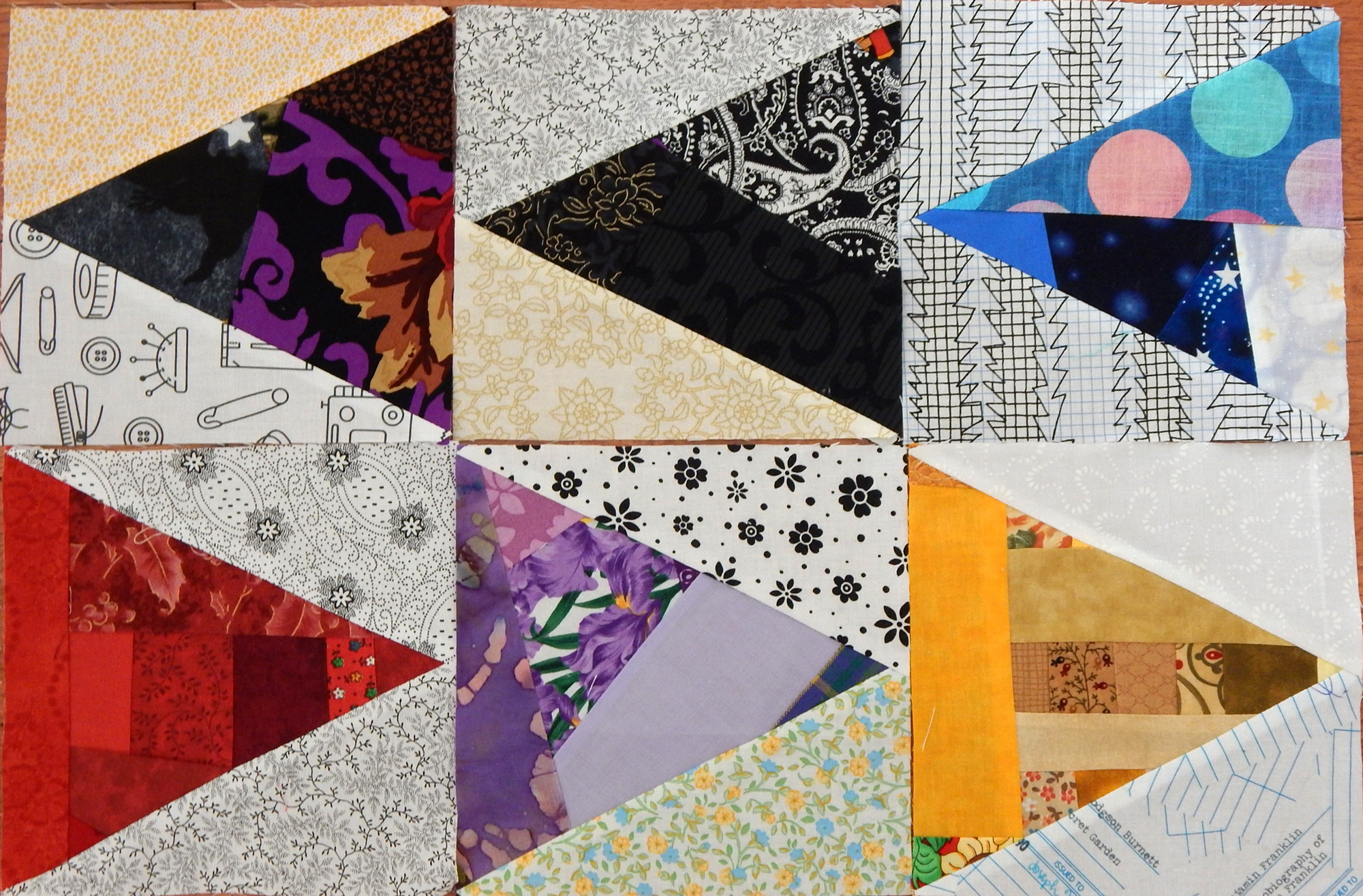
We take turns deciding what the block will be. All blocks are made from batiks and all finish 9″ square, but there are no other “rules”. Here are the blocks I’ve made or received so far.Obviously this is going to be more than one quilt. The original rule was make one block for each person each month, but mostly we’ve done 2 for each. And, as you might suspect, the most over-scheduled person in the group made 3 for each last month!

What are you doing to make up for missing your quilt group?

Have fun and stay safe.

Two Finishes with Kaffe Fabrics

As sometimes happens, I bought a fat quarter bundle of Kaffe fabrics for something else entirely but changed my mind.

If you’ve ever tried making a quilt with fabrics designed by Kaffe Fassett, you know that you have to choose the pattern verrrry carefully if you don’t want a hot mess.  The fabrics are beautiful in their own way, but they don’t play very well with traditional patterns or patterns requiring good contrast between pieces. Therefore, I found a pattern written specifically for Kaffe fabrics.

The pattern made a larger quilt than I wanted, so I sorted the blocks into Kaffe 1 and Kaffe 2.  Here’s the larger one:

Quilt Name:  Kaffe 1

Pattern Source:  Free Spirit Fabrics (see link at bottom of post)

Finished Size:  58″ x 70″

Quilted by: Julia Madison

And here’s the smaller one made with “leftovers”:

Quilt name: Kaffe 2

Pattern source:  Free Spirit Fabrics (see link below)

Finished size:  48″ x 60″

Quilted by: Julia Madison

It was fun working with those wild fabrics, and the pattern was fairly easy.  Here’s the source for the free pattern if you’re interested: Carnival of Color


Guest Blogger: Linda Reviews Rulerwork Quilting!

This is a guest post by my blogging friend Linda Hungerford (flourishingpalms.blogspot.com).Linda at her machine; photo courtesy of Linda Hungerford


This post is to review a new book published by C&T: The Ultimate Guide to Rulerwork Quilting by Amanda Murphy.

Photo courtesy of C&T

Mary invited me to review the book knowing I’m an avid domestic machine quilter who began quilting in 2000, and started quilting with rulers in 2011.

Here’s one of my first rulerwork attempts – doing a no-no by using a regular free motion quilting foot against a Fine Line brand quilting ruler.

Ruler work quilting with the WRONG machine foot!

And here’s a picture showing how it should be done 🙂

This is the Bernina #72 foot.

For ruler work quilting, a quilter should use a ruler work quilting foot with a quarter-inch heel.

Two overall observations about the book:

  • Because Amanda quilts on a Bernina (both a domestic machine and a longarm machine) the book focuses on how to rulerwork quilt on a Bernina. One page is devoted to: “What if you don’t own a Bernina?”
  • Pages 29 to 102 of the 127 pages having photos of rulers being used on a Bernina longarm.

Amanda states: 

“As a Bernina expert I am very familiar with the machines in the Bernina line, so that is what is shown here.  There are obviously a lot of other machines on the market, too.  If you have questions about any of them and their suitability for ruler work, please consult your local dealer.”

For me, currently using a Bernina 770QE for quilting, (I do not own a longarm), I was able to apply much of the information to my own Bernina experiences. She references using a stitch regulator, but those of us who quilt on a domestic machine with a stitch regulator, are unable to use the stitch regulator and a ruler work foot at the same time.

Interestingly, she mentions that rulerwork quilting is better for distributing quilting evenly across the surface because of being able to quilt in all directions:

“When you quilt with a ruler, you naturally change directions more easily than you would with a walking foot, and quilting in many directions generally ensures a squarer top than quilting in just one.”

This made me smile because Jacqui Gering, a renowned walking foot quilter with two quilting books under her belt, says precisely the opposite! According to Jacqui, there’s no need to change directions when quilting. Is it any surprise that two quilters have differing views? And doesn’t that make you feel better about how you quilt?

Amanda covers these important topics:

  • thicknesses and shapes of rulers
  • ruler work quilting table set-up
  • sewing machine settings
  • needles

I concur with these points covered in the book:

Ruler thickness is important, and which thickness ruler to buy depends on whether your machine’s ruler foot is high shank or low shank

Each sewing machine brand needs its appropriate high shank or low shank ruler work foot.

Buy a ruler you will use most often

Though Amanda mentions that different ruler brands are available, she definitely focuses on and uses her own line of Good Measure rulers made by Bernina.

Photo from the book showing one of Amanda’s rulers. Photo courtesy of C&T

Just as a quiltmaker invests in one or two most-used rotary cutting rulers, a rulerwork quilter need only invest in one or two rulers. Begin rulerwork quilting with a straight edge and/or gentle curve ruler and you’re good to go – like the Good Measure straight edge/curved edge ruler (shown in the book), or Westalee straight edge/curved edge ruler (shown below).

These are some of the brands of rulers I’ve accumulated in the past nine years, with Fine Line rulers being the ones I use most often… probably because that’s the brand I started with. I don’t own any Good Measure brand rulers.

Photo by Linda Hungerford

My ruler photo includes a picture of a roll of skateboard grip – a sort of sandpaper that’s grittier than sandpaper with an adhesive back. It’s the best product I’ve found for the bottom of the ruler, to make it “stick” to fabric while quilting. Amanda suggests putting blue painter’s tape or Stable Tape (by Westalee) on the bottom of the ruler.

A bit about Fine Line rulers… They’re different – made with two vertical posts to “hang onto” when quilting (see first blog picture). However, after buying a sewing machine with the dual feed feature, I quickly learned that these ruler posts bump into the dual feed! I can’t use the ruler on the back of the ruler foot, so that’s something to keep in mind when considering a Fine Line brand ruler.

Fine Line ruler posts bump into dual feed mechanism

Amanda mentions Bernina’s echo clips, something I frequently use, though the brand I own is made by Westalee. Each slips on/off the ruler foot, and has different spacing, so you can choose how far away to quilt from the previous line of quilting. It’s well worth $10 for the Westalee set!

Westalee Echo Clips

Set-up is important: have a flat work surface with a means for easy quilt gliding

Amanda recommends the Sew Steady table, and that’s exactly what I have. Top it with a Supreme Slider (or a Queen Supreme if you have a large machine harp), and you’re good.

Here’s my quilting set-up contrived by placing two hollow-core doors across four IKEA adjustable-height Finnvard trestles.Amanda mentions wearing quilting gloves for rulerwork quilting. Personally, I prefer rubbing Neutrogena original formula hand cream on my hands, and then donning a pair of Marcia Baraldi Quilting Grip Gloves. It’s the perfect combo because my fingertips are  “grippy” and yet free to grab threads, tie knots, and even change a bobbin! (Neutrogena hand cream won’t harm your quilt.)

Although I have my favorite methods for rulerwork quilting, I also learned a thing or two in the book. The tip that meant the most to me is this one…

“Machine baste all the way around the sandwich through all layers, about 1/8″ from the edge of the quilt top.”

I’ve heard of taking a final “lap” around the outside of a quilt top, but I’d never heard of stitching around the perimeter of a basted quilt sandwich. I tried this on my latest quilt finish, my “Hole Punch Ribbon” quilt, and it worked to help keep my quilt “on the square!”  I blogged about this quilt here.

Amanda concludes the book with 31 pages of colorful quilt examples, showing different quilting designs on real quilts including quilt-as-you-go; followed by 14 pages about domestic machine quilting and troubleshooting; and 10 pages on longarm quilting and troubleshooting.

One of Amanda’s pretty examples from the book  Photo courtesy of C&T

All in all, this book is a good resource for a thorough introduction to rulerwork quilting, and is especially worthwhile if the quilter quilts on a Bernina. Then, it’s a must-buy!

Linda


Project Planner!

So, here’s the new Quilter’s Project Planner, which I’ve already started using!

Photo courtesy of C&T

I love paper planners generally and was already planning to do a post about this one, then my friends at C&T invited me to take part in this Social Media Tour.  Woo!  Be sure to check at the end of the post for other blogs on the tour and for a chance to win your own copy of the planner.

Yes, it’s formatted to start in January (holiday hint for someone?), but I don’t see why I can’t start in September and go through August of 2021.

Ha! Fixed to suit me!

I’ve decided to use the planner for my own designs.  And yes, I design at least one quilt a month, I just choose not to sell patterns.  You get to see all the quilts here eventually, and some of the patterns are done for Studio Stitch to give away, so there are sources if you want to make my quilts.

The planner includes the kind of features you’d expect but without the bulk of some of the other quilting planners I’ve tried.  There are pages for planning individual projects as well as pages for quiilting goals, etc.

Photo courtesy of C&T

I’ve already started the project for September and filled out part of the pages.  (The quilt shown isn’t the real thing, but my preliminary drawing from EQ8.)

Here are the other blogs on the tour for you to visit:

9/9 C&T Publishing kickoff ctpub.com/blog/
9/10 Terificreations- Teri Lucas terificreations.com
9/11 Quiltville- Bonnie Hunter quiltville.blogspot.com
9/12 Quilt Fabrication- Susan Arnold quiltfabrication.com
9/13 Zippy Quilts- Mary Puckett zippyquilts.blog/
9/14 Lilo Bowman lilobowman.com/
9/15 SewVeryEasy – Laura Coia youtube.com/sewveryeasy
9/16 Slice of Pi- Laura Piland sliceofpiquilts.com/
9/17 C&T Publishing ctpub.com/blog/

And if you’d like a chance to win a copy of the planner, leave a comment and include your email.  My husband will draw a winner after the blog hop ends on September 17, so you must enter before midnight on September 17 to be considered.  C&T will contact the winner by email to get an address for sending the planner. Sorry, but U.S. addresses only.

Image courtesy of C&T

As always, please note:  C&T provides books to me for review, but I only blog about my favorites.  Links in my blog are NOT affiliate links; they are for your convenience but do not provide income to me.


For a Good Time…and OMG

For a good time, see if you can visit your local quilt shop! I was able to visit Studio Stitch last week because they are observing strict social distancing and mask guidelines, including limiting the number of people in the shop at a time. It was SO MUCH FUN to get to shop for fabric after being quarantined for 6 months!  I appreciate the care the staff are taking to try to keep everyone safe.

I should mention that I also checked the public health report and noted that COVID was trending down in Greensboro before going there.

Here’s the haul from one visit to the shop:Yes, the gray and white fabrics are metallic! And the fat quarter at the far right just jumped into my basket while my other fabric was being cut.  (Not my fault!!)

Which leads me to the OMG part.  For the first time, I am joining the One Monthly Goal challenge.  I’ve seen several blogging friends doing this for quite some time but haven’t joined up.  So, here is my OMG for September:

In September my goal is to make a quilt from these fabrics and write a pattern for that quilt.

These lovelies are from Studio Stitch, too

The pattern will be available through Studio Stitch when I finish it.  If you subscribe to their free newsletter (subscription form is about half way down their home page) you will see a picture and information on getting the pattern when the time comes. And of course I’ll show the quilt here when it’s finished!

That’s all the excitement for now.  Has anybody else been able to visit a shop in person with precautions in place?  Thanks for reading, and stay safe!