Unknown's avatar

About zippyquilts

I quilt for pleasure but I also teach and write about quilting.

A Few Favorites

I’ve been thinking about what inspires my quilt designs, and the first thing that came to mind was the beautiful or fun or amazing quilts I see at shows, guild meetings, retreats, wherever.  Here are a few of my favorite quilts for inspiration.

I love the variety of bright colors and the tiny pieces in this one:

Retreat-17

Quilt made by Jerri from TINY pieces of Liberty of London fabric

And this is a favorite because of the bright colors and eccentric design:

Cinco de Mayo, made by Renny Jaeger; pattern by Karen K Stone

This unusual design appeals to me:

Rena was given a circle cutter at the last retreat, and she went wild!

Pamela Wiley’s excellent workmanship and eye-popping designs make her quilts among my favorites:

art quilt, Pamela Wiley quilt

Outside In by Pamela Wiley

I like the use of color in this next one, as well as the movement generated by the curved piecing and curved quilting:

AQS Paducah

In the Marsh #2, by Carol Bryer Fallert-Gentry

And this one reminds me of Maine, where we lived for a while:

art quilt

Coves and Islands by Carol Anne Grotian

What inspires your designs?

Building A Better Pincushion

My modern guild loves dirty Santa games and loves pincushions, so a recent challenge involved making a pincushion to swap.  I found a nice cup and saucer at a thrift store and decided to make that into a pincushion.pincushion tutorial

I previously researched tutorials for making pincushions and learned that ground English walnut shells are one of the best types of stuffing for them.  The shells are heavy (dense) enough to keep the pincushion from coming up with the pin you are trying to remove from it, and they are ground fine enough to allow pins to be stuck in easily.  Ground walnut shells are available in pet stores, where folks apparently think I want them for my pet lizard to use as desert sand.  (They’re mistaken about that, but I bought the ground walnut shells anyway.)what to fill a pincushion with, pincushion filling

The problem was how to get the walnut shells firmly packed into a nice round ball that would fit smoothly into the cup.  I solved that problem by rescuing a discarded athletic sock from the trash, which is why there’s a sock in the picture of the cup above!

I cut off the toe of the sock, stuffed it with ground walnut shells, and closed it tightly with a rubber band.how to make a pincushion

I patted the filled sock into shape so that it fit nicely in the cup.easy pincushion instructions

Then I cut a circle of fabric and gathered the edge with a long machine stitch.better pincushion tutorial

After drawing up the edge of the circle as much as I could around the base of the sock, I finished drawing it tight by adding another rubber band.make a pincushion in a teacup

And before you ask, the size of the circle was a guess–I just used the largest circle on my circle cutting template.

Finally, I stuffed the whole thing into the cup, rubber band side down.  It was heavy enough and fit tightly enough that it did not need to be glued in.  I did glue the cup to the saucer, however.teacup pincushion tutorial

And that was it!  So easy and so fun!


The Condom Quilt Goes Home

In case you haven’t been reading my blog long enough to know about the condom quilt, here is a brief summary:

  • A couple of years ago I wanted to make a quilt from a QR code in such a way that the entire quilt top could be scanned to open the target website. Since I was going to be putting in a lot of effort, I wanted a QR code that had some meaning for me.
  • At that time I was working in public health, spending much of each day helping patients cope with various problems that might have been prevented by appropriate use of condoms.
  • When I looked for a condom-related QR code, I found that Planned Parenthood of the Great Northwest and Hawaiian Islands (PPGNW) had developed a QR code to be placed on their condom packages. Scanning the code linked to PPGNW’s “Where Did You Wear It?” site.  The goal was to encourage safer sex through condom use.

PPGNW graciously agreed to let me use their QR code in my design.  I colorized their code and made my quilt, checking after construction of each section to be sure the whole thing still scanned correctly.

Asheville Quilt Show

This is the finished quilt. That tiny embedded QR code leads to my blog.

I showed the quilt anywhere I could.  (It isn’t just younger people who need safer sex.)  That included guilds, quilt shows, and the folks in my office.  After a year of showing it to anybody who would listen, I donated the quilt to PPGNW to be used in any way they wish.

I was very pleased recently to receive this picture of the PPGNW management staff with the quilt.  That funny looking guy is their condom mascot.

The folks at PPGNW report that the quilt has sparked discussion, especially about the interaction of traditional crafts and technology.  I enjoyed this quilt from start to finish and I’m glad it is now in its home.

Fun Teaching Projects

Last Saturday I taught my “secret valentine” pillow at Studio Stitch in Greensboro (NC).  Here are a few pictures of the finished pillow covers with their proud makers.

I’ll be teaching Yow again this spring, this time at A Stitch in Time in Franklin, NC.  The class is scheduled for Friday, April 6.  This is a lively quilt, and I teach three different ways to piece a curve perfectly.

What have you been up to?

Gypsy Wife Adopted

The Gypsy Wife quilt is quilted, and bound, and ready to go to its “forever home”, as our daughter calls it when one of the animals she fosters is adopted.Gypsy Wife quilt

I recently read a post listing pictures we supposedly should take of every quilt, and thought “not”. I think Rita, at Red Pepper Quilts, does one of the best jobs anywhere on her photos and posts about her quilts. She includes enough pictures for me to get a good idea of the quilt. Even better, she lists “statistics” about each quilt at the end of the post. So here’s my attempt:

First, a picture showing the back and giving a closer view of the binding:Binding gypsy wife quilt

Then, a picture of my favorite block. OK, that wasn’t Rita’s idea, but I like it 🙂

A picture showing the quilting:

Gypsy Wife Quilt

Pattern:  Gypsy Wife by Jen Kingwell, with several modifications by me

Fabric: Just A Speck collection by Jen Kingwell,

Moda Grunge in various colors

And a few others

Finished Size:  61” x 66”

OK, did any of those pictures or details add to your experience of the quilt?

With a little help from my friends…

One of the things I love about blogging is hearing from people who comment and share their ideas.  Here are a couple of ideas that I thought you might enjoy, too.

When I blogged about some household items that are useful for quilting, Peggy commented that she cuts up her old calendars and uses the numbers to label her blocks and rows.

It was the perfect time of year for that handy hint, so I promptly cut up an old calendar. The numbers worked great for labeling pieces for a complex project. I clipped them to groups of fabric for the various sections of the quilt using binder clips–an idea I got from Judy Niemeyer’s class years ago.

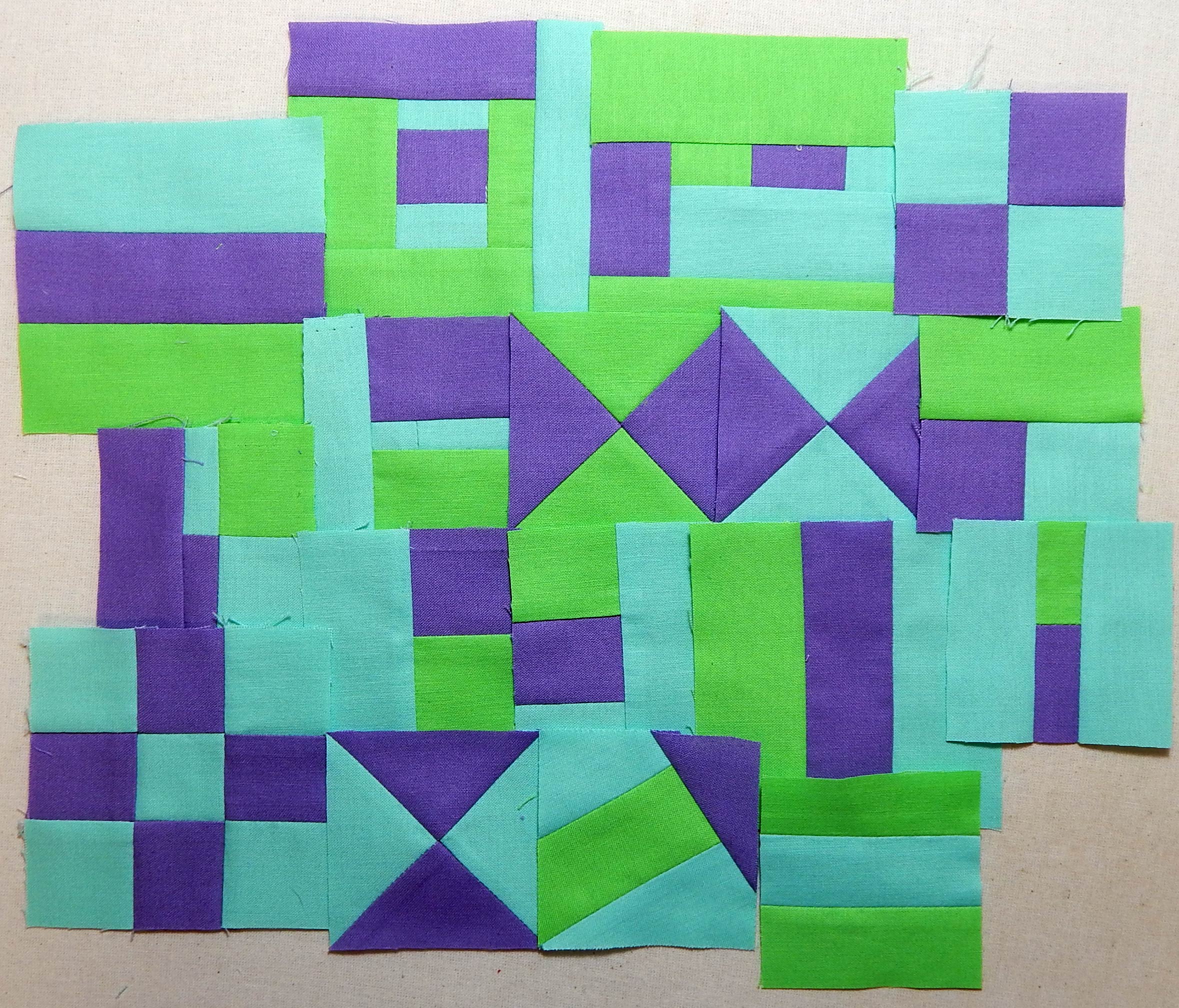
Another friend, Claire, responded to my post on making single-color slabs by asking what I do with fabric that is a mixture such that no one color predominates.  I had been cutting out sections based on the predominant color, and that seemed to work.  But…

When I came to this piece, I realized I had NO desire to cut out chunks small enough to be mainly one color.  Then I started looking and saw that I had a number of prints from which I would NEVER be able to cut single-color pieces of any size.quilt slab, slab block, quilt block, modern block

So I made a block of multi-color pieces.  It is pretty wild, but so were some of the fabrics that went into it.  I’ll see how it looks with the single-color blocks when I assemble a quilt.  What do you think?  Make more of these or give up on the truly multicolored fabrics for slabs?


A Little Break for Fun

After finishing a big project and preparing classes for the next quarter, I took a little break and used some of the scraps from the unsorted pile.  This is where scraps go before I cut them into the standard sizes I use for storage.scrap block, slabs, scrap quilt

Cheryl Arkison, who blogs at Dining Room Empire, calls this type of block a slab. Of course the idea of joining scraps as you find them has been used by many people in various ways.  I really enjoy making them in a single color, so I made a few when I had a minute.slabs, scrap blocks, scrap quilt

Of course, this didn’t make a dent in the scrap pile, but it was fun!  Has anybody out there found a way to make a real dent in the scrap pile?  It seems to me to grow and grow, with no decrease in size no matter how many scrap quilts I make!

Classes Coming Up

I’ll be teaching two classes at Studio Stitch in Greensboro, NC, this coming quarter.

First is a “Secret Message Pillow”. Go by the shop to see the sample and sign up!  That class will be the morning of Saturday, January 27, which means the pillow will be finished in time for Valentine’s Day.

scrap quilt

Scrap quilt made with strips that finish 1″ wide

Second, I’m teaching a scrap management class that will show several ways to use even small scraps to make beautiful quilts. I call it scrap management because that’s what most of us need: management of the scraps. One option is shown above.  That class will be March 24 and we will have all day to play with our scraps.

All you need to bring is the basket (dump truck load?) of scraps that have been accumulating in your studio.  Sign up at the shop and come have fun!

An Unfortunate Event

But luckily just the one, not a series.  Here goes…

I’ve said before that I enjoy Pinterest and I use it to save everything from quilt ideas to recipes.  I mostly ignore the ads, though I do note that they somehow have me pegged as needing plus size clothing, which is not the case, thanks!

I know there’s a lot of “profiling” going on at Pinterest as well as most other sites, but usually I don’t worry about it.  However: I recently found an idea I thought I’d blog about, so I started a Pinterest board labelled “blog”.

Oh. my. goodness.  Pinterest immediately sent me a bunch of suggested pins concerning how to “improve” my blog.  The first one I clicked on led to an obviously fake blog post (meaning this person doesn’t really have a blog, she’s just a front for an advertisement).  That was bad enough, but the product advertised is designed to “spam” Pinterest for you by posting your stuff several times a day with “no effort” on your part.  This is supposed to drive traffic to your blog, and it probably does.

Now I wonder how many people are using the strategy of spamming Pinterest to have their stuff put in front of me looking like a genuine pin, when really it is an ad?  I’m always cautious online, but this is ridiculous.

You’ve been warned.  And I’ll go back to blogging nice pictures of quilts next week.

Anybody had a similar experience with Pinterest?

Favorite Quilt Tools 2017

There are lots of great tools on the market these days to make quilting easier.  Here are my three favorites of 2017.

(As always, please note that I receive no payment or product in exchange for these recommendations, and the links are provided only for your convenience.  I do not profit in any way from these opinions.)

Matilda’s Own rotating cutting mat.  I’ve actually had this for several years, since trying it at a retreat.  It’s great for trimming blocks because you just rotate the mat without having to move the block. The picture here is from Nancy’s Notions, where I found one of the best prices on this admittedly-expensive item.

rotary cutter review

Photo from Connecting Threads catalog

The Martelli ErgoCutter.  I’ve written before about how handy this item is.  After I cut off a piece of a finger with an ordinary rotary cutter a couple of years ago, it seemed worth looking for something safer.  I was not happy with the cutters that run on a groove along the ruler, so I kept looking until I found this item.

This cutter is, as the name suggests, designed for more ergonomically correct cutting, resulting in less strain on the hand and wrist.  And, because it is guided by the index finger over the front of the blade, it is less likely to get away from me.  It comes in right- and left-handed versions.  My only complaint is that the blade is slightly more difficult to change than in a traditional rotary cutter.

The Tucker Trimmer I.  I am not a big fan of buying every ruler on the market, but after seeing a friend using this one, I was sold.  It makes construction of accurate half square triangles, combination blocks, and hourglass blocks easy.  I use it with the rotating cutting mat to trim down these blocks, and it is a winner.

What are your favorite tools?