Pantone Challenge

You’re getting this blog early because of the deadline for the Pantone Challenge.  I’ll be back to my regular schedule on Sunday, March 30.

The Quilt Alliance’s TWENTY challenge was so much fun last year that when I heard about the Pantone Radiant Orchid Challenge I decided to enter

Applique quilt

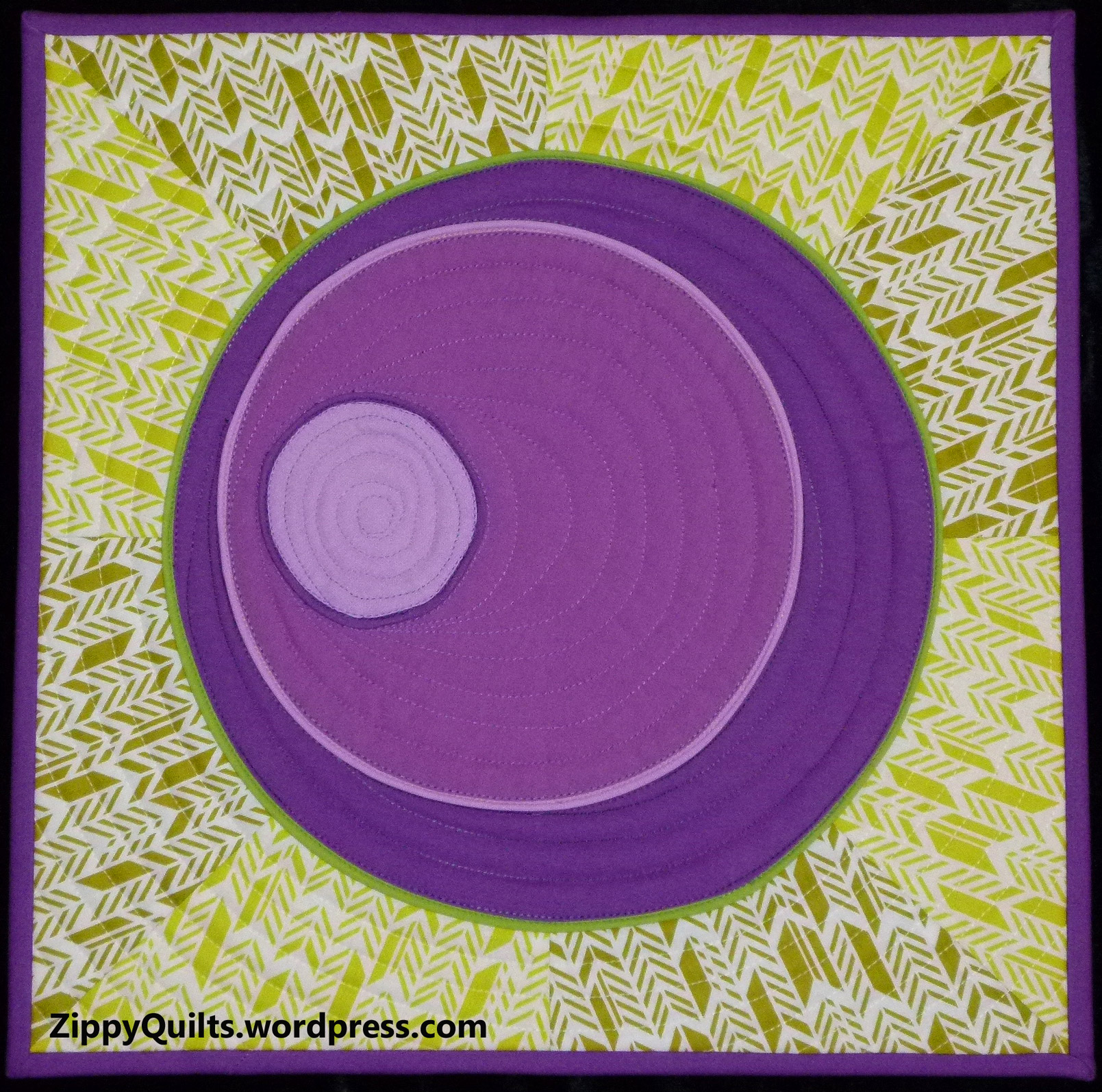
Radiating Orchid mini-quilt for the Radiant Orchid Challenge, 15″ x 15″

This challenge is via link-up with one of the two sponsoring blogs, On the Windy Side and Play Crafts.  You can go to either blog to see the other entries and get details.

Luckily I had a pretty orchid color FQ (fat quarter) in a collection of modern solids (came from my smart son-in-law at Christmas!).  And I took a piping class with Susan K Cleveland a few years ago where I learned to make little bitty piping.  I’d already gotten the Alison Glass green fabric to go with the modern solids, so I was ready to roll!

Using piping to help turn under the edge is one of my favorite ways to applique circles, and I wanted a little extra definition for the edges.  I had to make templates (yikes!) to cut the green and, naturally, the print turned out to be directional so I had to be careful how I cut it (double yikes!).

As always, I learned several things making this project.  Using templates wasn’t so bad; I made them from freezer paper & ironed them onto the fabric for cutting.  And Susan’s method for joining the ends of the piping worked perfectly so you can’t tell where it begins and ends as it circles the shapes.  So, it was fun and now it’s done!  😉  Have a good week!

3 Lessons from an Older Quilt

I recently got to borrow a quilt I made for our daughter when she left for college 12 years ago, and I learned several things from looking it over.

patchwork quilt

The Cheerful Child Quilt

First, it was much softer than when I made it.  This is notable because when I gave it to her, she wondered, “When will it be soft like Granny’s?”  Many of the quilts she grew up with were made by my grandmother (her great-grandmother).  Those quilts, made from the 1930s through the 1950s, were soft by the time our daughter slept under them in the 1990s.  She was happy to get the quilt but was disappointed with the stiffness of new fabric.  Having learned that lesson, I subsequently backed quilts for her with minky, which is very soft from Day 1.

patchwork quilt

“Punch bugs” were popular cars when our daughter was in high school

Second, some fabrics have held up better than others, and the price of the fabric does NOT seem to be as important as other factors.  Pastels have not held their brightness well over time, and “sparkles” on some of the fabrics have worn off.  On the other hand, the car and child prints in the photo at left were inexpensive novelty prints but have held up well.

Third, and most gratifying, my work has kept the quilt intact.  There are no ripped seams, loose binding, or quilting that has come undone.  I pieced this quilt on my old faithful Bernina and quilted free-motion stars on the same machine.  (That’s when I learned that sending a quilt to a longarm quilter is worth every penny–my shoulders ached for days!)  I backed it with a sheet, which was my practice for years despite all the dire threats that sheets are inappropriate for quilt backing, and that worked out fine.

My quilting style has changed a lot since I made this quilt, and I certainly am much more technically adept now.  It was great to see that an earlier quilt has survived our daughter’s college and young adulthood intact, even if it isn’t as bright as it once was.

Stick your neck out with me!

New-Sue-2OK, folks, you may recall that I made a donation quilt for the Quilt Alliance last year BEFORE I realized that most of the other quilters were WAY better known than I am!  It turned out pretty well, because the ladies who won first place were local and not all that famous (at least until they won)!  And my quilt did sell in the auction, so it’s all good.

IT’S THAT TIME AGAIN!  The Quilt Alliance has just announced the 2014 contest, and I hope you’ll consider making a quilt for them.  You can see the contest announcement and a link to the rules on the Quilt Alliance website. (You can see last year’s donation quilts here–mine is #29 if you’re interested.)  The theme this year is “Inspired by” and your entry must be inspired by one of the quilts in the Alliance’s Quilt Index or their Quilters’ S.O.S.- Save Our Stories (Q.S.O.S.) project.

I already have my project in mind and here’s a hint:  it’s based on Sunbonnet Sue.  I searched the QSOS project files for Asheville, since that’s the nearest town of any size, and one of the first quilts I saw was a Sunbonnet Sue–you can see it if you click the link but I think it would be a copyright violation for me to reproduce it here.  I was immediately drawn to it because I have a Sunbonnet Sue quilt made by my Grandmother (Mary Lee Ownbey Kimsey, who lived in Asheville) and it hangs in my studio much of the time.

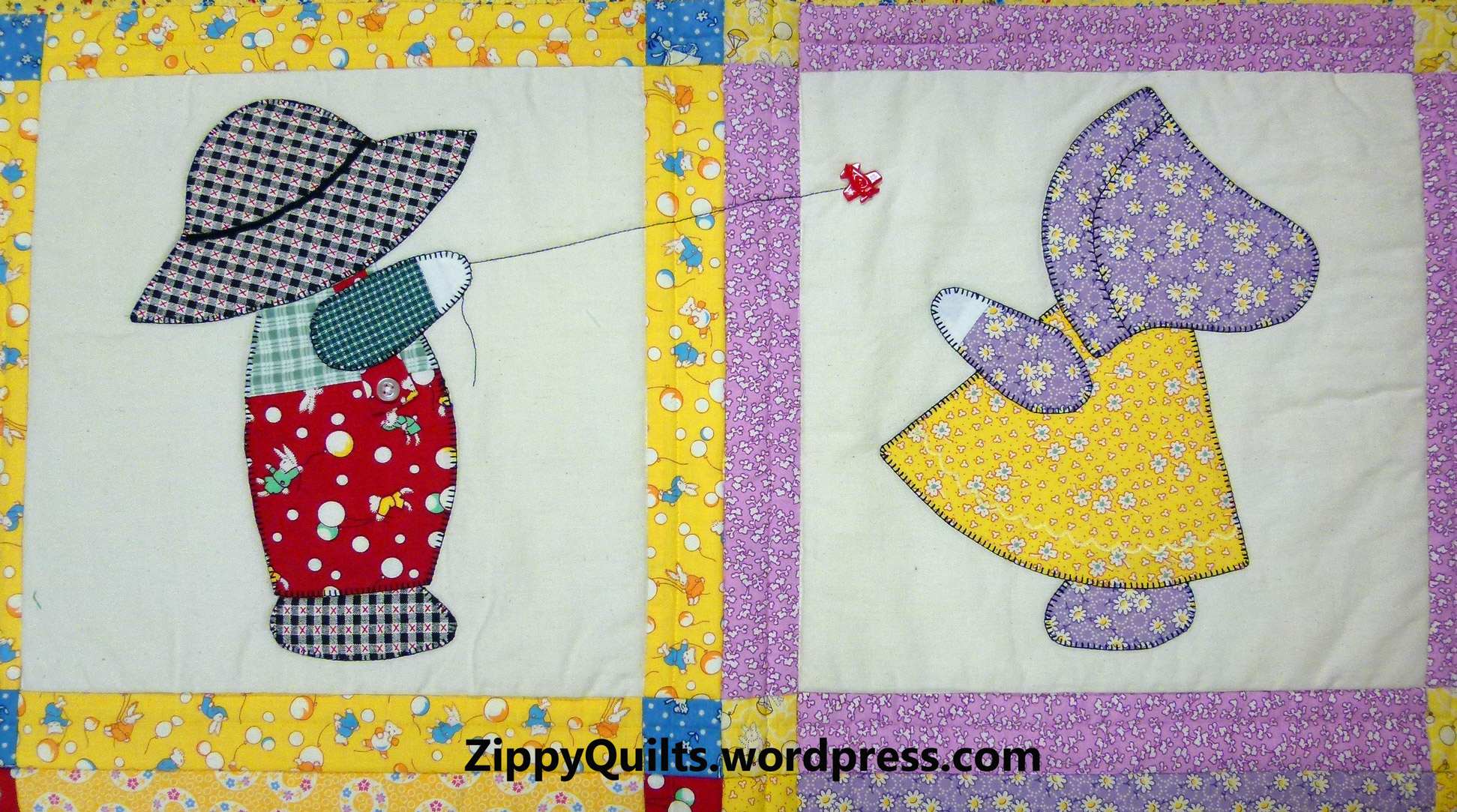
I also made Eleanor Burns’ Sunbonnet Sue and Overall Sam a few years ago; that is the quilt at the top of this post.  The contest quilt is going to be “inspired by” Sunbonnet Sue, but you’d have to know Sue to “get it”.  You’ll see later!

Sunbonnet Sue

Sunbonnet Sue by my Grandmother

Meanwhile, come on:  STICK OUT YOUR NECK WITH ME!  Even if you’ve never entered a contest, I’m pretty sure you regularly make donation quilts.  Design a donation quilt and send it in to the Quilt Alliance Contest. Here are the TOP 3 REASONS to make a quilt for this contest:

1.  DO SOMETHING NEW!  TAKE A RISK!  If I can do it, you can do it.

2.  You’ll have to spend time browsing the Quilt Index or the Q.S.O.S.–either could be hours of fun!

3.  It’s just a LITTLE quilt–16 x 16 this year!  Just do it!  Here’s the link again: Quilt Alliance

My friend is famous!

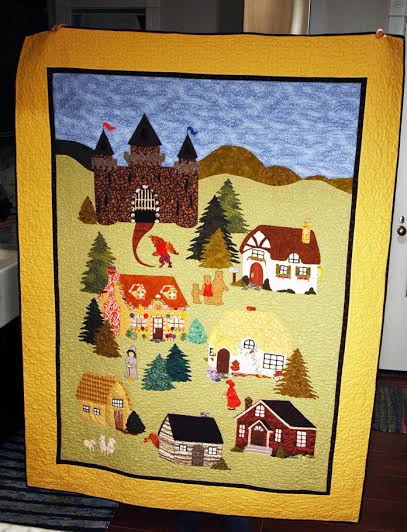
One of my quilting buddies dared to submit her quilt to the AQS Paducah show and IT WAS ACCEPTED!  I think that’s pretty special (even if she isn’t really famous yet).  Here’s the quilt:

applique storybook quilt

Jerri’s quilt, which she calls “Tell Me A Story”

And here is a picture of Jerri Szlizewski, who made the quilt:

head shot of Jerri

Jerri Szlizewski

.The pattern is “Once Upon a Time” by Cheryl Almgren Taylor, who graciously gave Jerri permission to enter the quilt in AQS shows.  Here’s a close-up of the work on the quilt:

Jerri's quilt close-up

Close-up of Jerri’s quilt

Jerri is very patient when it comes to her quilting and does beautiful applique as well as lovely pieced quilts that some of us would consider tedious 😉  I’m so happy for her to have a quilt in this prestigious show!  The quilt will be shown at AQS in Lancaster, PA as well, so if you live near either Lancaster or Paducah you’ll have a chance to see it in person.

A Few Internet Ideas

A good while back I listed what I thought were some helpful hints for quilters, but there were too many to fit into a post of the length I like.  So, here are a few more, these related to the internet:

Colors:  If you want some new ideas about colors and palates, subscribe to Design Seeds (Design-Seeds.com) to get free palates delivered to your mailbox every day.  It’s a great inspiration!  Here’s an example of the type of thing they send every day:

street hues

Keep track of internet ideas:  I use Pinterest (www.pinterest.com) to keep track of things I find on the internet, from quilts I want to see again to inspiration and color trends. If you like, you can go to my page (http://www.pinterest.com/mjp28723) and get an idea of how it works by browsing my boards.  Here’s a picture of the front page of one of my boards:

Quilt Ideas

Quilt Ideas / by Mary Puckett

56 Pins

Search colors:  Use Pinterest to keep up with color trends.  By putting “Pantone colors 2014” in the search box, you will get an array of palates predicted to be popular in the next season. The Pantone company provides color standards for the advertising industry but also is at the forefront of color predictions.  You can also Google “Pantone color of the year” and similar phrases to get interesting results.  Here’s a pin of the pantone color of the year 2014, just from putting the words in the Pinterest search box:

PANTONE Color of the Year 2014 - Radiant Orchid decor

PANTONE Color of the Year 2014 – Radiant Orchid decor

So, go have fun on the internet!

Fairyland to Vermont

I’ve just submitted my improvisational quilt “In Fairyland” to the Vermont Quilt Festival, and of course I’m hoping it gets in!

improvisationally pieced quilt

In Fairyland

I made the blocks at the top just for fun when I got an EQ add-on called “Town & Country Patchwork” by Cori Derksen & Myra Harder (who have generously agreed to my use of their designs in this quilt for the show).  The blocks are paper pieced and I made them in fantasy colors because those were the scraps I had on the day I decided to make them. Then the blocks sat around for quite a while 😉  Sound familiar?

Eventually I decided I needed to use up some of my MANY scraps.  At least the scraps are cut into strips of standard widths, so when I get a notion to use them, they’re ready to go.  So I just made rows of scraps, putting the sky-type ones at the top.  Below the houses, I arranged the thinner rows in the “distance”.  Finally, I found one of the flower fairies and put her in near the bottom.improv pieced quilt

My friend Joyce quilted the whole thing on her long arm, using a pattern of leaves at my request.quilting on improv quilt

I’m happy to say I’ll be going to the Vermont Quilt Festival this year–something I’ve wanted to do for a long time.  I’m hopeful that “In Fairyland” will be included so I can view my own quilt there!  Anybody else going?

Quilt Labels the Easy Way

I have made my quilt labels a variety of ways and generally have felt that the result looked amateurish.  However, I’ve now developed a method that I like, so here’s how.

Binding-7

First, I compose my labels in my word processing program and print them onto those fabric sheets prepared for a computer printer.  These sheets are fairly expensive, so I wait until I have enough to fill a page.  Gives me an excuse to procrastinate on labeling my quilts 😉

I like to frame each label with leftover binding from the quilt because I like the way it looks. That printer-ready fabric is very stiff, so the border makes the whole thing easier to sew to the quilt back.

There’s almost always enough left-over binding to frame the label. ironing quilt binding I start by ironing the binding open (yes, after having worked earlier to get it ironed into a nice fold).  I then sew it to all 4 sides of the trimmed label with a 1/4 inch seam.  I sew the binding to opposite sides of the label the press it out, away from the label.  I then sew to the two remaining sides and press them out.

Note that it’s easiest to sew to the two (opposite) longer sides first, then to the two shorter sides, which are now longer because the border has extended them.quilt label

After framing the label with the binding, I attach it as I would have done without the frame. That is, I turn under 1/4 inch on each side of the frame and sew the label to the back of the quilt by hand.  I think having the label framed with the same fabric used to bind the quilt gives it a nice finishing touch.Binding-7

Give it a try and let me know what you think!

Confetti!

I’m very excited to be making a quilt for the Summer 2014 issue of Modern Quilts Unlimited.  (Hint:  If you go right over there and subscribe you’ll get not only the issue with my quilt, but the spring issue with a quilt by my friend Ann over at SewMessy.)

fabric stack

Beautiful Fabric from Michael Miller Fabrics

I’ll blog about that project when it’s published this summer, but for now I’ve made a confetti block from the scraps.

The Michael Miller Fabric Company (one of my favs) kindly supplied the fabric for this quilt from their Cotton Couture solids, plus a wonderful print called “Tara’s Fireworks“.

The quilt top is made, and I’m quilting it, BUT LOOK AT THIS:

scraps

Scraps! Lovely scraps!

All those beautiful colors in little bitty pieces just FORCED me to make an improvisational block representing confetti!

I just grabbed those scraps and started joining them any old way, putting in lots of white so the pieces of confetti would stand out.  When the edges came out wonky, I trimmed.  Usually I then sewed the trimmed section onto the next piece!  Some of those bits were TINY:

improv quilt block

The pin is for perspective on these tiny pieces

Eventually some bigger sections emerged.improv quilt blocks

And finally, I had a piece just a bit larger than 12-1/2 x 12-1/2, which I’ll eventually trim to make a block.

I can just hear someone saying, “so what is this block FOR?”  Well, it’s FOR FUN!  OK, I do have a plan for this block, but that’s a secret for now 😉  Meanwhile, that was great fun, so if you haven’t tried improvisational piecing yet, just go for it!

You may be a modern quilter if…

I’ve always thought the Amish were the original modern quilters, with their solid fabrics and striking designs.

Amish design quilt

I made this quilt when we lived in Pennsylvania

Still, there is a lot of discussion of the definition of modern quilting, and there are some financial issues at stake because there is (a little) money to be made in quilting.

There are lots of definitions that I like, including the one offered by the Modern Quilt Guild website. Individual modern quilters have their own definitions, too.  I’ll tell you mine at the end, but meanwhile, here’s a list to consider:

You may be a modern quilter if

…you’ve ever said, “This is the LAST TIME I’m making a quilt with a lot of blocks exactly

36 patch block

I’ve seen quilts like this defined as modern–no kidding!

alike!”

…you like to design quilts inspired by the mid 20th century aesthetic

…you like the look of quilts with a variety of different size blocks

…or you like your quilts with no identifiable individual blocks at all

…you like quilts with lots of negative space

improvisational blocks

Improvisational blocks made from scraps of the quilt shown at the top

…you enjoy working with solid (or almost solid) fabrics

…you often use improvisational piecing

…you like to challenge yourself to create something new rather than following a pattern …you are drawn to “low volume” fabric with a lot of background showing

Here’s my first stab at a definition:   Modern quilting is about good design first.  Many traditional quilts are good designs, but the emphasis is too often on how many tedious piecing techniques can be used perfectly.  Modern quilts are more like “modern” art–technique must be good, but design is paramount.

Finally, of course, you’re a modern quilter if YOU SAY you are!  You get to define yourself.

A Cute Fat Quarter Project

I subscribe to lots of blogs, and this little project caught my eye on a blog called Noodlehead, by Anna Graham.  She has an excellent tutorial on how to make these zippered pouches in several sizes.  She also has tutorials for more complicated bags.  I KNOW, I just went on a bag-making kick with that gift wrap book, but these really are easy and fun!chevron-both

The bags here each used 2 fat quarters (FQs) from my stash, and I think I’ll make a few more to go with them!.  I also got to use some of my (OOPS, very large) stash of beads to make little zipper pulls to fancy them up. That was fun.

Here are a few more pics of the bags:zippered pouchZippered pouchChevron-bag-3So, go check out the Noodlehead blog–lots to see!