Two Favorite Quilt Patterns

I love designing quilts and making my own designs, but I also enjoy making quilts from outstanding designs by other people.  I thought I’d list a couple of my favorites, and I hope you’ll let me know (in the comments) what some of your favorites are, too.

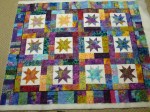
star quilt

A floral quilt made from Lucky Stars by Atkinson Designs

A favorite quilt pattern for me should be striking in appearance, should have foolproof instructions [because I certainly could be a fool on any given day ;-)], and should be something that makes me say, “I wish I’d thought of that!”

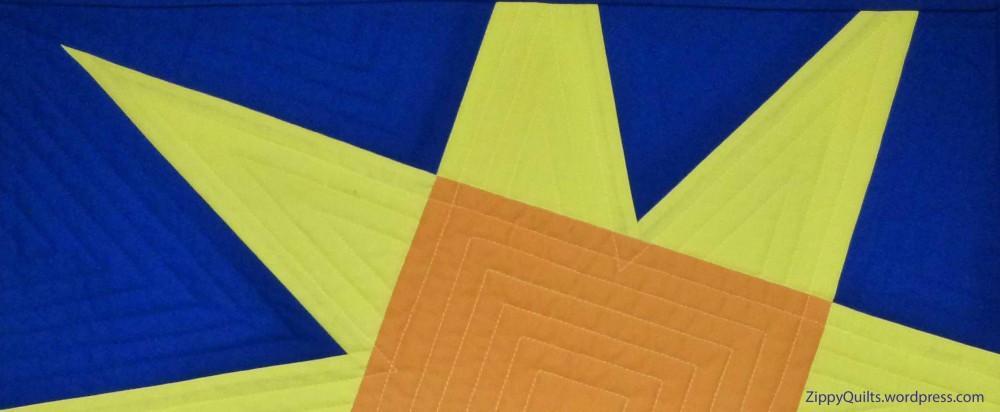
Lucky Stars by Atkinson Designs.  This is the first quilt pattern I ever bought, though far from the first quilt I made.  When I started quilting, I just decided what I wanted, drafted the pattern,and then made it.  Buying this pattern was a revelation!  Such great instructions!  Such great results!  And so little effort compared to what I’d been doing!  I’ve made this pattern several times, and the recipients have loved every one of these quilts.  I’ve also used this to teach “Make Your Second Quilt” for advanced beginners, and the students loved it, too.

I LOVE any quilt with concentric boxes, and having them in multiple sizes and bright colors is just the BEST!  This quilt pattern is Outside the Box, by Rose Mason.  I put 4 of these together to make a queen quilt for a friend’s daughter when she got married, and it worked out really well.

Outside the Box, pattern by Rose Mason

Outside the Box, pattern by Rose Mason

 And even that didn’t wear me out on concentric boxes!  I’ve made many more, both from patterns and my own designs. 

Please leave a comment telling me what your favorite patterns are, and I’ll pass along the love in a later post.

Happy Plaids is my own design, but there are MANY similar quilts out there

Happy Plaids is my own design, but there are MANY similar quilts out there
Your Inner Designer, Part 2: Many block arrangements

In our last exciting episode (as they used to say on the radio), we took a traditional-type quilt pattern and tweaked it 3 (or more) ways to make different quilt designs.

pieced quilt design

Large blocks, with the intersections lined up

pieced quilt design

Now we’ll take some combinations of blocks and arrange them to make new designs. As before, your new designs can be drawn on graph paper (or with a computer program like Electric Quilt). It’s your choice whether to make them in cloth or not.

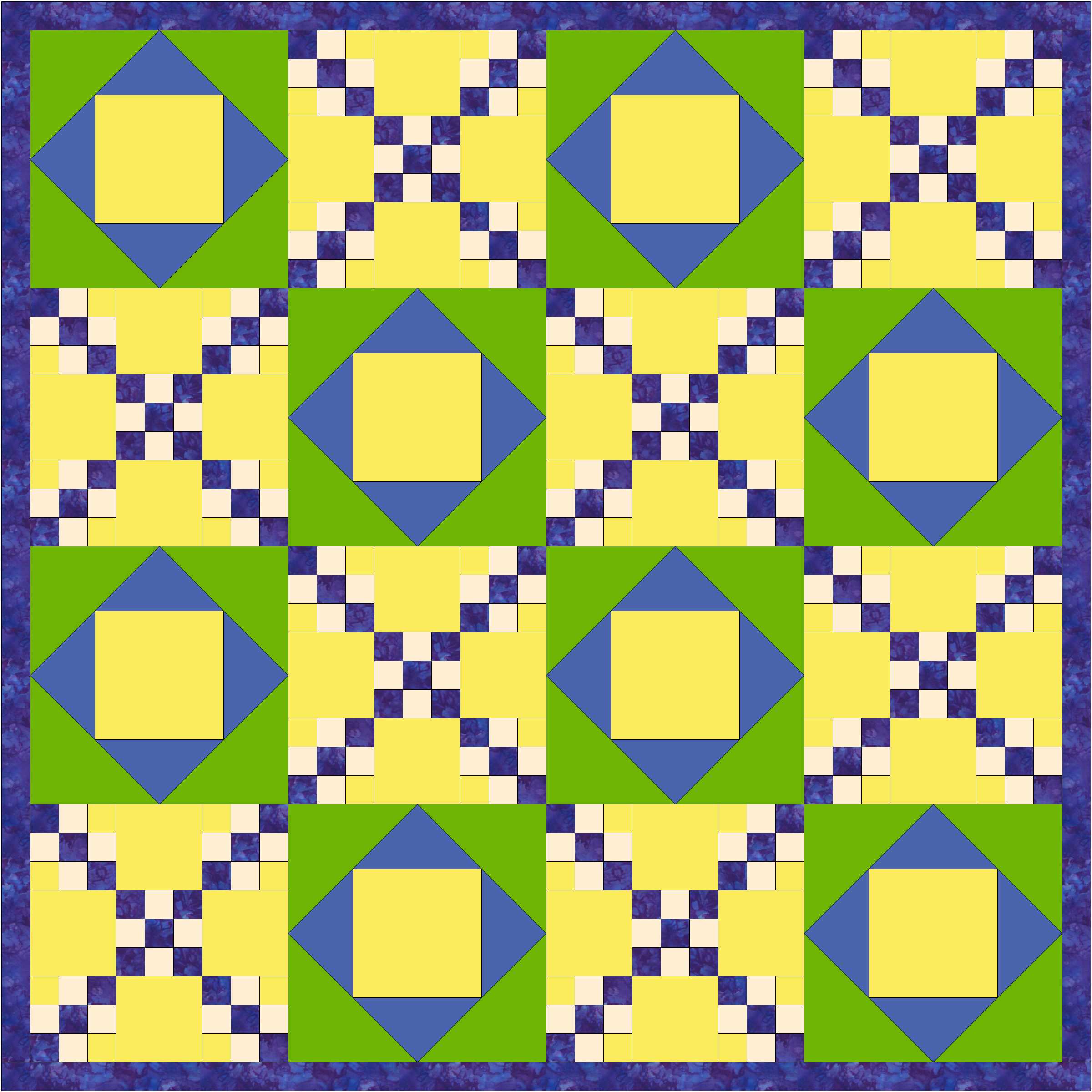
1. Combine two easy, familiar blocks.The usual advice is to combine blocks such that their seams will line up,like that first one on the left. This has the advantage of making more secondary patterns when you look at the combination overall, and the disadvantage of making the construction more tedious. Try it both ways.  My personal preference is for the second design on the left.  The different sizes of the pieces in the blocks make the quilt more interesting; I really don’t notice that the seams haven’t lined up.

.

.

2. Take a quilt made of just one block, or even just one patch, and color it different ways. Here’s one of my favorites.  It starts as the traditional tumbling blocks pattern, but can also be stars, chevrons, or many, many other things. There is LOTS of room for experimentation here.

Some folks make an outline drawing then copy it several times so they can color it different ways.  I can see this going on for weeks if you attend lots of boring meetings where you can take your sketchbook 😉

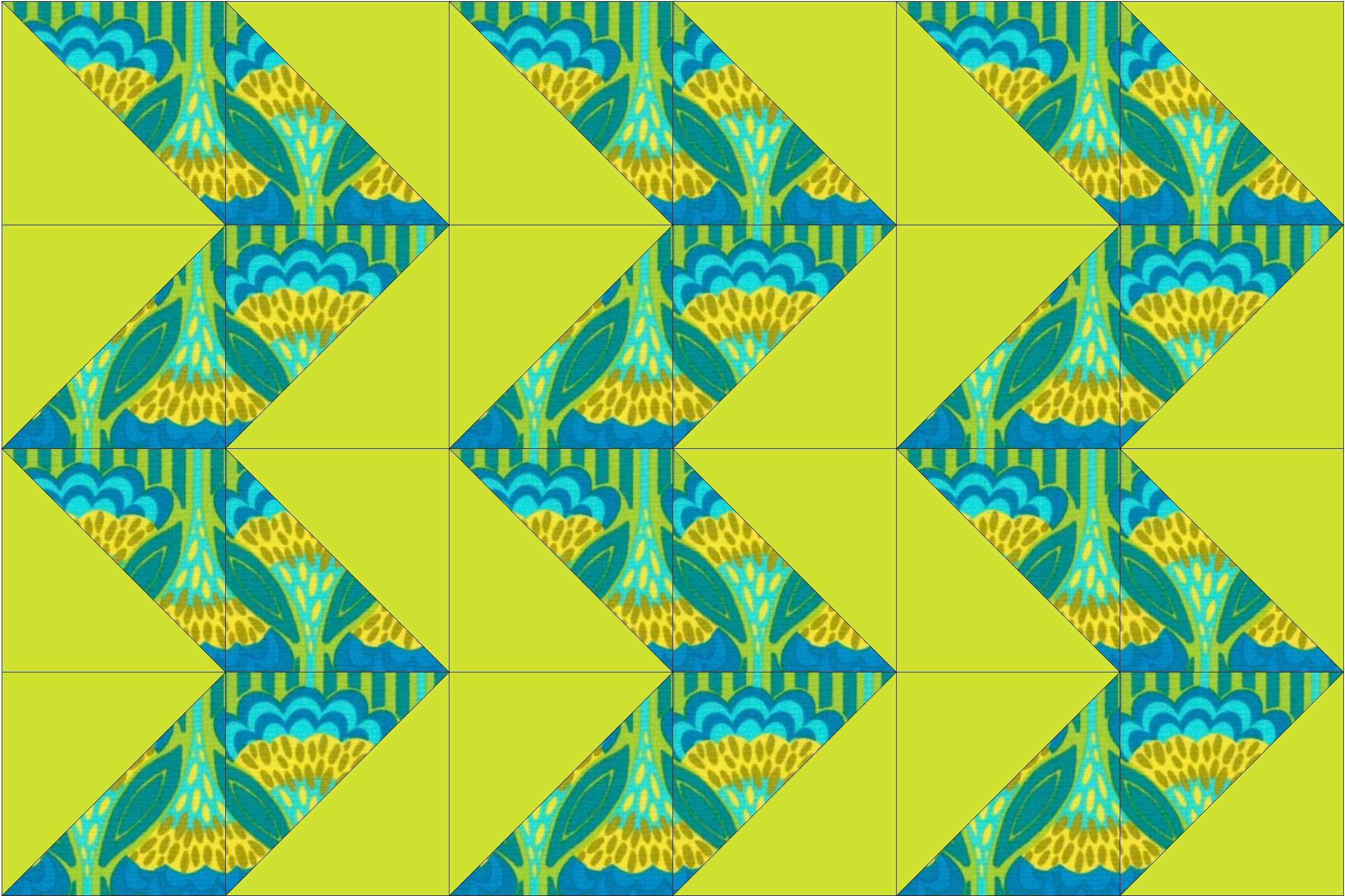
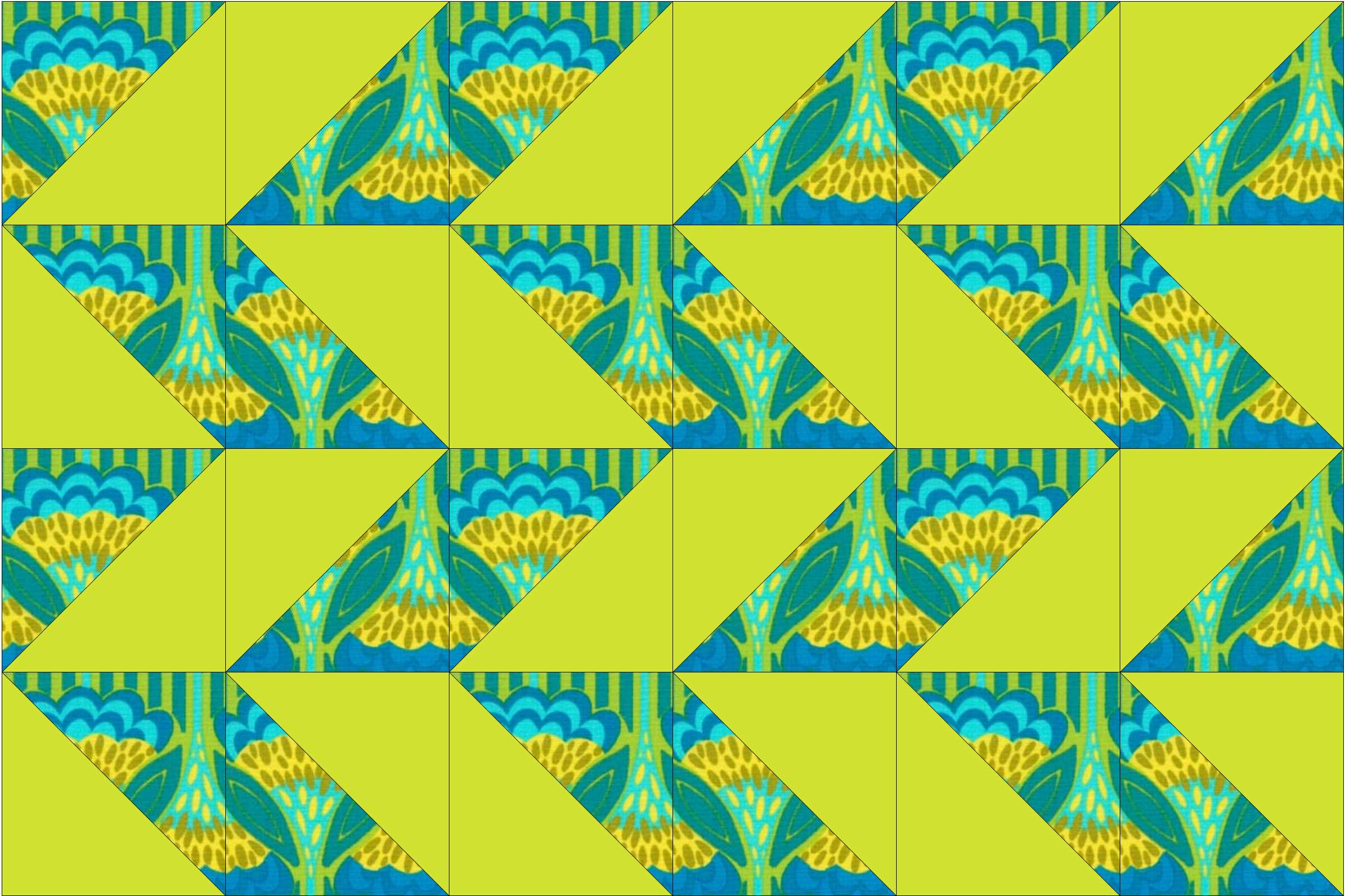
3. Pick an asymmetric block, make lots of them (on paper or in fabric) and rotate them into different combinations. There are almost endless variations with HST (half-square triangle) blocks, for example.

These options should keep you busy for a LONG time. I suggest you buy a graph paper notebook and some colored pencils so you can keep your designs all together. Next thing you know, you’ll have more quilt designs than you could make up in a lifetime! You can just pick your current favorite next time you want to make an original quilt.

The next blog on designing your own quilts will be the first Sunday in June.  Meanwhile, remember that it can be fun to try out a design by making just a small quilt.  You could make a lot of HSTs and combine them in 4 different ways for a set of 4 placemats, for example.  Have fun!

pieced placemat

This is made from HSTs that finish 3″ square, set 4 x 6 so that the mat is 12″ x 18″

pieced placemat

The same HSTs have been rearranged here

pieced placemat

Using the same fabric in different arrangements is a fun way to make a unique set of placemats

pieced placemat

I recently saw this arrangement touted as an “easy herringbone quilt”

Gallery Show!

applique art quilt

Leaf, made in class with Laura Wasilowski

The Asheville Modern Quilt Guild is lucky enough to meet in a nice conference room in the building occupied by both the Quilt Alliance and the Handmade in America organization.  Because of those connections (and the quality of our work) we will be having a show of our members’ work at the gallery maintained by Handmade in America.  This is an organization representing craft artists from Western North Carolina (that would be us!) The work they represent is very high quality, so we are thrilled to be invited to display our work in their gallery, located at 125 S. Lexington Avenue in Asheville.  (The entrance is on Hilliard Avenue between Church and S. Lexington.)

I’m including pictures in this post of the works I’m submitting, but I hope any of you whoshow announcement are in the area will come see the show.  It will run April 29 – August 19, with an opening reception 2-4 p.m. on Sunday, May 4.  We have several fine quilters in our group, and they really do make “all kinds of quilts”, as the title of the exhibit suggests.  Please come!

Handmade-3

Improv I, my original design

pieced quilt original design

Bubble Up, my oritinal design


Quilt Alliance Challenge

After thinking I would use Sunbonnet Sue as my inspiration,

Fabric scraps

Scraps!

I did a total about-face and chose a scrap quilt instead.  I LOVE scrap quilts, and since I certainly HAVE a lot of scraps, it all works out 🙂

Here’s the process for this year’s Quilt Alliance donation quilt.  I wanted to use tiny scraps and have one tiny star.  I used Electric Quilt (EQ7) to print a foundation pattern for a star that finishes about 3″ square.  The first one I made, using the brand of fabric we’ve all

depended on for solids, was just a little off.  Turns out the “beefy” thick texture of that fabric doesn’t lend itself well to tiny, tiny points (the center square here is 1/2″ x 1/2″).  So I re-generated the foundation pattern and, as often happens, decided on a little design change at the same time.  Then I made the star using Moda Bella black, which is a lighter weight cloth that folded more crisply in such a small space.

For the rest of the quilt I pulled out my zippy-colored Michael Miller cotton couture scraps and just sewed them together as I took them out of the box.  Eventually I had to cut a few more “scraps” to finish the top.  There were so very MANY seams that I was glad of the lighter weight of this cloth, almost like voile.  It took many days to do this, quite a bit longer than I had expected for a 16″ x 16″ quilt!  The smallest pieces finish about 1/4″ squares or triangles!

scrap quilt

Quilt Alliance Challenge 2014

So here it is!  I would love to count the pieces, but I don’t think I have the energy left to do it!  Besides, who wants to know a thing like that? 😉

Stash smash: 8 inch squares

I’m slowly working my way through my stash, and currently my focus is on “unfinished projects”.  There seem to be a lot of them 😉

8" squares

8″ Squares

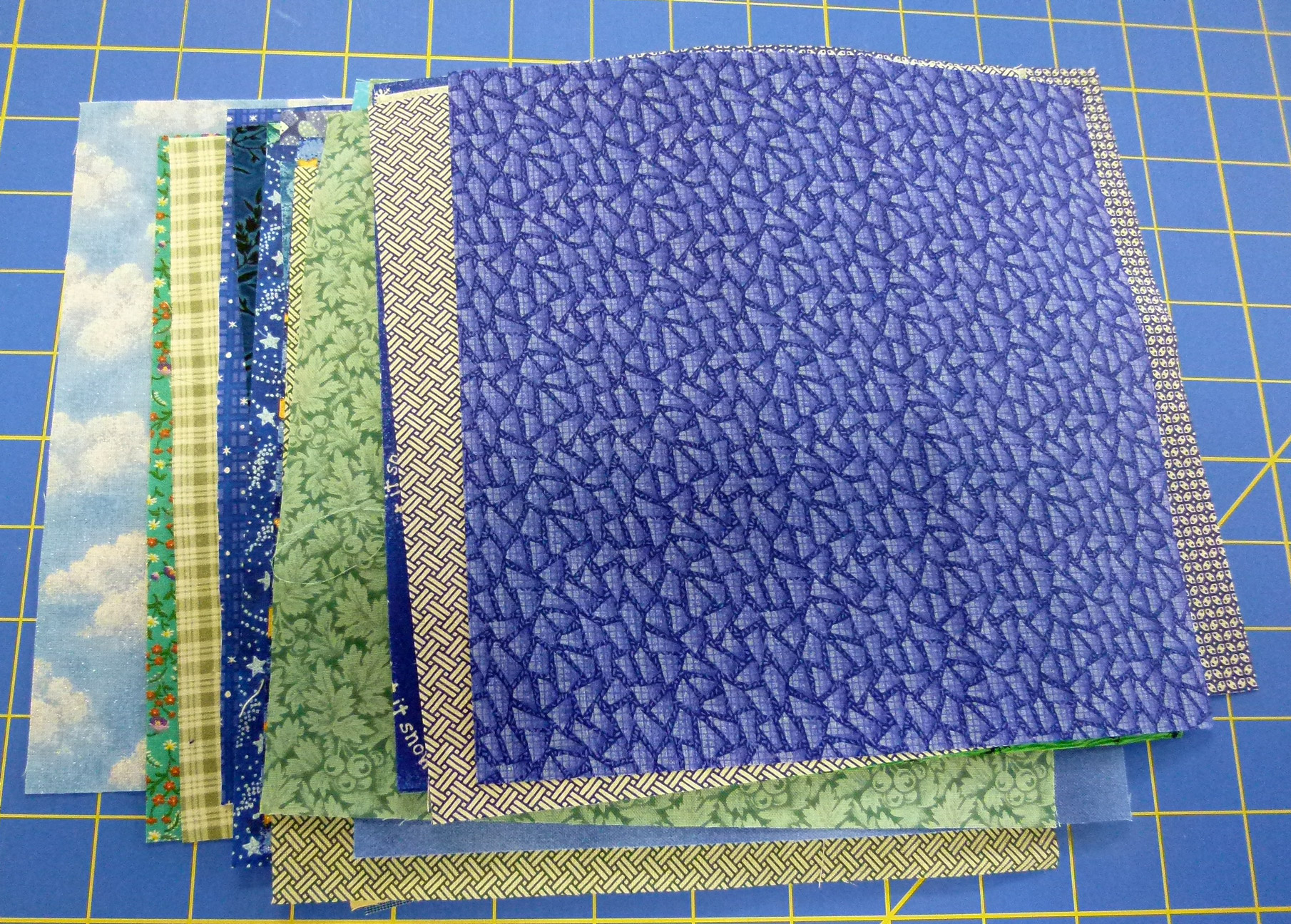
I found this stack of 8″ squares that was made as the start of a quilt a while back.  I didn’t like the pattern once I got started on it, so here’s this stack with no purpose.  Not my favorite fabrics is part of the problem, I think.

Of course, SOMEBODY sure would like these fabrics, so I had options:

1.  Try to give them to friends.  But those friends probably would try to give me some of their stash in return!

2.  Put them in the donation pile.  Several problems with that idea; never mind!

3.  Make them into something.  Since I make a fair number of donation quilts for Ronald McDonald House, that seemed like the best bet.

So I paired lights with darks and cut each pair into 3 unequal strips.  I did the cuts at random intervals, but parallel to the sides to keep the blocks from getting too wonky.  Then I traded the center strips and sewed the strips back together to make a set of 2 blocks.

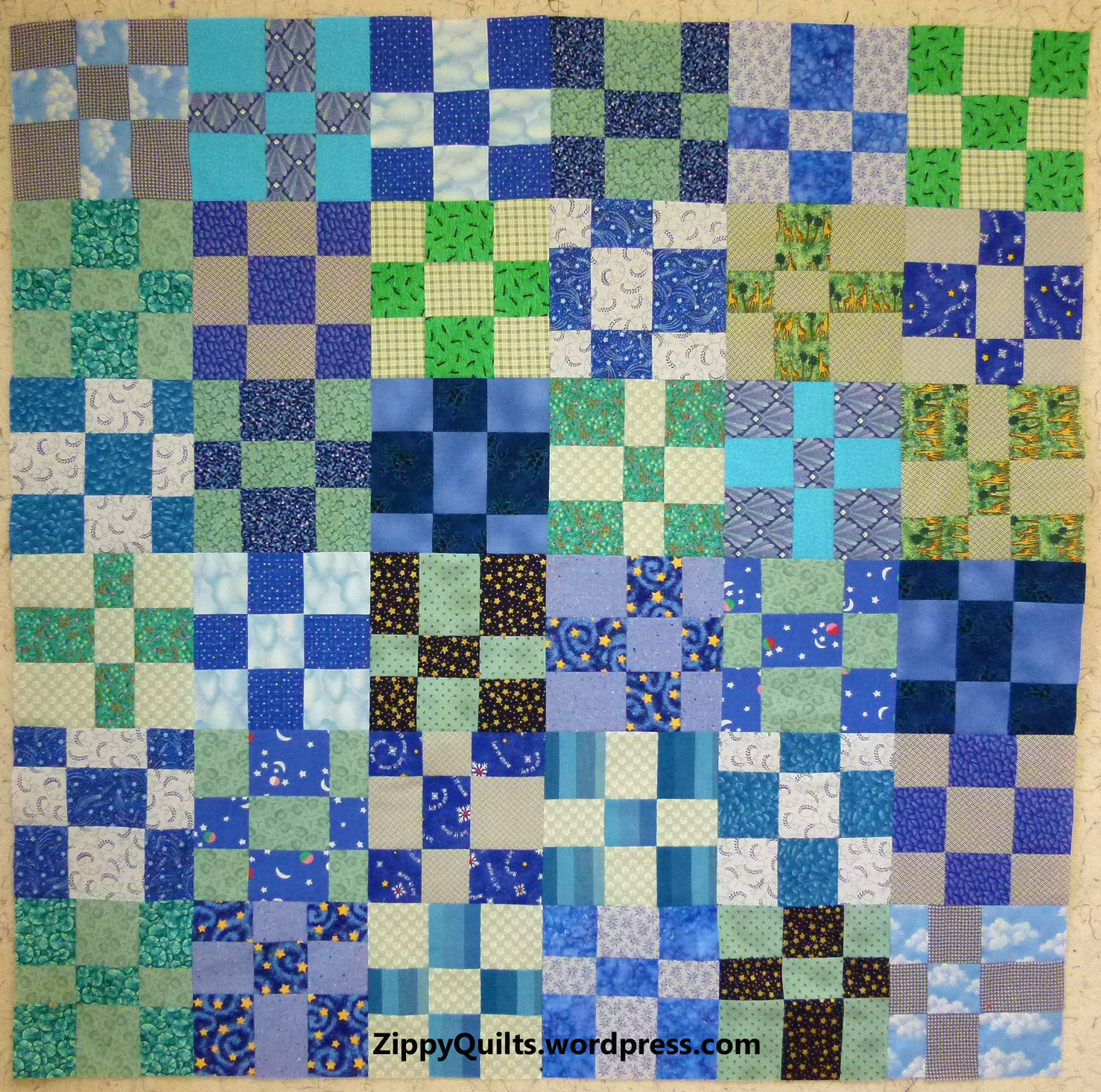
I stacked the sets again and cut them at irregular intervals, switched the middle strip again, and re-assembled them into irregular 9-patch blocks:

Now they are a donation quilt top for Ronald McDonald House, and this one will be suitable for an older child, since the fabrics aren’t juvenile novelty prints.  Success!  Another stack gone!  And another donation quilt done!

I’m taking part in “Aunt Marti’s” UFO challenge so to finish 12 UFOs in 2014.  It might help you get your UFOs done, too.  Click HERE for the link to the original post where she tells you how to do it.

nine patch quilt

Nine Patch Quilt

Hope you have a good week.  Maybe some of your leftovers would make good donation quilts, too!


Pop-up Show

quilt show

Asheville Modern Quilt Guild Show

Here are some pictures from the Asheville Modern Quilt Guild’s Pop-up Quilt Show, held Sunday, March 16 at the Folk Art Center on the Blue Ridge Parkway.  We had good attendance and gained several new members!  As you can see, we had some members demonstrating quilt making, as well.  If you missed it, the Guild will have a show at the Handmade in America gallery in Asheville from mid-May through mid-August.  Meanwhile, here are some of our members and their quilts:

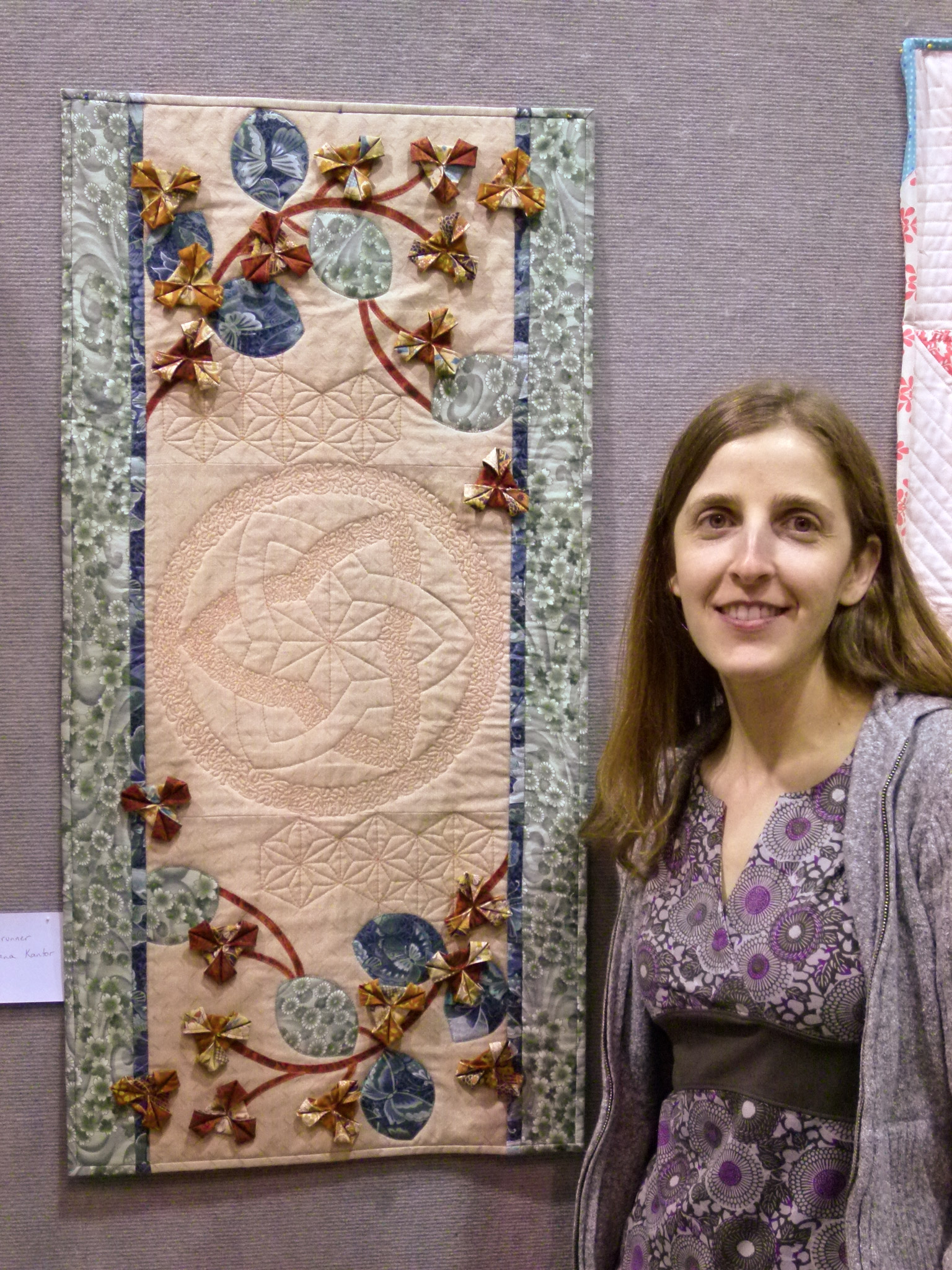
First, here’s Diana Kantor with her amazing table runner.  It has 3-D folded flowers and leaves in addition to that beautiful quilted design in the center!

quilted table runner

Diana Kantor

And here’s Erica Kilgo with her very fun Bricks and Bubbles quilt:

modern quilt

Erica Kilgo

Here’s Amy Anderson with three of her beautiful quilts:

modern quilts

Amy Anderson

Here is Connie Brown with some of her amazing art quilts:

art quilts

Connie Brown

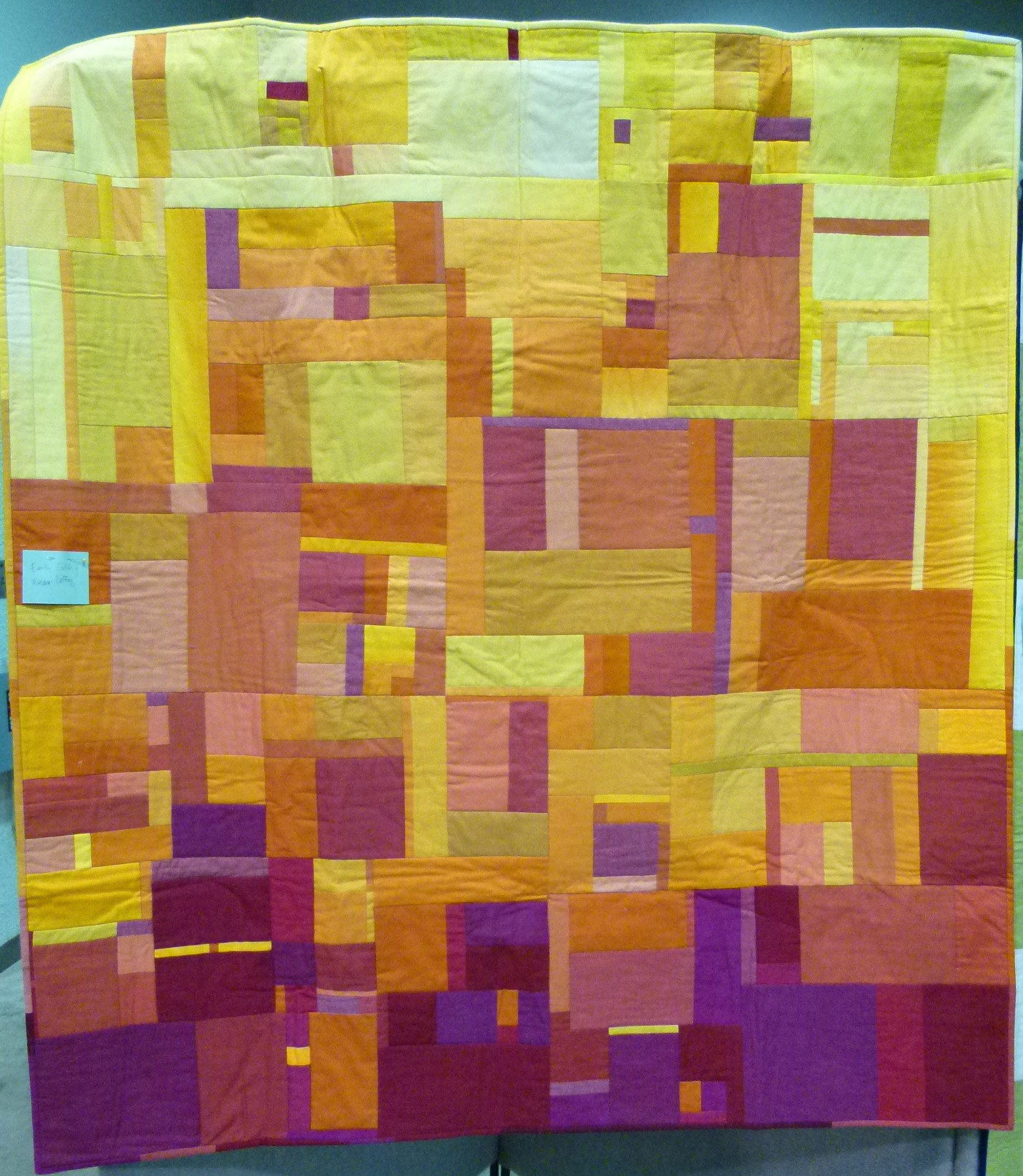
Emily and Miriam Coffey weren’t able to be there, so I don’t have their pictures, but here is one of their beautiful quilts:

modern quilt

Emily and Miriam Coffey’s quilt

And of course we had our Opportunity Quilt on display so people could take an interest and maybe even buy tickets:

modern quilt

Asheville Modern Quilt Guild Opportunity Quilt

Hopefully you’ve found these quilts inspiring.  If you’re interested in joining our guild, here is a link to our Facebook page.

Next week I’m starting a series on designing your own quilts.

My friend is famous!

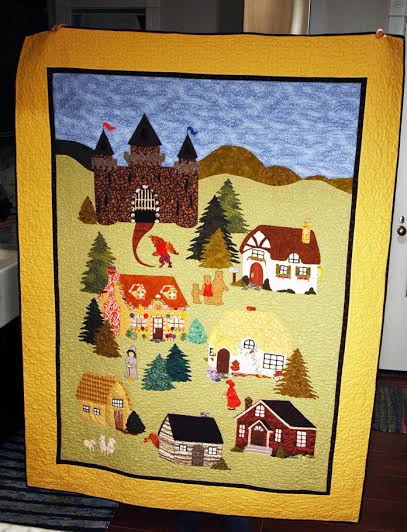
One of my quilting buddies dared to submit her quilt to the AQS Paducah show and IT WAS ACCEPTED!  I think that’s pretty special (even if she isn’t really famous yet).  Here’s the quilt:

applique storybook quilt

Jerri’s quilt, which she calls “Tell Me A Story”

And here is a picture of Jerri Szlizewski, who made the quilt:

head shot of Jerri

Jerri Szlizewski

.The pattern is “Once Upon a Time” by Cheryl Almgren Taylor, who graciously gave Jerri permission to enter the quilt in AQS shows.  Here’s a close-up of the work on the quilt:

Jerri's quilt close-up

Close-up of Jerri’s quilt

Jerri is very patient when it comes to her quilting and does beautiful applique as well as lovely pieced quilts that some of us would consider tedious 😉  I’m so happy for her to have a quilt in this prestigious show!  The quilt will be shown at AQS in Lancaster, PA as well, so if you live near either Lancaster or Paducah you’ll have a chance to see it in person.

Quilt Labels the Easy Way

I have made my quilt labels a variety of ways and generally have felt that the result looked amateurish.  However, I’ve now developed a method that I like, so here’s how.

Binding-7

First, I compose my labels in my word processing program and print them onto those fabric sheets prepared for a computer printer.  These sheets are fairly expensive, so I wait until I have enough to fill a page.  Gives me an excuse to procrastinate on labeling my quilts 😉

I like to frame each label with leftover binding from the quilt because I like the way it looks. That printer-ready fabric is very stiff, so the border makes the whole thing easier to sew to the quilt back.

There’s almost always enough left-over binding to frame the label. ironing quilt binding I start by ironing the binding open (yes, after having worked earlier to get it ironed into a nice fold).  I then sew it to all 4 sides of the trimmed label with a 1/4 inch seam.  I sew the binding to opposite sides of the label the press it out, away from the label.  I then sew to the two remaining sides and press them out.

Note that it’s easiest to sew to the two (opposite) longer sides first, then to the two shorter sides, which are now longer because the border has extended them.quilt label

After framing the label with the binding, I attach it as I would have done without the frame. That is, I turn under 1/4 inch on each side of the frame and sew the label to the back of the quilt by hand.  I think having the label framed with the same fabric used to bind the quilt gives it a nice finishing touch.Binding-7

Give it a try and let me know what you think!

Auction!

Remember that quilt I made to donate to the Alliance for American Quilts “TWENTY” contest?  If not, you can see a section of it as the header for my blog, and you can read about it here.Rising Star for Web

In any case, the time has come!  The TWENTY entries have travelled to shows around the country and are now up for auction on eBay.  The group that includes my quilt will be auctioned starting at 9:00 EST (U.S.) tomorrow night.

I’ve been happy to learn about the Quilt Alliance over the past few months.  I originally donated a quilt because I liked the idea of the TWENTY challenge and I’m always donating quilts to various causes—who isn’t?  However, I’ve since learned that the Alliance has several missions I’m especially happy to support:

  • They promote awareness of quilting as a grassroots American art form
  • They document quilts so their stories aren’t lost, and encourage all quilters to document their work
  • They make their information available to the public through various forums, including an association with The University of Texas at Austin (where I went to school)

The Quilt Alliance has numerous projects to further their goals, and their staff are some of the nicest people I’ve encountered.  They have a fun blog that presents quilts from various periods in history, and you can subscribe by e-mail so you get to see different quilts from their records.

Check out the Quilt Alliance website and then check out the Ebay auction.  You may become a Quilt Alliance fan, too!

Oh, yes, and bid on the quilts.  Most of them are by people a lot more famous than I am  😉  You might enjoy going to the Ebay site just to look at the quilts!

3 Great Holiday Hints

 Feel free to share this post with anyone who may want to give you a gift! 😉

Here are my Top 3 Gadgets of the moment.  You may need them, too!

  1. Oil pen.
    oil pen

    Oil pen

    This handy little oiler has a long, thin tip at one end and a pushbutton at the other, making it possible to dispense just one drop of machine oil in the tight recesses of your machine!  It comes with a secure screw-on cap so you can even carry it around in your pocket like a pen if you want to.  So far mine has never leaked when I’ve thrown it in my gadget bag for workshops and retreats.  My sweetie got mine on Amazon HERE, though there certainly there may be other sources.

  2. Mini vacuum attachments.
    miniature attachments

    Miniature attachments allow use of a standard vacuum cleaner to clean your machine
    My husband got these for me at a big box home and hardware store, but I’ve seen them at quilt shows, too.  The price varies wildly for what appears to be the same set of attachments, so I say shop around and pay less than $10.  These are especially useful for cleaning a serger because a serger gets so messy so fast, but I use them happily on my regular sewing machine, too.  Just attach the adapter to your regular vacuum cleaner and the little attachments clean those hard-to-reach areas of either machine.  I could still use an even smaller tip, but it’s a big improvement over using only a cleaning brush with no suction.

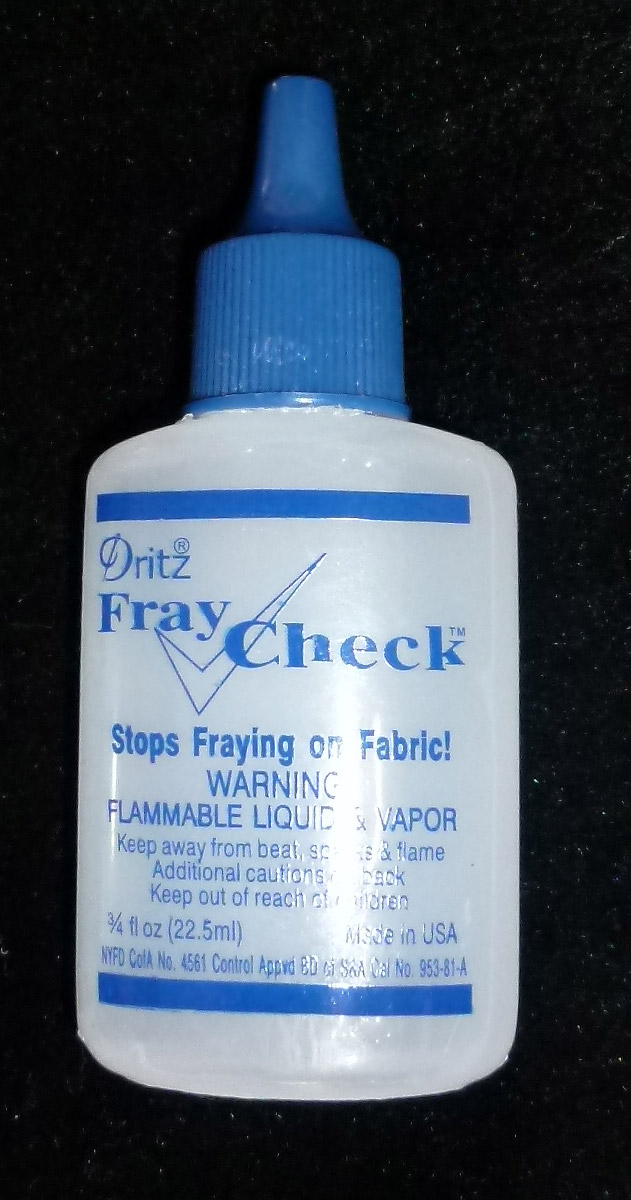
  3. Fray checkFray-Chek Well, it isn’t exactly a tool, but it has many uses this time of year 🙂   I apply it to ribbon ends so they won’t fray and outline my iron-on applique with it before I sew around the edge.  I don’t do a lot of iron-on applique on things that will be washed, but this makes me feel a little more secure when I do. And shown below IS the latest iron-on applique, which I’m showing just for fun.  I made the onesie tie with a tutorial from a blog called Crap I’ve Made. I love it!  Then I made a pattern from one of my husband’s ties and made a grownup-size T shirt for the Father of the child, so they can match!onesie and t shirt with iron-on ties

So:  go drop a few hints!