Two Favorite Quilt Patterns

I love designing quilts and making my own designs, but I also enjoy making quilts from outstanding designs by other people.  I thought I’d list a couple of my favorites, and I hope you’ll let me know (in the comments) what some of your favorites are, too.

star quilt

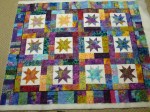
A floral quilt made from Lucky Stars by Atkinson Designs

A favorite quilt pattern for me should be striking in appearance, should have foolproof instructions [because I certainly could be a fool on any given day ;-)], and should be something that makes me say, “I wish I’d thought of that!”

Lucky Stars by Atkinson Designs.  This is the first quilt pattern I ever bought, though far from the first quilt I made.  When I started quilting, I just decided what I wanted, drafted the pattern,and then made it.  Buying this pattern was a revelation!  Such great instructions!  Such great results!  And so little effort compared to what I’d been doing!  I’ve made this pattern several times, and the recipients have loved every one of these quilts.  I’ve also used this to teach “Make Your Second Quilt” for advanced beginners, and the students loved it, too.

I LOVE any quilt with concentric boxes, and having them in multiple sizes and bright colors is just the BEST!  This quilt pattern is Outside the Box, by Rose Mason.  I put 4 of these together to make a queen quilt for a friend’s daughter when she got married, and it worked out really well.

Outside the Box, pattern by Rose Mason

Outside the Box, pattern by Rose Mason

 And even that didn’t wear me out on concentric boxes!  I’ve made many more, both from patterns and my own designs. 

Please leave a comment telling me what your favorite patterns are, and I’ll pass along the love in a later post.

Happy Plaids is my own design, but there are MANY similar quilts out there

Happy Plaids is my own design, but there are MANY similar quilts out there
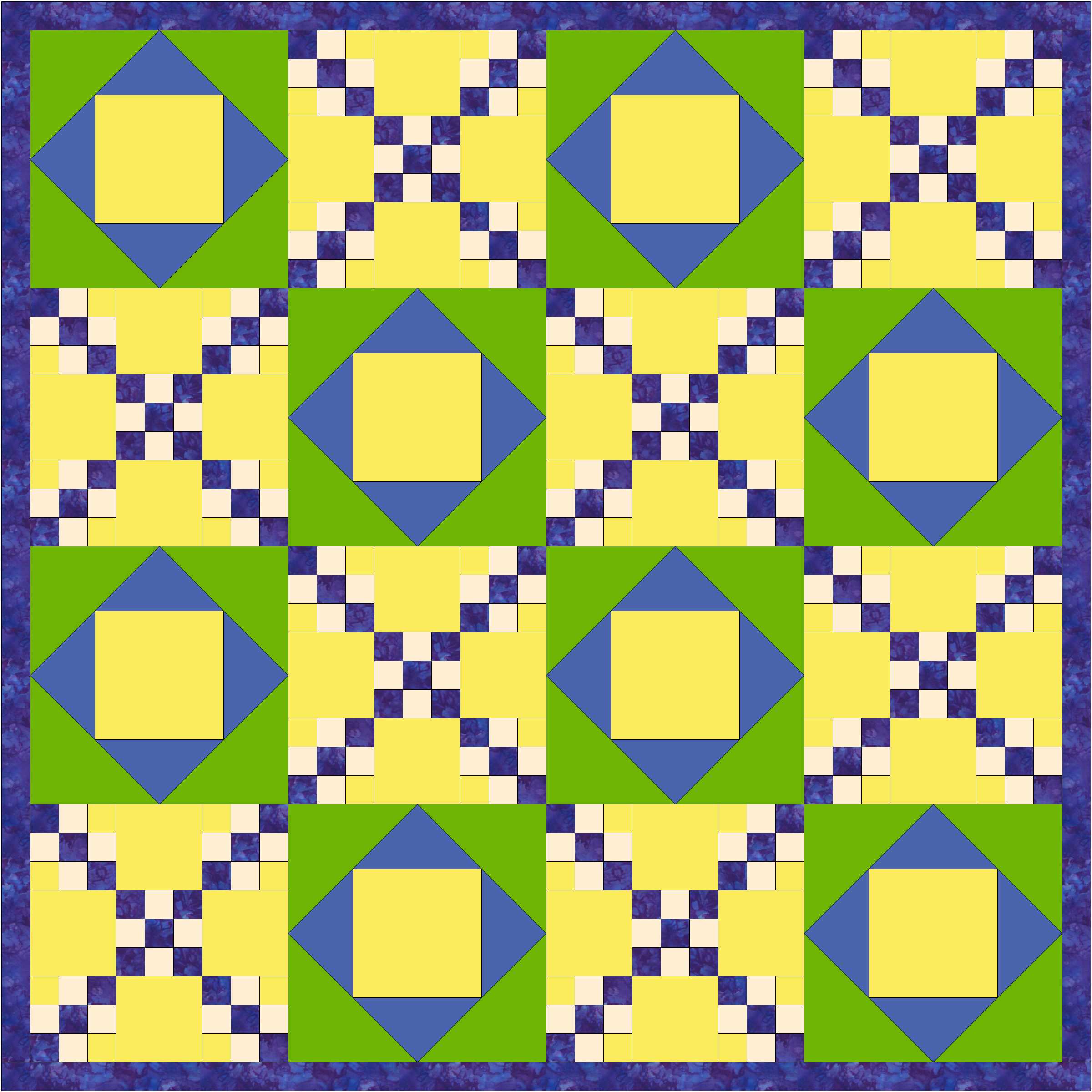
Your Inner Designer, Part 2: Many block arrangements

In our last exciting episode (as they used to say on the radio), we took a traditional-type quilt pattern and tweaked it 3 (or more) ways to make different quilt designs.

pieced quilt design

Large blocks, with the intersections lined up

pieced quilt design

Now we’ll take some combinations of blocks and arrange them to make new designs. As before, your new designs can be drawn on graph paper (or with a computer program like Electric Quilt). It’s your choice whether to make them in cloth or not.

1. Combine two easy, familiar blocks.The usual advice is to combine blocks such that their seams will line up,like that first one on the left. This has the advantage of making more secondary patterns when you look at the combination overall, and the disadvantage of making the construction more tedious. Try it both ways.  My personal preference is for the second design on the left.  The different sizes of the pieces in the blocks make the quilt more interesting; I really don’t notice that the seams haven’t lined up.

.

.

2. Take a quilt made of just one block, or even just one patch, and color it different ways. Here’s one of my favorites.  It starts as the traditional tumbling blocks pattern, but can also be stars, chevrons, or many, many other things. There is LOTS of room for experimentation here.

Some folks make an outline drawing then copy it several times so they can color it different ways.  I can see this going on for weeks if you attend lots of boring meetings where you can take your sketchbook 😉

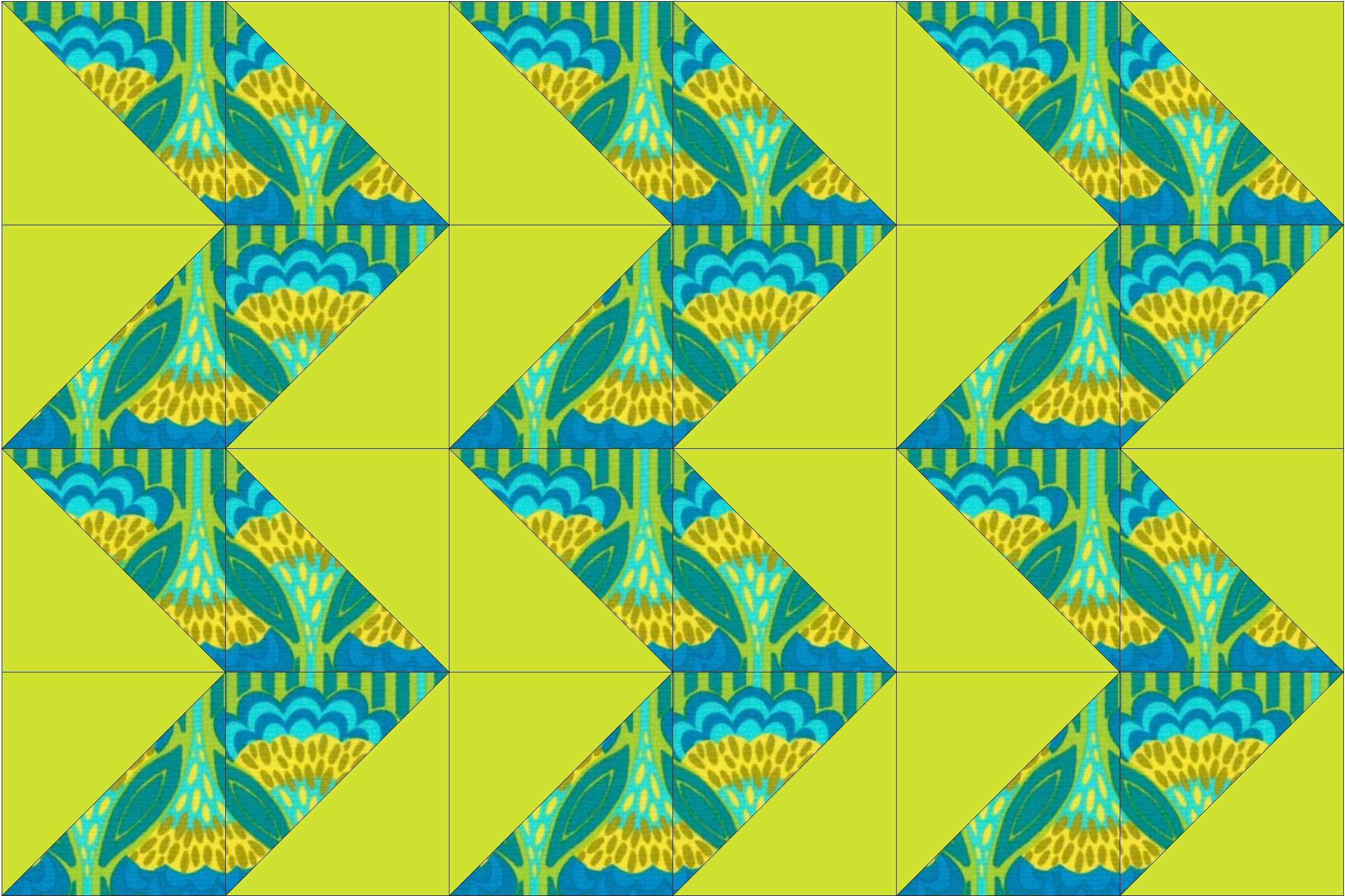
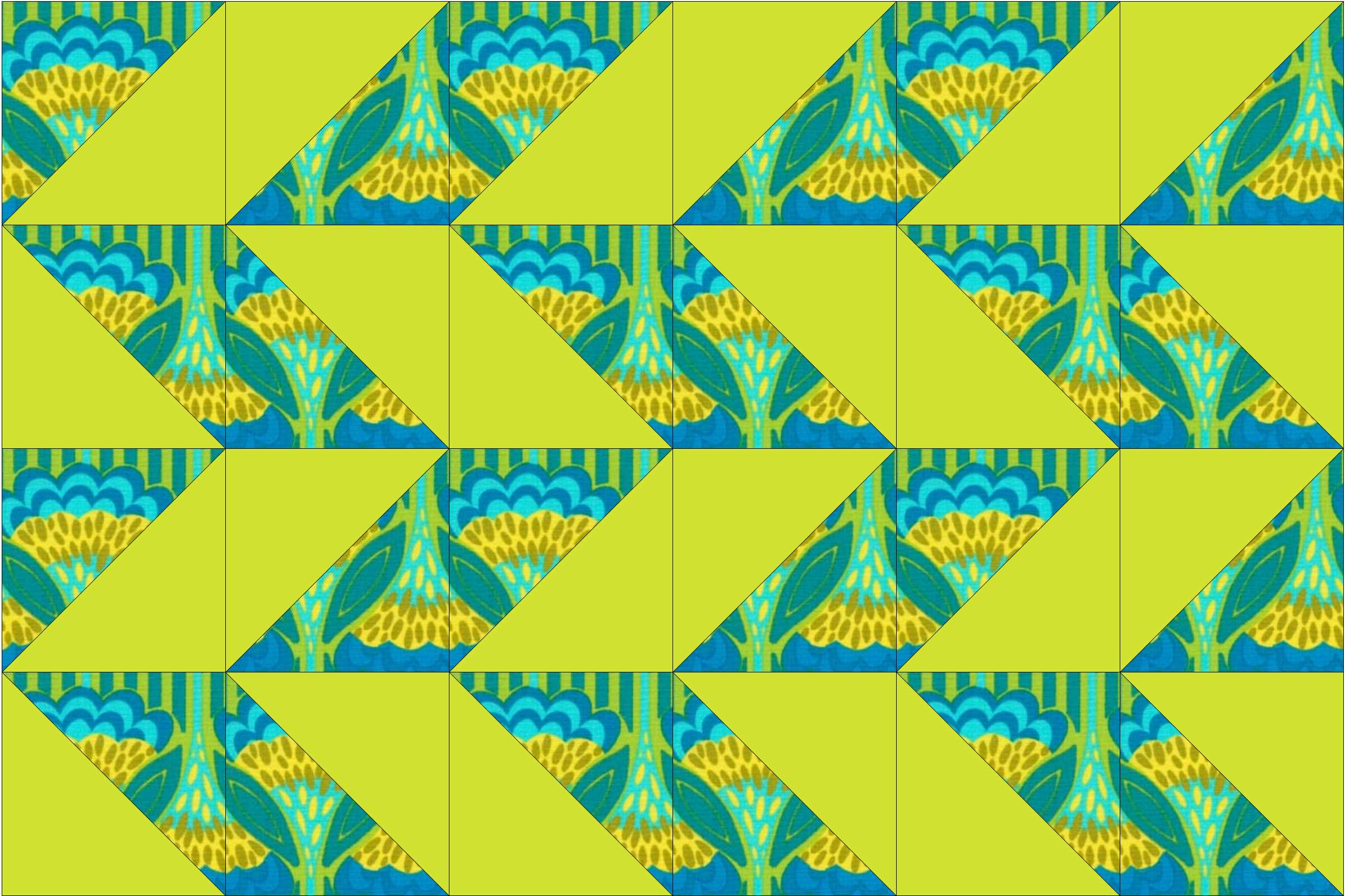
3. Pick an asymmetric block, make lots of them (on paper or in fabric) and rotate them into different combinations. There are almost endless variations with HST (half-square triangle) blocks, for example.

These options should keep you busy for a LONG time. I suggest you buy a graph paper notebook and some colored pencils so you can keep your designs all together. Next thing you know, you’ll have more quilt designs than you could make up in a lifetime! You can just pick your current favorite next time you want to make an original quilt.

The next blog on designing your own quilts will be the first Sunday in June.  Meanwhile, remember that it can be fun to try out a design by making just a small quilt.  You could make a lot of HSTs and combine them in 4 different ways for a set of 4 placemats, for example.  Have fun!

pieced placemat

This is made from HSTs that finish 3″ square, set 4 x 6 so that the mat is 12″ x 18″

pieced placemat

The same HSTs have been rearranged here

pieced placemat

Using the same fabric in different arrangements is a fun way to make a unique set of placemats

pieced placemat

I recently saw this arrangement touted as an “easy herringbone quilt”

Quilt Alliance Challenge

After thinking I would use Sunbonnet Sue as my inspiration,

Fabric scraps

Scraps!

I did a total about-face and chose a scrap quilt instead.  I LOVE scrap quilts, and since I certainly HAVE a lot of scraps, it all works out 🙂

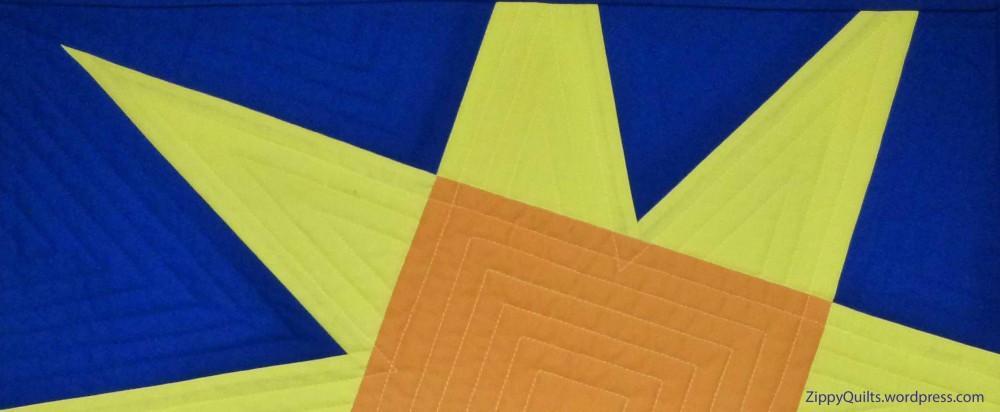
Here’s the process for this year’s Quilt Alliance donation quilt.  I wanted to use tiny scraps and have one tiny star.  I used Electric Quilt (EQ7) to print a foundation pattern for a star that finishes about 3″ square.  The first one I made, using the brand of fabric we’ve all

depended on for solids, was just a little off.  Turns out the “beefy” thick texture of that fabric doesn’t lend itself well to tiny, tiny points (the center square here is 1/2″ x 1/2″).  So I re-generated the foundation pattern and, as often happens, decided on a little design change at the same time.  Then I made the star using Moda Bella black, which is a lighter weight cloth that folded more crisply in such a small space.

For the rest of the quilt I pulled out my zippy-colored Michael Miller cotton couture scraps and just sewed them together as I took them out of the box.  Eventually I had to cut a few more “scraps” to finish the top.  There were so very MANY seams that I was glad of the lighter weight of this cloth, almost like voile.  It took many days to do this, quite a bit longer than I had expected for a 16″ x 16″ quilt!  The smallest pieces finish about 1/4″ squares or triangles!

scrap quilt

Quilt Alliance Challenge 2014

So here it is!  I would love to count the pieces, but I don’t think I have the energy left to do it!  Besides, who wants to know a thing like that? 😉

Find Your Inner Designer – Part 1

Some of my readers have asked about how I design quilts, so I’ve decided to do a monthly series of posts to lead you to design your own original quilts. I know there are several courses and lectures out there on “principles” of modern quilt design, but this series is about a practical approach.  So here is Part 1: Start by tweaking a design you already like.

Start with a traditional-style pattern you want to make.  By traditional-style, I mean one with multiple similar blocks, probably arranged in a grid.  Here’s my example, which really is more of a modern design because the blocks are improvisationally cut, but it has the blocks in a grid

modern pieced quilt

I saw this quilt at the house where we have retreats

Now experiment, tweaking this pattern (or a similar one) 3 different ways:

1. Change the size of the blocks. A quilt made up of 20 blocks each 10″x 10″ will look quite different from a quilt of the same size made up of 80 blocks 5″ x 5″.

You can go up or down in size, but change the size of the blocks. If the math gives you trouble, either get help from a friend who LOVED algebra in high school, or use a computer program like Electric Quilt to re-draw the blocks in the size you want and give you instructions for cutting them. If you want to make the blocks very small, consider paper piecing: Just draw your paper base and you don’t need any math because the pieces you use to construct the block on the paper base aren’t cut exactly to size.

.
2. Change the size of just one (or a few) block(s):

modern quilt design

Substitute one large block for 4 of the small ones!

Either replace one block with 4 little blocks 1/4 the size of the usual, or replace 4 regular blocks with one big one. Either tweak makes the overall quilt design more interesting.

Pieced quilt

Substitute 4 little blocks for one large one–or for several large ones!

3. Add (or subtract) a little: Instead of making the usual grid of blocks, add a strip or a row of blocks to each row to make some of the grid offset. I like to put the insert at a different place in each row.

modern quilt design

Insets make the blocks move out of line in some places, adding interest

Another option is to remove the sashing and/or border(s) from a quilt, or to insert an extra border.

You don’t have to sew any of your designs unless you want to; just draw them out on graph paper (or your computer program), and color them if you like. The drawing counts as a design! And don’t worry that modifying somebody else’s design isn’t “original”. You have to start somewhere, just like the designer of your pattern did!

Now, go try some of this! I like to make baby quilts to try out new designs or techniques—not too much commitment in time and materials, but I learn a lot. And watch for the next post in this series; I’m going to do a design post the first Sunday of each month for a while.