Orphan Blocks and Scraps

You can make a great quilt from nothing but leftovers–orphan blocks and scraps!  Of course there are a lot of ways to do this, but here’s an easy one to get you started on both using scraps and trying out improvisational quilting.

Orphan blocks:  Go through your collection and pick enough, or almost enough, blocks to go along one edge of the quilt.  Pick some with colors that go together and set the color range for your quilt based on these blocks.

Yin Yang quilt blocks

These are all in the same color range, and of course all the same design–a good start for an orphan block quilt!

The blocks can be a “header” for the quilt, or an insert somewhere inside the quilt, or they can go down one side.  Or across the top and down one side.  Or…well, you get the idea! There are lots of ways to use them.  But if you’re new to improvising your own designs, consider making a row of orphan blocks across the top.

Orphan block quilt

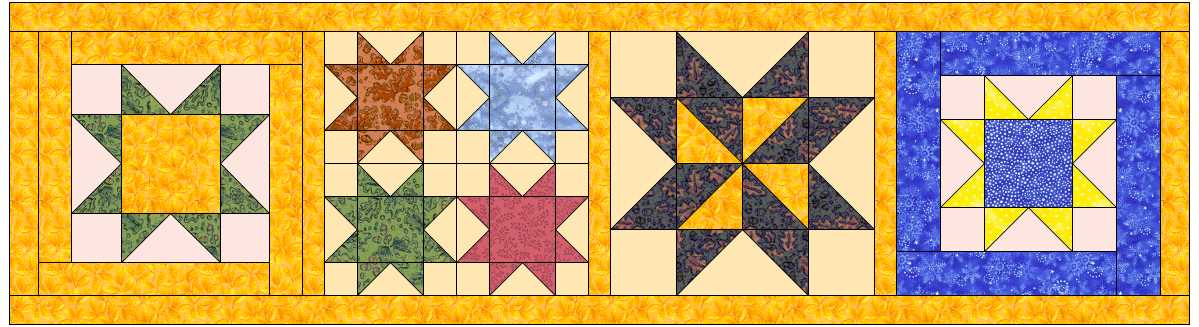
Here’s a design I’ve already made, but I can’t show the actual quilt because I’m entering it in a show

The blocks do not all need to be the same size.  Just add strips to them to make them all the same.  A lot of times you’ll have something like two 7″ blocks and three 8″ blocks.  You COULD add 1″ strips to the smaller ones on two sides, but that’s a little tedious.  Better to add 2″ strips on 2 sides of the 8″ blocks and 3″ strips on 2 sides of the 7″ blocks.

quilt block with border

Quilt block with larger border added on 2 sides

quilt block

quilt block with small border added on 2 sides

See, they’re modern blocks already–asymmetry!  Because of adding larger strips, you didn’t have to fool around with tiny pieces, and you get a full row with fewer blocks.  Win-win!

.

.

In the quilt above it was easy to add grass and sky to adjust the size of the blocks.

After getting the blocks arranged on your design board, go to your scrap bins.  Pick out all the scraps in colors that go with your orphan blocks.  Since I save my scraps as strips, I make a stack of each strip size in the colors I’ve chosen, and I’m ready to go.  If you don’t save your scraps as strips, you really should–it’s so handy!  However, you can also cut strips to get you started.

Yes, it’s perfectly acceptable (and fun!) to make an improv quilt from scraps of any size and shape, but it’s easier with strips.  So if this is your first time, cut strips!

Now join those strips into rows, and the rows into sections, and keep going until you have the size quilt you want.  You’ll probably want to square it up after you get the top pieced; a top made of pieces of different sizes rarely comes out even on all sides.

Here’s another idea, assuming I had several leftover leaf blocks:

orphan block and scrap quilt

Leaves and scraps, assuming I had 5 leftover leaf blocks

Now, go for it!

Orphan Block Table Runner

When I looked at my (er, large!) collection of orphan blocks, I found not only single blocks, but groups of blocks all from the same quilt, and several strips of blocks that looked like they had been almost included in a quilt.  The first such strip I came to was from an improvised batik quilt made with Bold Over Batiks and assorted others.  It was almost 24 inches long and 4 inches wide.

I cut the strip into a length of 12 inches and one of a few inches less, then added fabric to the shorter one so both were 12 inches.  I then joined them lengthwise with a black strip down the center:

table runner

Table runner made from a strip of leftovers

I made a backing by piecing together scraps from my current quilt, which happens to be batiks also.  I just put them together semi-randomly.  (You can see the current quilt at the end of this post.)

quilted table runner

The back was pieced from the scraps that happened to be on the top of the scrap bin!

I quilted the whole thing in the ditch and bound it in black.  I think I like the back almost as well as the front!

Of course, if you have individual orphan blocks instead of a strip, you can make a table runner by joining them, either with or without sashing.  I find that sashing is a good idea because it allows for the use of blocks of different sizes just by varying the size of the sashing.  (I made the mistake once of putting together a “group quilt” and it DEFINITELY required sashing individualized to each block, since apparently everybody in the group had a different idea of the size of a 9″ block.)  Sashing can save your bacon (or table runner) in a case like that.  So here’s a quilt design with blocks of 4 different sizes.  The blocks at the ends had extra sashing added.Table Runner

Finally, here’s a peek at the current quilt-in-progress.  It’s made from the FQs that jumped on me at Quiltfest in July and were shown at the end of an earlier post here. The quilt is up on my sticky wall with a label on each piece so I don’t get confused as I sew it together! Scraps from this were on top of the scrap pile, so I used them for the back of the table runner shown above.

Bermuda Sunrise quilt pattern

This pattern is Bermuda Sunrise

Hope everyone has a good week!

Make An Orphan Block Pillow

Start by deciding what size and shape pillow you want; or start with the block you want to use and decide what size/shape pillow form to buy.

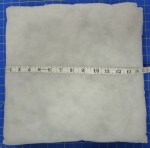
Once you have that pillow form home, measure from seam to seam to be sure it’s the size you think it is.  Add 1/2 inch to each dimension for seam allowances and you have the size to cut (or assemble) the front and back pieces.  For example:  Pillow form here is 16 x 16, so I’ll make the (unfinished) front and back pieces 16-1/2 x 16-1/2 inches.

I stated with an improvisationally pieced log cabin block and added logs to 2 sides to make it big enough.  While I was at it, I added pieces wider than I needed to allow for shrinkage during quilting and squaring up the final top.

I spray-basted and quilted the top with a thin batting and muslin backing.  However, a block will make a perfectly good pillow top without being quilted, like these:

To make the pillow cover easy to remove, I make an overlapping closure in the back.  It’s also fine to add a zipper to one of the edge seams IF you’ve got a zipper, and of course if you know how to put one in.  I do that sometimes, but there are lots of places on the web that show you how to put in a zipper, so I’m not doing it here.

To make the overlapping back:  Divide back width by 2 (16-1/2 divided by 2 = 8-1/4 in my case) and then add enough to each piece for overlap and hem.  “Enough” should be proportional to the size of the pillow, but in this case I added (8-1/4″ for back and one seam allowance + 1-1/4″ for hem + 2″ for overlap = 11-1/2″, which I rounded up to 12″).  So I cut two back pieces 12″ x 16-1/2″, then finished one of the long sides on each piece with a hem of 1/4″ first turn + 1″ second turn.

Next, I layed out the backing pieces with hemmed edges overlapping to make a square 16-1/2″ x 16-1/2″, and basted the overlapped edges together.  Put the front and back pieces right sides together, sew all around the edges with 1/4″ seam, turn right side out and insert the pillow.  Voila!

Orphan Block Tote Bag

There are a TON of bag patterns out there, and a lot of them are very good.  However, they aren’t really a FAST way to use up orphan blocks!


In contrast, there are several sources of good, sturdy, plain fabric bags that can be decorated with orphan blocks in very little time to make an attractive and useful bag.  If you haven’t run across them, try craft stores.  You can also Google “blank canvas totes” to find lots of options.  I like buying them in dark colors so they won’t show dirt with use!

NOTE:  Even if you didn’t prewash the fabrics for your orphan block, you should prewash the canvas tote.  Otherwise it may ruin your work by shrinking or bleeding color when it’s washed later.

Choose your block and, if you want, quilt it with your choice of batting and a thin backing.  It’s also fine to leave it unquilted.

orphan block

I quilted and bound my block, but it isn’t necessary

Once your block is ready to attach, either bind it or frame it with fabric.  Alternatively, it works fine to just turn under 1/4″ on each edge.  REALLY, you could just zig-zag stitch it to the bag without any edge finish.

The only trick is that you need to make full use of the free arm feature of your machine, and squnch the bag a bit, to sew around the block.  These bags aren’t very big, so it’s entirely do-able.

.

.

DONE!  This is a nice quick-and-easy project and a useful gift.  But don’t use up all your orphan blocks—there are more projects to come!

Final-bag

Quilt Portraits–please comment

A straight-on picture of a quilt is great if you need to see the whole design, but I’m aiming for quilt photos with personality.  Here are a few first attempts.

#1  This is made with bright batiks and templates from Elisa's Backporch Design

#1 This is made with bright batiks and templates from Elisa’s Backporch Design

I live in a beautiful part of the country (I’ve said that about every place I’ve lived) so there should be lots of photo ops for my quilts.  I also live in the woods, which limits opportunities at my house.

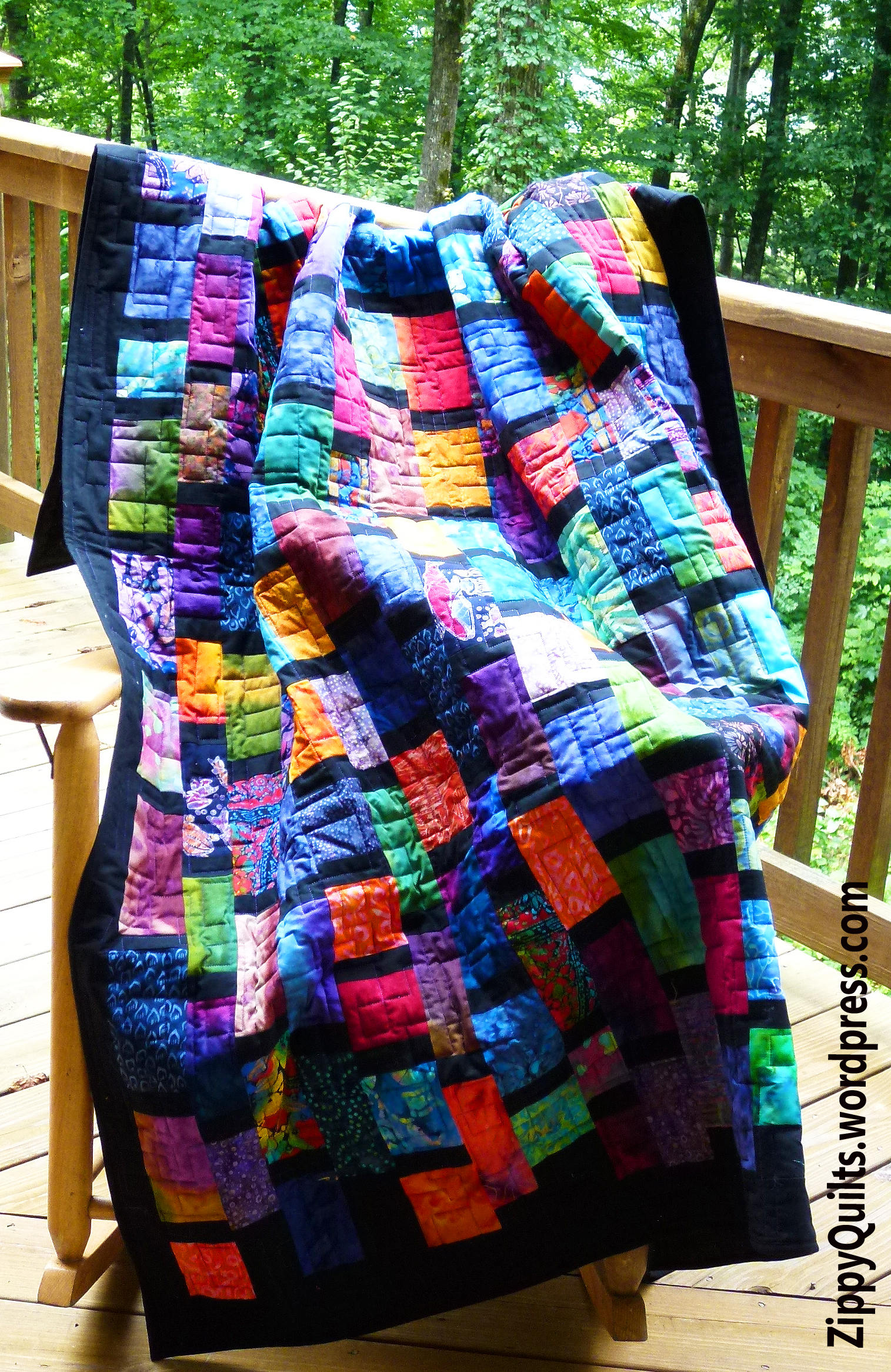
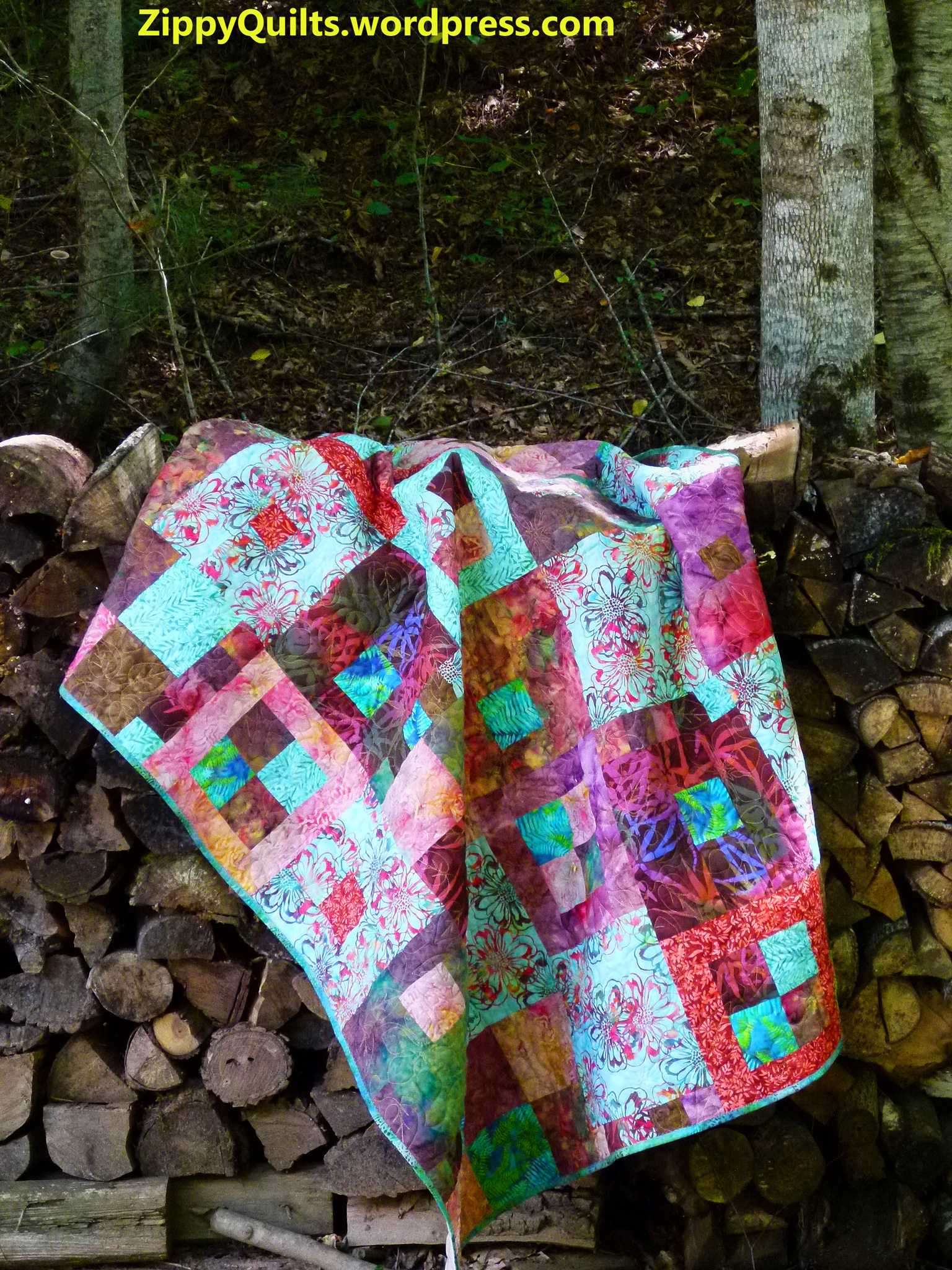
Improvisational piecing using a bundle of Bold Over Batiks

#2: Improvisational piecing using a bundle of Bold Over Batiks

Luckily, some friendly neighbors let me borrow their setting for a few of these shots.  One thing I found out right away is that full sun washes out the colors in a photo.

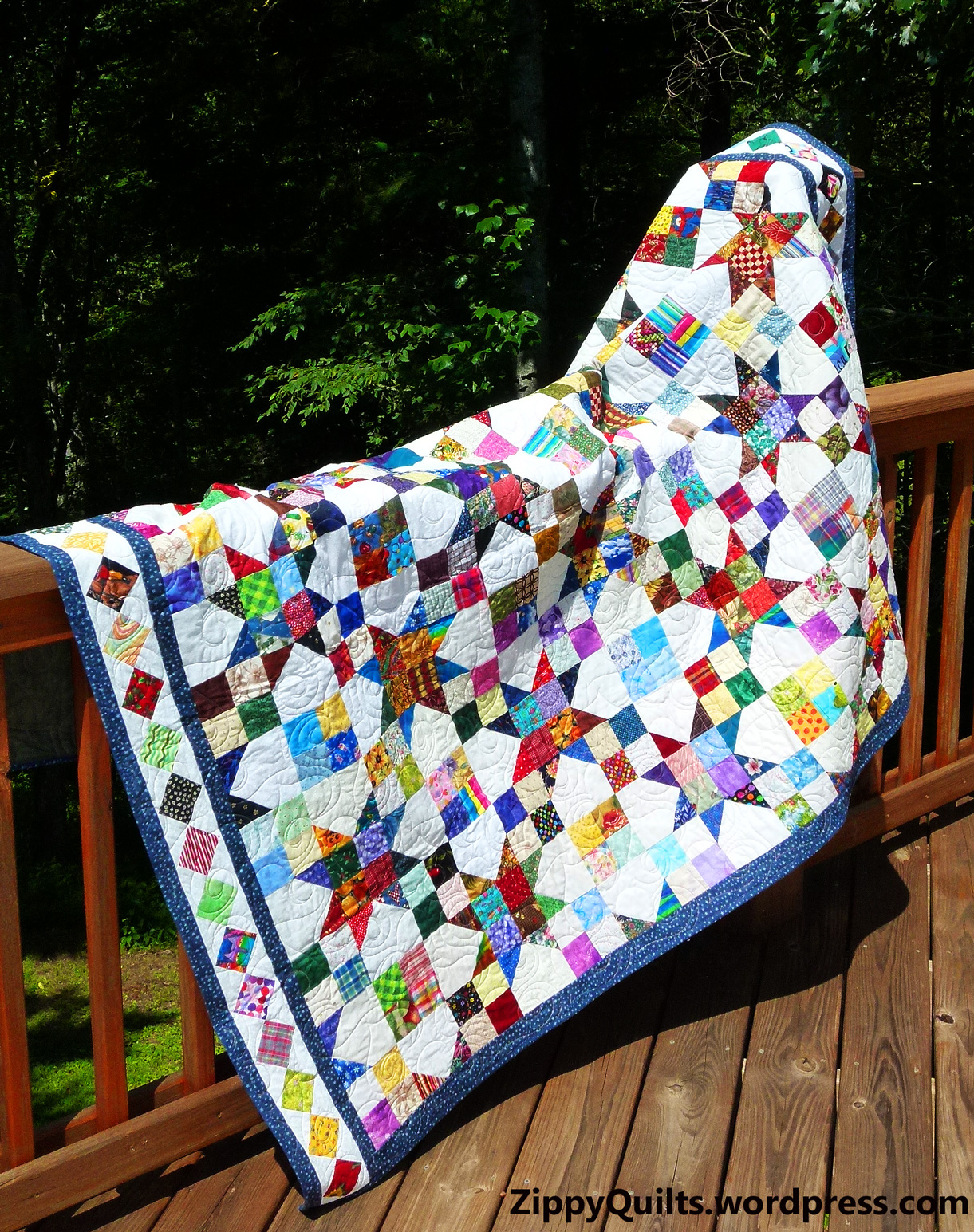
#3: This is a traditional design taught by Augusta Cole; I added a border to make it a little longer

#3: This is a traditional design taught by Augusta Cole; I added a border to make it a little longer

I need your help!  Which of these quilt portraits sets the best mood for the quilt?  Which makes you say, “I MUST have that quilt!” so you would be tempted to make it, buy the pattern, buy the quilt, ask me to give you the quilt for your birthday (I KNOW who you are)?  And why?  Please comment!

Twinkle, a pattern by Swirly Girl Designs, was made because I had some fabulous leftover fabric

#4: Twinkle, a pattern by Swirly Girl Designs, was made because I had some fabulous leftover fabric

If you’ve never commented on a blog post, here’s how: Folks who get the post by e-mail need to click on the title of the post and that will take you to the blog online. Online, you’ll see a dialog bubble next to the title, like the bubble that appears over the head of a cartoon character. Click on that and you’ll be taken to a screen where you can type your comment. Thanks for your help!

#5: I love concentric squares!  This is similar to the Hip To Be Square pattern.

#5: I love concentric squares! This is similar to the Hip To Be Square pattern.