Little Pincushions

A friend and I went to a new class last week to learn to make little pincushions. Of course, I’ve made pincushions before, as I think most quilters have, We went to the class because we are interested in having the presenter come to our guild.
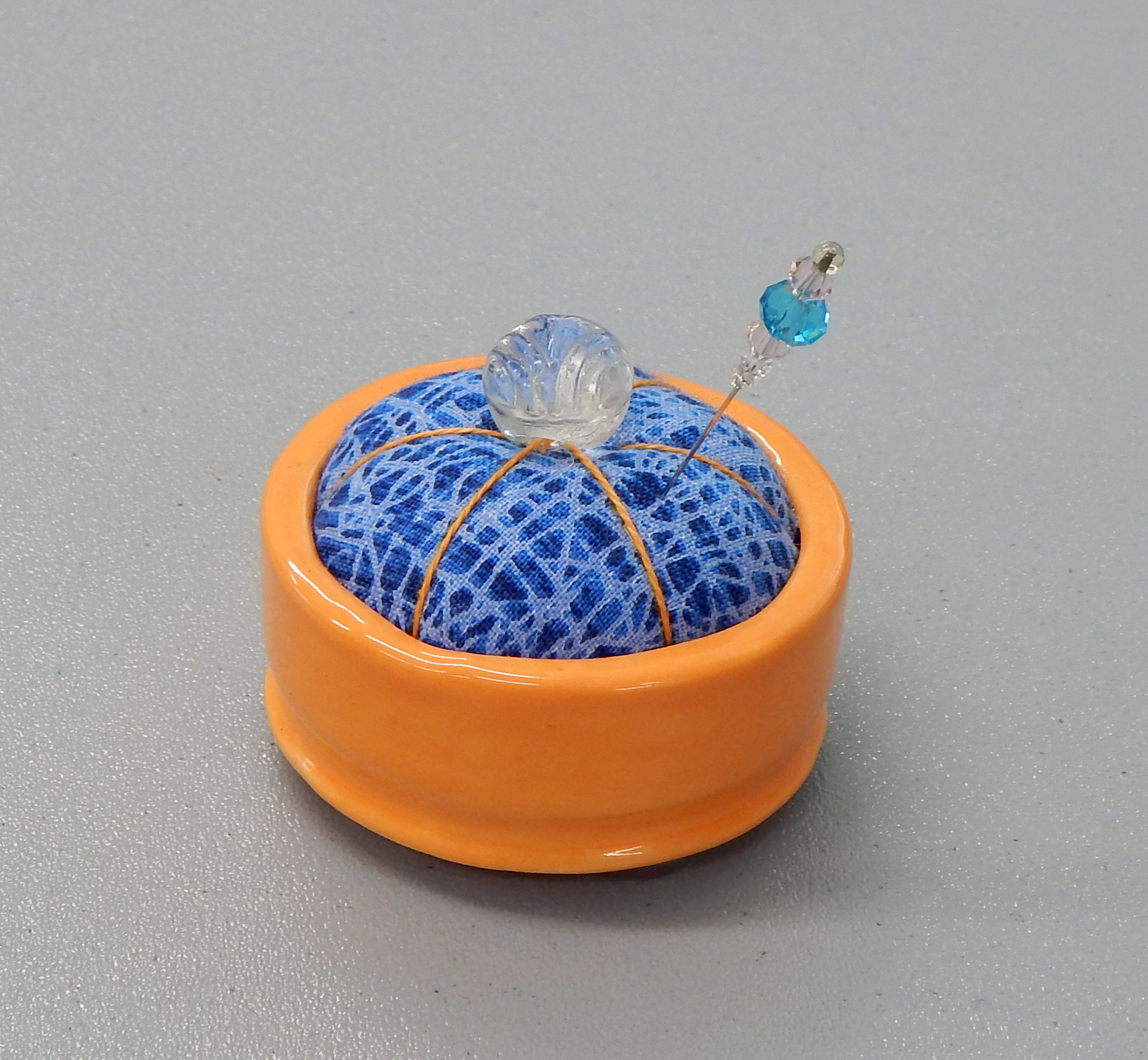
This is the pincushion I made in class

The class was held at Sew Much Fun in Lowell, near Charlotte, NC. My friend had told me it was a wonderful shop, and indeed it was.

Lesley Storts was the teacher. I’ve known of her for some time, but she used to be in Ohio and I only recently learned she had moved to North Carolina.

Lesley Storts

It looks like Lesley’s interest started with vintage glass and then she and her daughter got to making little pincushions in the vessels she collected.

Some of Lesley’s pincushions

Lesley did a great job of teaching to students with variable levels of experience. The class included someone who literally needed assistance threading a needle and others who had been sewing for years. Best of all, Lesley’s pincushion technique is totally different from mine, so I learned a lot!

And Lesley is really into this pincushion thing. In addition to her vintage vessels she has a potter make little bases especially for her pincushions. We enjoyed seeing her collection.
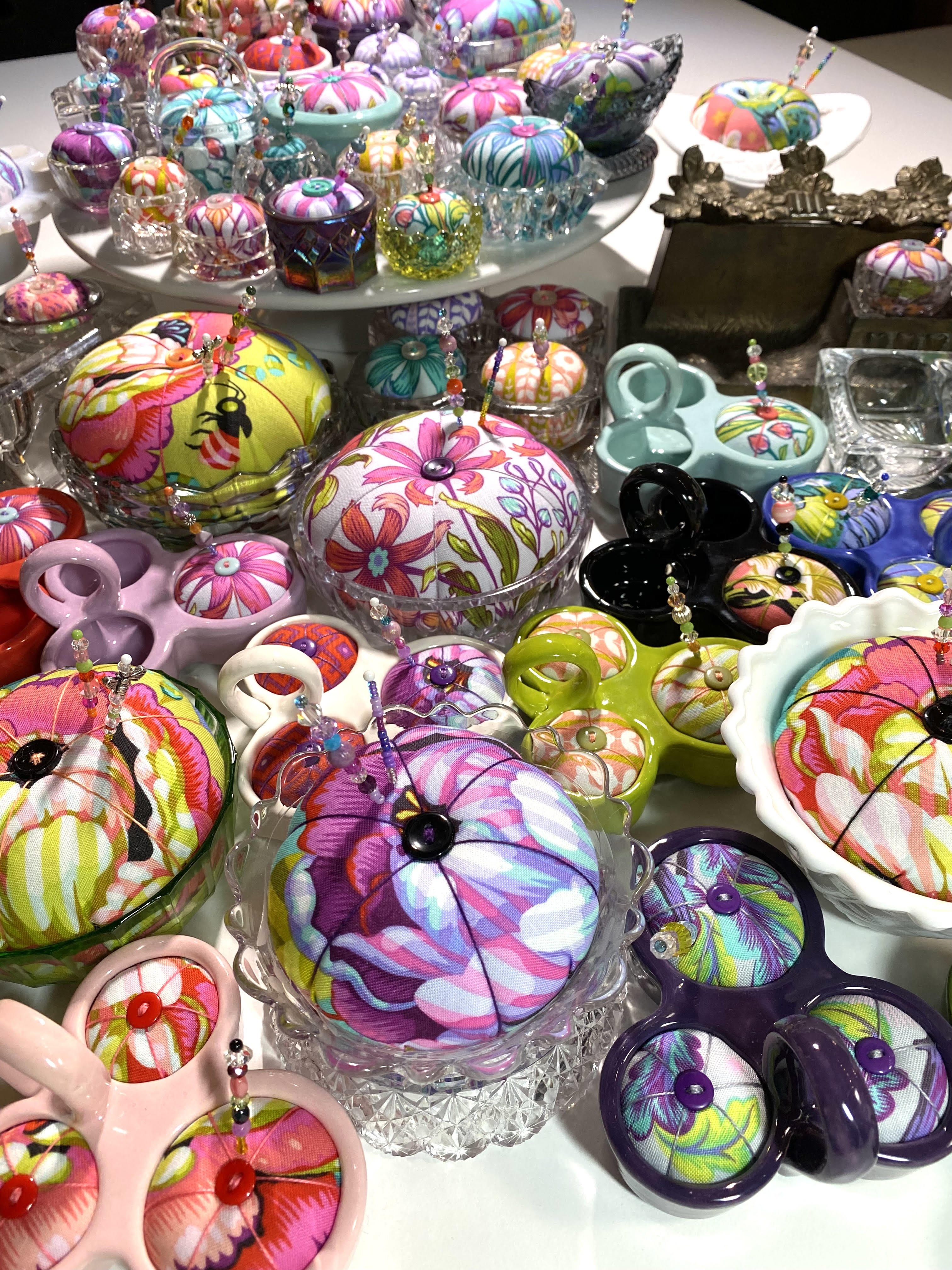
OK, Lesley is REALLY into little pincushions!

You can go to Lesley’s blog and see a number of YouTubes of her techniques. Or, if you live near Charlotte, go take a class with her. My friend and I both enjoyed it!


Another Fun Guild Program

This is part of my occasional series on guild programs, with the hope that it will help others who need to come up with program ideas.

Our modern guild has no money to hire speakers, so we are taking turns sharing our talents. One of our members recently volunteered to teach us block printing on fabric, and she furnished all the materials herself!

block printing quilt fabric

Suzanne brought a beautiful print she had made as an example

A few of us had done block printing in the past, but these blocks were much easier to carve. Apparently the block medium is now made of soft rubber rather than linoleum–a big improvement for the hands and wrists.

block printing

Some people carved abstract designs, using the whole block

Everyone got a square of rubber to carve. Some people carved a design on the square using the entire thing. Some carved an object and then cut out around the object so that it could be glued to a board backing for easier handling.

It was fun to see what everyone did.


Then we were given ink and encouraged to mix the colors, either to produce a variegated print or to produce a secondary color.

The prints were amazing and fun.

I didn’t get a picture of the block used for these fish, but they were very successful.

block printing fabricOur challenge for next month is to use the printed fabric in a project.  Can’t wait to see what everyone does!

Pinwheels!

Jayne published instructions on how to make fabric pinwheels on her blog.  This was just in time for me, since I needed decorations for my Christmas packages.  Check out her tutorial here.fabric pinwheels

Naturally, I made a few changes to her instructions 🙂  Jayne’s pinwheels were small, but I needed to decorate a big package.  So I used some of my 5″ squares. (Remember the Nickel Quilt craze? That’s how old these squares are; I was in a swap group.)  If you want to use your own 5 inch squares to make bigger pinwheels, follow Jayne’s instructions but trim them to about 4-3/4 inches after fusing the two fabrics together.  Then make your corner cuts (see her instructions) 1-1/4 inches.  I just marked the center while marking for the corner cuts, so I didn’t need her measurement for the center dot.

Also, Jayne used Steam-A-Seam, which is a good product, but I had Heat-n-Bond, and that worked just fine. I did try gluing the center together rather than sewing it, but I wasn’t patient enough to hold it until it dried.

Finally, Jayne noted that “there will be fraying” since the edges are unfinished.  I think that is unlikely with Heat-n-Bond; I’ve never had trouble with it.  But just in case, I trimmed my edges with pinking shears rather than my rotary cutter.  Remember pinking shears?  Those were what we used to “clean finish” the inside seams on our garments back before everybody had a fancy machine with overlock stitch.  They still work just fine if you saved yours!

Happy holidays!

A Quilty Shirt

Orphan blocks make great decoration for denim or chambray shirts.  They might work on

quilt blocks on a work shirt

A decorated chambray work shirt

T shirts, too, but it’s easier to put them on a woven shirt than a knit one, so I vote for “workshirts”.

Here’s an example, modeled by my friend Anna.

These blocks had been around a while 😉  You know how that goes! Then I got a good deal on some chambray shirts and bought them in all the sizes my sisters-in-law wear.  They made good holiday gifts!

I suggest you turn under a 1/4″ hem on all sides of the block and then applique it to the shirt by hand or machine.  Very easy.  I don’t suggest quilting the block first, because even thin batting can feel uncomfortably lumpy attached to a shirt.

quilt block on a shirt

Here’s another orphan block on a shirt

Here’s another one attached to the back of a shirt.  I just sewed around these blocks with a straight stitch, but if you like hand applique, go for it!  If you don’t know sizes and don’t want to guess, you can buy L or XL for most people; if it’s too big just explain it’s meant to be worn as an overshirt 😉

Next week:  turn your orphan blocks into table runners!