A friend recently asked why I use poly batting. The reasons mostly have to do with the aesthetics of my quilts. I use thin, high quality, polyester batting, NOT to be confused with the awful stuff available at the big box store. So here are my reasons:
Main reason: Polyester batting doesn’t shrink. Years ago, when I started designing my own quilts, I used polyester batting to minimize distortion when the quilt is washed. If I’m going to all the trouble to get the design just the way I want it, and make all the points match, I want all that to show, even after the quilt is washed. In short, if I design it, I don’t want the design distorted.
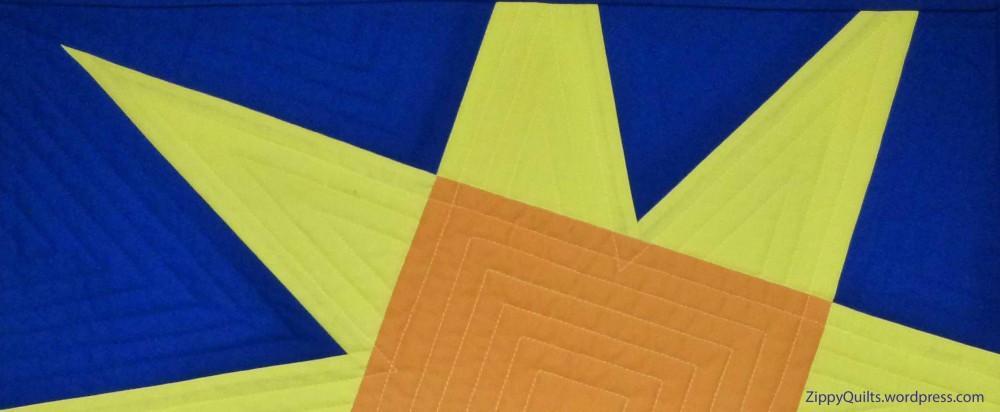
Here’s an example of a quilt where I worked hard to get things straight and square.

Of course this is based on Piet Mondrian’s paintings, and particularly on the Mondrian dresses derived from them
That said, I prewash only selected fabrics, so there’s likely to be some shrinkage of the fabric anyway. At least shrinkage is minimized if the batting doesn’t shrink, too.
Second reason: After hefting quilts made by other people using cotton batting, I appreciate the light weight of polyester batting! I hadn’t realized the difference until I was involved in hanging quilts. Most of those were traditional and had cotton batting. The heft of some of them was amazing.
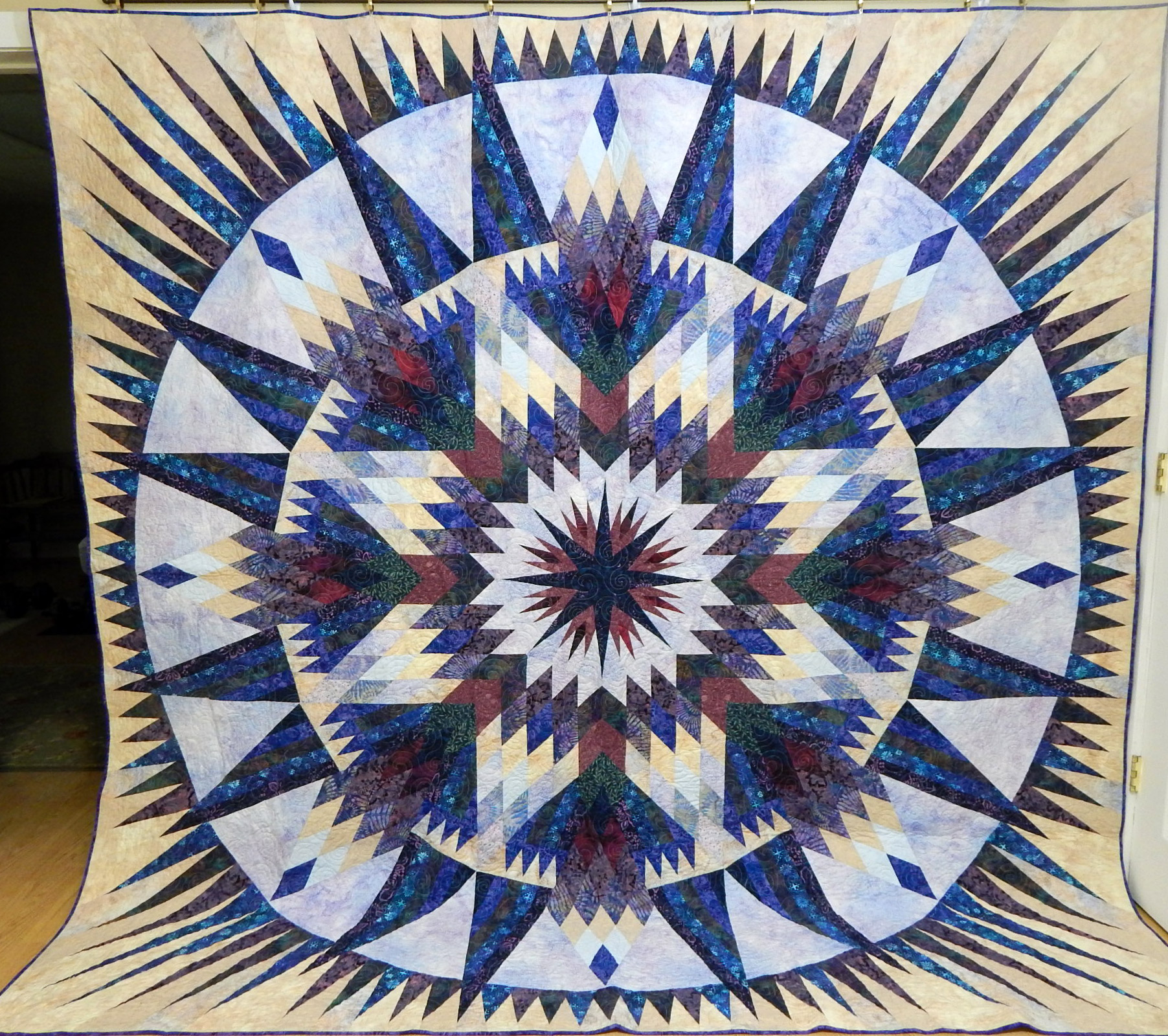
Above is a king sized quilt I made years ago. It would have been very heavy with cotton batting. Yes, I’ve heard that cotton batting “breathes” and poly batting doesn’t, but do you really feel the difference when you’re sleeping under it? And if you do, is it good or bad?
Third: Poly batting doesn’t crease as easily or hold onto folds after it’s unfolded. Since most of my quilts are stored folded for months at a time, it makes a difference. Also, it’s good to avoid hard folds when I’m shipping a quilt somewhere. The quilt below is one I use for teaching, but it lives in my quilt closet the rest of the time. I like being able to take it out and find it’s ready to go without having to “hang out” the folds.
With all that said, not just any batting will do. I use Quilter’s Dream, a high quality batting available in several lofts. They even make a poly batting from recycled plastic bottles; it’s called Dream Green. I’ve used some other brands and found some of them to be good quality as well, but Quilter’s Dream is my current choice. Which brings me to a final consideration: Request loft, the thinnest, is still suitable for longarm quilting if you choose polyester. The thinnest loft in cotton doesn’t work with a longarm. (By the way, Quilter’s Dream makes excellent cotton batting also, if that’s your jam.)
And finally, there are a couple of exceptions. One of the places I donate quilts is a camp for seriously ill children and they want cotton or 80/20 batting. Thankfully, my quilter stocks it so I can get it easily for those quilts. And when I fail to match points despite my best efforts, I sometimes ask for cotton batting and then wash the quilt as soon as it’s finished 😀 Distortion may not be all bad!
Opinions, anyone?

 Zippy Quilts
I prefer Quilters Dream cotton but I have a few I made in the “old” days with poly batting. They have held up well through washings and look good. I have started using polyester thread when quilting on my DSM. Will give Quilters Dream poly batting a try!
Poly batting has improved a lot since the old days. And I use poly thread (Superior So Fine) too. Thanks for visiting and commenting.
There are so many things to consider when making a quilt. I have always let my quilter(s)decide what batting to use because I never thought of all the issues you brought up. Now I have more information to base a conversation with my quilter.
I don’t think there’s a right or wrong here. It should be an interesting discussion.
I did not even know there was an upscale poly! Your reasons would make me consider it, especially if I were going to make a quilt to hang. 🙂
As with so many other tidbits, I think I learned about this at a guild meeting. I expect there are other brands of good quality poly too; I just don’t know them.
I use what the quilt top “needs.” But for most quilts, I lean toward using poly batting, especially Dream poly for all the reasons you mentioned. I very much like their bamboo batting, too.
I haven’t tried the bamboo yet, but I do hear good things about it so that may be in my future. Thanks for your comment!
I used to use Hobbs Thermore light weight poly a lot back when I did a lot of hand quilting. It quilted beautifully. Sadly, the local quilt store that stocked it closed and it doesn’t seem economical to have wadding posted
Yes, I expect it would be expensive to mail-order batting/wadding. I hope you have a useful substitute.
I usually use a cotton now, but I machine quilt more so I don’t mind so much
I have noticed that quilts with cotton or wool battings are very heavy. I didn’t realize that polyester is much lighter. Good to know! My husband can’t stand that I use thin batting. He’d much rather I use the high loft stuff. Can’t do that on a longarm, huh? Thanks for this article–very informative.
Haha. Some folks are indeed hung up on the high-loft stuff, which really is only usable if you tie the quilt. Been there, done that!
Good post, Zippy! I am a Hobbs 80/20 gal for the most part. I especially like your points about weight and folds. I like the texture cotton batting adds after washing. There are definite considerations when one wants a certain result for their creation. 🙂
Yes, cotton or 80/20 definitely adds texture that poly does not, which is good for some quilts!
Thank you for writing about poly batting! I too love it for the same reasons you state. I’m going to share the URL to your post in my Wilmington, NC guild’s February newsletter (I’m the editor!). I think many in my guild will begin to see the light (lightness!) about poly batting after reading what you have to say. I love the king-sized Lone Star/Mariner’s Compass (?) quilt – gorgeous!!
Thanks! That quilt is a Judy Niemeyer, of course. And thank you for sharing!
Forgot to add… I use Quilter’s Dream ‘Green’ poly batting for many of my quilts. It’s made from 100% recycled plastic bottles. I learned about it from Carolyn Friedlander when she wrote about it in one of her newsletters a few years back.
Good for her!
Thank you for the insight on polyester batting! I had it drilled into my head to use the cotton batting like Warm & Natural and I appreciate another perspective/experience 🙂
Yes, cotton used to be the choice for “quality” and “traditional” quilts, but poly batting has improved a lot. I’m surprised nobody has complained that poly batting isn’t “natural”, but of course if we look at everything used/done to process it, cotton batting isn’t really “natural” either!
Great information. Thanks so much
Glad you liked it 😀
Pingback: Creative Juice #381 | ARHtistic License
Thanks for this very informative post. I too mostly use polyester batting, for economic reasons. It works well for me. I did use cotton batting for a quilt that I use daily and I do think it is more cosy and/or light as a covering. But then, I may be biased.
Thanks for stopping by 😀
I really like your review of poly batting! You’ve justified its use in many ways, and all of them are good. I would be more inclined to use poly myself, if I wasn’t thinking about the almost-year-round heat here in Florida. I DO sleep under a quilt with cotton batting – two of them with cotton batting during winter months. But I can see that having one quilt with poly batting would be nice in the winter – we haven’t turned on our furnace this winters, so some mornings have been chilly. Anyway, I like all your reasoning and opinions. This is great information!
Thank you 😀
I just completed my first quilt made with polyester batting. I used Quilter’s Dream Poly Select. The quilt came out well but I was disappointed because there was slight bearding on the quilt top. I first noticed it when I was quilting it on the sewing machine. And it was evident that it was bearding after I machined washed and dried the quilt. I used good quality fabric softener as the website recommend with poly to reduce static, which in turn will reduce decrease risk of bearding.
The quilt was a gift so I carefully handpicked all the bearding off the gift top before I delivered it. I’m going back to Quilter’s Dream 80% cotton 20% polyester.
Thanks for letting me know! I’ve had no trouble with bearding, but I don’t quilt my own so maybe that’s the difference. I’m sorry it didn’t work out for you!