I recently took a class, along with some friends, at Calla Lily Quilts in Greensboro. Here’s the result:
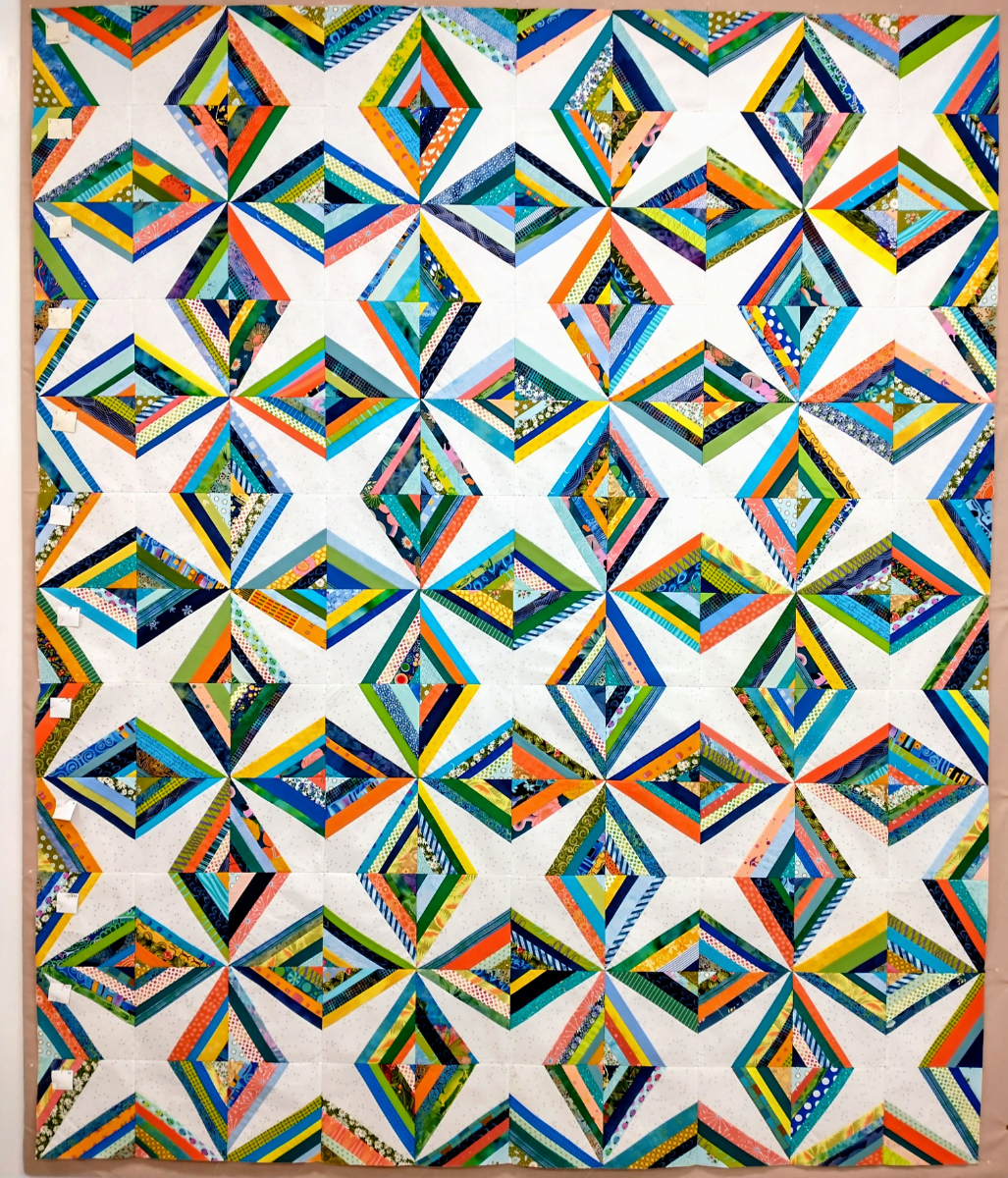
Strip Quilt, 60″ x 80″ (yes, I forgot to remove the row tags before the photo)
I limited the palette to blues and greens with sparks of orange and yellow, and I like the result.
The blocks are built on fusible interfacing, which makes them stable but a bit thick. That plus having 12 fabrics come to a point at some of the intersections…
caused me to get out the leather mallet and board I use to pound those seams flat where they meet!
This top is going to the friend who quilts our group’s donations for Flying Horse Farms, so you won’t be seeing the finished product here. I hope it will be a cheerful surprise for some kid at the camp.
So, have you made any strip quilts? Did you use a base, and if so what was the material? Any suggestions?
And by the way, I used scraps for this but look at what was left!
Of course we all know that old story.

 Zippy Quilts
Don’t know if my comment sent. Here goes again. We use unscented dryer sheets. Very thin. Use as a rectang
Dryer sheets certainly would be more flexible than the fusible interfacing. I also have several yards of batiste purchased for foundation piecing. I used interfacing because this was a class, but would not use again. Thanks for visiting!
great way to recycle those dryer sheets!
What a beauty! Isn’t this the Spider Web pattern? I’d love to make such a quilt, but I don’t have any strips, as you apparently do. Whenever I’ve string-pieced a quilt, I’ve used Bonnie Hunter’s technique, sewn on telephone book pages. It works well, and is a good way to get rid of a few no-longer-used phone books. The negative is that block sizes are limited to the size of the phone book pages. In any case, you’ve made a pretty donation quilt. Someone is gonna love it!
Thanks, Linda. The pattern is out there in multiple variations, by multiple authors, like a lot of things these days. This version was drawn on EQ8 and the technique worked out by the woman who taught it.
The only string quilts I’ve made, a while back, used Gwen Marston’s method of no foundation at all. Just sewed strips, pressed, and then cut shapes
I like your mallet set up…clever with a bit of exercise on the side!
And it does the trick–ha!
I have a plan for a strip quilt but going to do it straight onto batting so it is quilt as you go. If you don’t want the bulk of the base you could do it on paper and tear it out perhaps.
I like your quilt-as-you go idea! Solves several problems at once!
I like the quilt and I am sure it will bring joy to whoever receives it.
I like the look of it, too, but it is rather heavy. The woman who quilts for our group is going to try it anyway, so fingers crossed.
With 12 seams meeting and backing for the squares, I am not surprised it’s a bit heavy. I admire your technical skill — the construction must have been tricky
I have taught string quilting all over the southeast. Students are encouraged to try all the different products available and use what they like. Personally, I use and recommend Sheer Delite. It weighs nothing, has no grain to worry about and does not need to be removed. It quilts on a domestic machine and a longarm like a dream.
Thank you for this tip! I don’t know Sheer Delite but will look it up.
Very pretty way to use your scraps! I want to make a string quilt like that someday and plan to use muslin as my base. I actually have a string quilt book that I plan to pull out someday and use 🙂
Yes! Those books we plan to pull out and use some day! I look forward to seeing your string quilt 😀
I do also, ha!
Wow…you finished that quickly! I think it’s one of my favorites.
Thanks! And I got so many suggestions from readers regarding how to make it lighter next time 😀